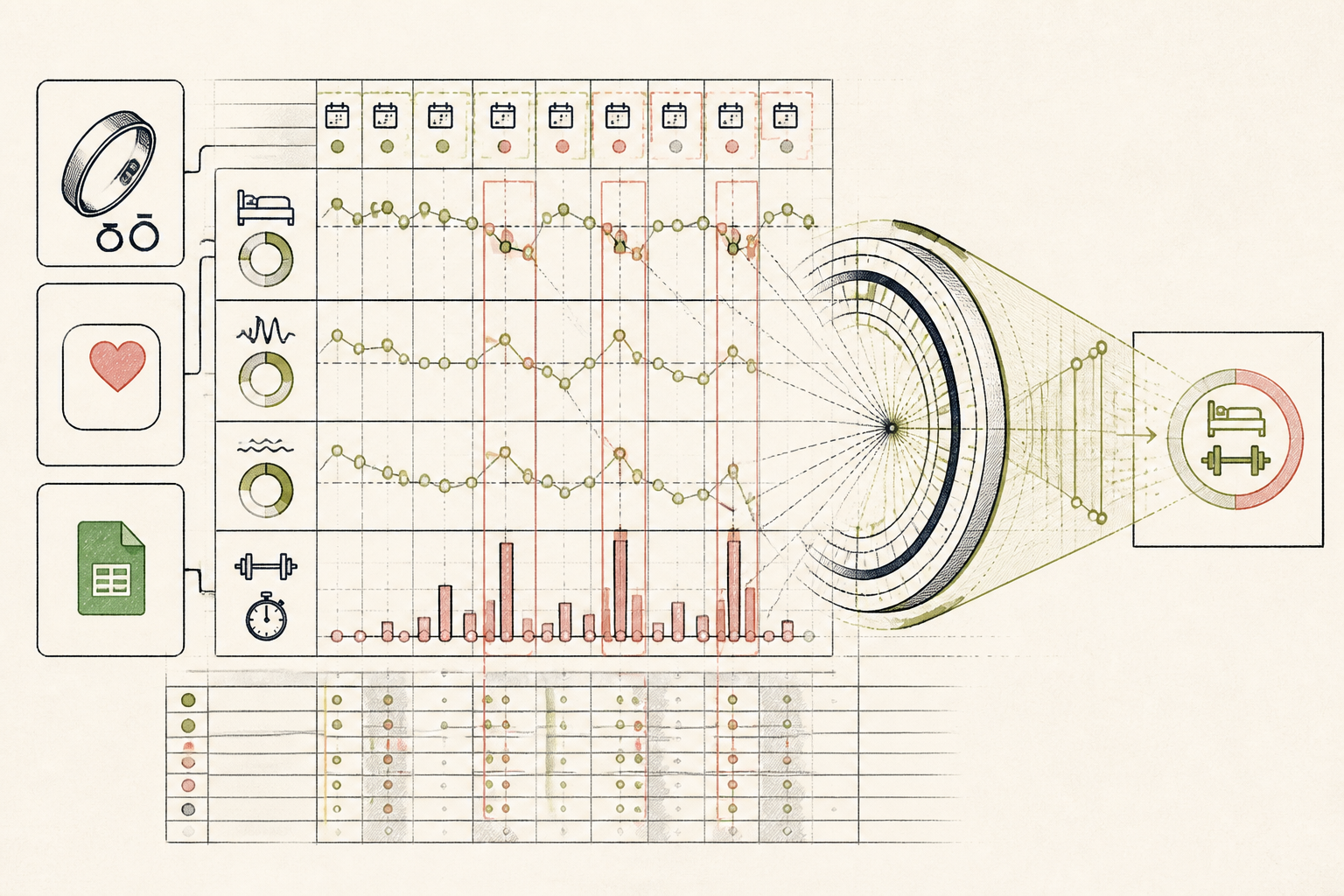
What the AI found
“Your three worst-sleep nights all followed strength training after 7pm — not screen time, which you'd assumed. Specifically, sleep efficiency dropped by an average of 9% on those evenings.”
Before
Disparate sleep data, vague assumptions
After
One clear pattern, informed evening choices
The same system, three states — real screens, not a screenshot
| Workout Type | Strength, Endurance |
| Workout Time | 18:30, 20:15, 17:00 |
| Sleep Duration | 7h 15m, 6h 30m, 7h 40m |
| Sleep Efficiency | 88%, 79%, 92% |
Prompt
I have been tracking my sleep with Oura and workouts with Apple Health. My Oura sleep data for the last 7 days is: [paste raw Oura export]. My Apple Health workout log for the same period is: [paste raw Apple Health export]. I suspect late screen time harms my sleep. Can you analyse this data for correlations, specifically looking at workout timing and sleep efficiency, and tell me if my assumption about screen time is correct or if something else stands out?
I have been tracking my sleep with Oura and workouts with Apple Health. My Oura sleep data for the last 7 days indicates multiple disturbed nights with sleep efficiency below 80%. My Apple Health workout log shows several strength sessions, some finishing after 7 PM. I suspect late screen time harms my sleep. Can you analyse this data for correlations, specifically looking at workout timing and sleep efficiency, and tell me if my assumption about screen time is correct or if something else stands out?
AI
Based on your data, your assumption about screen time doesn't appear to be the primary factor. Your three lowest sleep efficiency nights (79%, 78%, 81%) directly followed strength training sessions that concluded after 7 PM. On these specific nights, your sleep efficiency dropped by an average of 9% compared to nights without late training, showing a stronger correlation than any other variable in the provided data.91%
Average Sleep Efficiency (post-adjustment)
0
Late Strength Workouts (last 30 days)
7h 45m
Average Time in Bed
From Scattered Sleep Data to a Clear Pattern
How a daily AI prompt transformed a vague sense of restless nights into a precise, actionable insight about late-day training.
A 41-year-old amateur cyclist, EU
Tools used
The real tools used here — swap any for your own equivalent. Each links to how we’d set it up.
Starting state
Before anything was set up
For months, this amateur cyclist had been diligently tracking sleep with an Oura ring and logging workouts in Apple Health, but the sheer volume of data felt overwhelming. He suspected late-night screen time was the culprit behind his restless nights, but without a clear way to connect the dots, it remained a hunch.
| Workout Type | Strength, Endurance |
| Workout Time | 18:30, 20:15, 17:00 |
| Sleep Duration | 7h 15m, 6h 30m, 7h 40m |
| Sleep Efficiency | 88%, 79%, 92% |
| Wake-ups | 2, 4, 1 |
Working state
Hacks Pass, doing its job
He started using a daily AI prompt to cross-reference his sleep and activity logs. Each evening, after a late strength session, he would paste his Oura sleep data and Apple Health workout summary into a chat interface. The AI's role was to identify correlations he couldn't easily spot, focusing on patterns related to workout timing and sleep quality.
Prompt
I have been tracking my sleep with Oura and workouts with Apple Health. My Oura sleep data for the last 7 days is: [paste raw Oura export]. My Apple Health workout log for the same period is: [paste raw Apple Health export]. I suspect late screen time harms my sleep. Can you analyse this data for correlations, specifically looking at workout timing and sleep efficiency, and tell me if my assumption about screen time is correct or if something else stands out?
I have been tracking my sleep with Oura and workouts with Apple Health. My Oura sleep data for the last 7 days indicates multiple disturbed nights with sleep efficiency below 80%. My Apple Health workout log shows several strength sessions, some finishing after 7 PM. I suspect late screen time harms my sleep. Can you analyse this data for correlations, specifically looking at workout timing and sleep efficiency, and tell me if my assumption about screen time is correct or if something else stands out?
AI
Based on your data, your assumption about screen time doesn't appear to be the primary factor. Your three lowest sleep efficiency nights (79%, 78%, 81%) directly followed strength training sessions that concluded after 7 PM. On these specific nights, your sleep efficiency dropped by an average of 9% compared to nights without late training, showing a stronger correlation than any other variable in the provided data.Use case implemented
The finished system, running on its own
The prompt became a cornerstone of his evening routine. Each morning, after a late training session, he received a concise analysis directly correlating specific workout timings with his sleep metrics. This allowed him to immediately adjust his next day's training schedule or evening wind-down, moving from reactive guesswork to proactive, data-informed decisions about his pre-sleep activities.
91%
Average Sleep Efficiency (post-adjustment)
0
Late Strength Workouts (last 30 days)
7h 45m
Average Time in Bed
What an outside observer would notice
increased by 7%
Avg Sleep Efficiency
reduced by 80%
Nights with <80% Efficiency
implemented on 5 occasions
Evening Training Adjustments
The stack — build it yourself
Delivers consistent, detailed sleep stage and efficiency metrics.
Aggregates diverse workout data, providing a unified activity log.
Excels at identifying non-obvious correlations in complex datasets.
Allows easy extraction and staging of raw data for AI input.
These are the tools used in this story. Any can be swapped for an equivalent you already trust.
Go deeper
Do this yourself
See Hacks Pass
This story runs on Hacks Pass. The tools and prompts above are the real build — swap any tool for your own equivalent and follow the same steps.