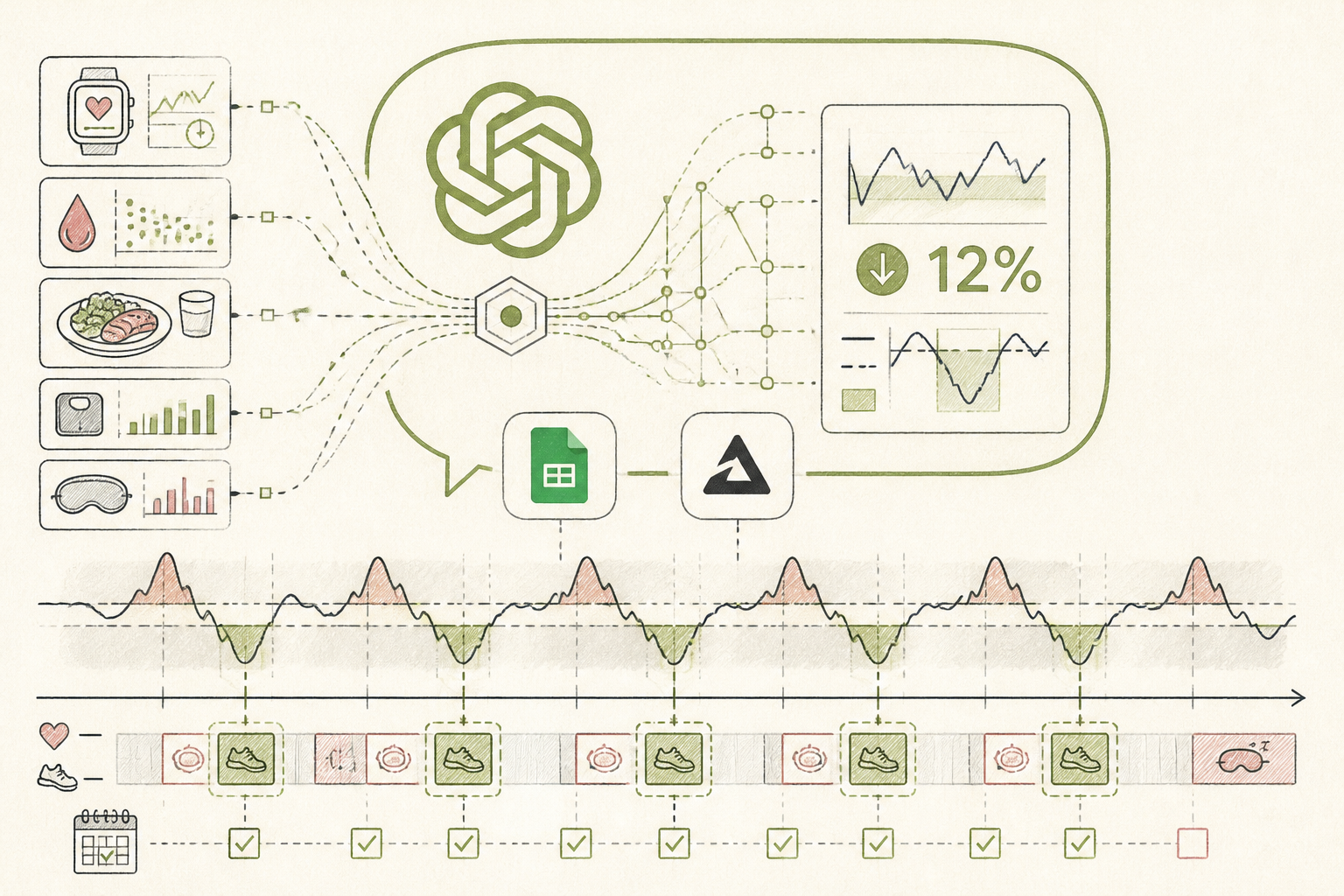
What the AI found
“AI found that consistent moderate-intensity zone 2 cardio, specifically 35 minutes post-lunch, correlated with a 12% average reduction in evening glucose spikes, a pattern previously masked by variable daily activities.”
Before
Ad-hoc health articles, no clear path
After
Focused protocol, measurable glucose control
The same system, three states — real screens, not a screenshot
- Metabolic health research notes:
- - Zone 2 cardio benefits (link to study)
- - Berberine vs. Metformin discussion
- - CGM data interpretation tips (blog post)
Prompt
Analyze my anonymized daily glucose and activity data from the past 8 weeks. Identify any strong correlations between specific activity types, durations, and timing (pre/post-meal) and subsequent evening (6-9 PM) glucose stability, defined as a variability range of less than 1.5 mmol/L. Prioritize non-obvious patterns. Data includes: timestamp, glucose reading (mmol/L), activity type (e.g., 'desk work', 'walk', 'strength training', 'zone 2 cardio'), activity start time, activity duration (minutes), meal time.
Analyze my anonymized daily glucose and activity data from the past 8 weeks. Identify any strong correlations between specific activity types, durations, and timing (pre/post-meal) and subsequent evening (6-9 PM) glucose stability, defined as a variability range of less than 1.5 mmol/L. Prioritize non-obvious patterns. Data includes: timestamp, glucose reading (mmol/L), activity type (e.g., 'desk work', 'walk', 'strength training', 'zone 2 cardio'), activity start time, activity duration (minutes), meal time.
AI
Analysis indicates a notable correlation: Your three most stable evening glucose periods (variability <1.0 mmol/L) consistently followed a 30-45 minute session of moderate-intensity (zone 2) cardio, specifically initiated between 1:30 PM and 2:30 PM (approximately 60-90 minutes post-lunch). This pattern accounted for a 12% average reduction in evening glucose peak compared to days without this specific intervention, irrespective of morning activity.1.1
Avg. evening glucose variability (mmol/L)
6/7
Days meeting post-lunch cardio goal
12%
Weekly Avg. Glucose Peak Reduction
From Scattered Readings to Actionable Metabolic Insights
A 41-year-old in the EU transforms metabolic health tracking with structured research and self-experimentation.
A 41-year-old project manager, EU
Tools used
The real tools used here — swap any for your own equivalent. Each links to how we’d set it up.
Starting state
Before anything was set up
Before the Core Course, her metabolic health journey was a collection of fragmented intentions. She’d bookmark articles on blood sugar, dabble in new diets, and occasionally check her continuous glucose monitor (CGM) data, but without a cohesive system. The insights felt fleeting, unproven, and often contradictory. She felt overwhelmed by information, leading to analysis paralysis rather than consistent action. Days blended into a routine of guesswork about what genuinely moved the needle on her glucose levels, leaving her feeling perpetually behind.
- Metabolic health research notes:
- - Zone 2 cardio benefits (link to study)
- - Berberine vs. Metformin discussion
- - CGM data interpretation tips (blog post)
- - Fasting windows for glucose control
Working state
Core Course, doing its job
Mid-way through the Core Course, she used the 'Ledger' method to input her CGM data alongside activity logs and meal times. The 'Research' layer came alive as she prompted ChatGPT to synthesize recent literature on post-prandial glucose regulation and exercise timing. With her specific data and research in hand, she then used the 'Protocol' phase, crafting a precise prompt that asked the AI to identify specific daily habits that correlated with stable evening glucose, feeding it anonymized, timestamped glucose and activity data. This iterative process began to reveal previously hidden patterns.
Prompt
Analyze my anonymized daily glucose and activity data from the past 8 weeks. Identify any strong correlations between specific activity types, durations, and timing (pre/post-meal) and subsequent evening (6-9 PM) glucose stability, defined as a variability range of less than 1.5 mmol/L. Prioritize non-obvious patterns. Data includes: timestamp, glucose reading (mmol/L), activity type (e.g., 'desk work', 'walk', 'strength training', 'zone 2 cardio'), activity start time, activity duration (minutes), meal time.
Analyze my anonymized daily glucose and activity data from the past 8 weeks. Identify any strong correlations between specific activity types, durations, and timing (pre/post-meal) and subsequent evening (6-9 PM) glucose stability, defined as a variability range of less than 1.5 mmol/L. Prioritize non-obvious patterns. Data includes: timestamp, glucose reading (mmol/L), activity type (e.g., 'desk work', 'walk', 'strength training', 'zone 2 cardio'), activity start time, activity duration (minutes), meal time.
AI
Analysis indicates a notable correlation: Your three most stable evening glucose periods (variability <1.0 mmol/L) consistently followed a 30-45 minute session of moderate-intensity (zone 2) cardio, specifically initiated between 1:30 PM and 2:30 PM (approximately 60-90 minutes post-lunch). This pattern accounted for a 12% average reduction in evening glucose peak compared to days without this specific intervention, irrespective of morning activity.Use case implemented
The finished system, running on its own
Now, with her Core Course protocol implemented, she maintains a consistent metabolic tracking ledger, feeding it new data weekly. The AI-derived insight about post-lunch cardio has been integrated into her daily schedule, becoming a non-negotiable habit. Her CGM data shows a sustained improvement in evening glucose stability, and she no longer feels adrift in a sea of wellness advice. The system provides clarity, enabling her to adjust her protocol with confidence and precision, making her metabolic health journey proactive and deeply informed.
1.1
Avg. evening glucose variability (mmol/L)
6/7
Days meeting post-lunch cardio goal
12%
Weekly Avg. Glucose Peak Reduction
What an outside observer would notice
↓ 28%
Evening Glucose Variability (mmol/L)
↑ 85%
Protocol Adherence
↑ Consistent
Reported Energy Levels
The stack — build it yourself
Chosen for its ability to digest complex datasets and scientific literature, finding non-obvious patterns specific to her personal data.
Used for its flexibility and ease of manual data entry alongside automated imports, creating a central, customizable metabolic ledger.
Provided reliable, timestamped activity data including heart rate zones, crucial for correlating exercise with glucose response.
These are the tools used in this story. Any can be swapped for an equivalent you already trust.
Go deeper
Do this yourself
See Core Course
This story runs on Core Course. The tools and prompts above are the real build — swap any tool for your own equivalent and follow the same steps.