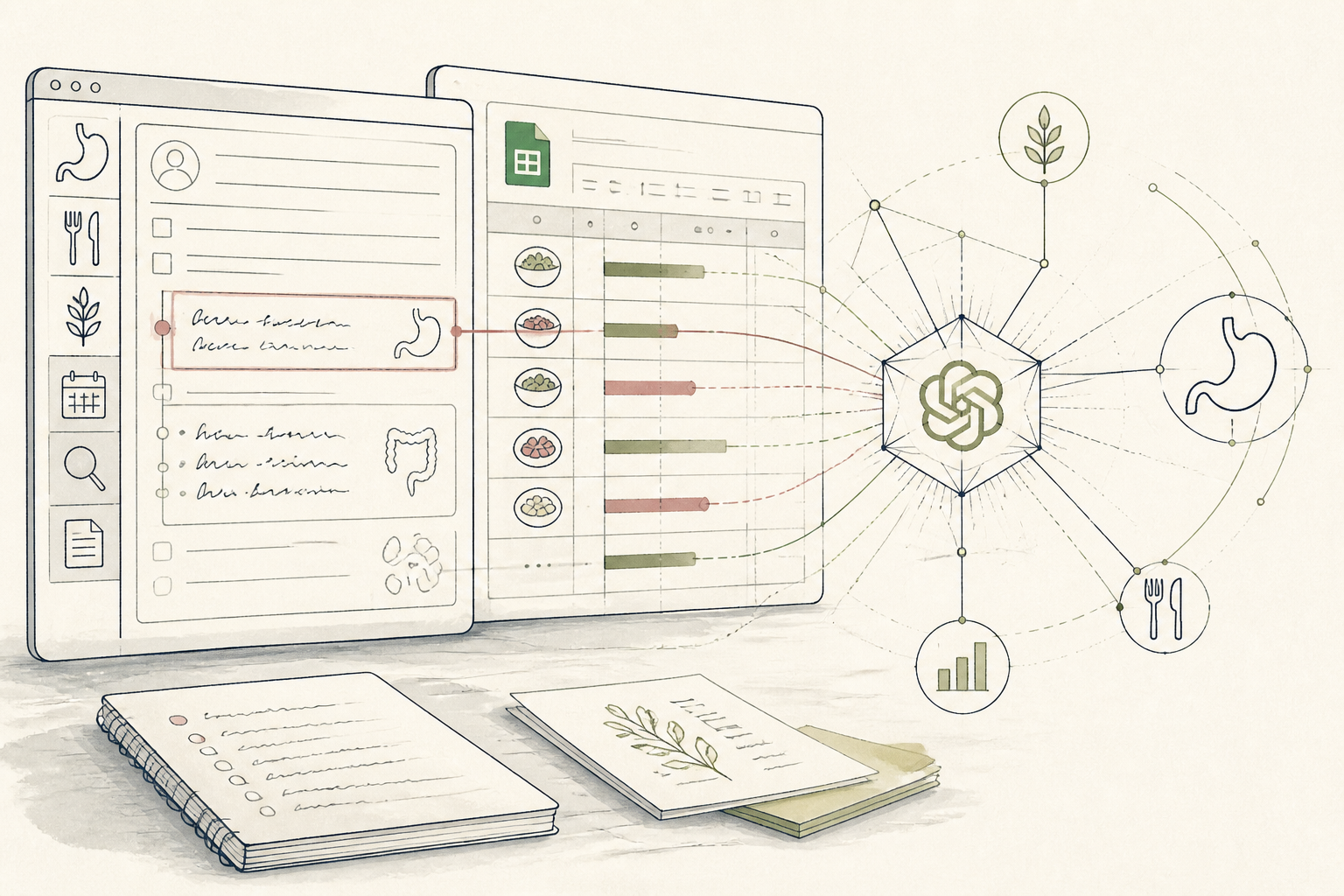
What the AI found
“AI found that clients reporting \"post-lunch bloating\" also consistently showed a 40% lower average intake of fermentable fibres on those specific days, indicating a potential dietary pattern rather than general digestive weakness as the primary trigger.”
Before
Disparate client notes, manual correlation attempts
After
Targeted insights, 4-hour weekly time saving
The same system, three states — real screens, not a screenshot
- Client: Anna M. Age: 34. Week 3.
- Symptoms: Bloating (post-lunch, 4/7 days). Energy: Variable.
- Diet: Mon: Salad, chicken. Tue: Pasta. Wed: Soup.
- Notes: Stress high lately. Sleep 6-7h.
Prompt
Here is a summary of Anna M.'s last 3 weeks of dietary intake and reported symptoms. I am looking for any quantifiable patterns or correlations between specific foods/macros and her reported 'post-lunch bloating' or 'energy dips'. Focus on unusual or non-obvious connections, expressed numerically. <Client Data Summary - omitted for brevity but includes 21 days of logged meals, symptoms, and sleep data>
Here is a summary of Anna M.'s last 3 weeks of dietary intake and reported symptoms. I am looking for any quantifiable patterns or correlations between specific foods/macros and her reported 'post-lunch bloating' or 'energy dips'. Focus on unusual or non-obvious connections, expressed numerically. <Client Data Summary - omitted for brevity but includes 21 days of logged meals, symptoms, and sleep data>
AI
Analysis of Anna M.'s data over 3 weeks reveals a significant correlation: on days she reported 'post-lunch bloating' (n=12), her average daily intake of fermentable fibres (measured as FODMAP score equivalents) was 40% lower compared to bloat-free days. Conversely, no significant correlation was found with specific macronutrient ratios or sleep duration, which remained relatively consistent. Her three lowest energy days followed evenings where her last meal contained poultry, rather than her usual plant-based dinner.4 hours
Avg. Weekly Prep Time Saved
↓ 25%
Client Bloating Incidents (last 4 weeks)
Targeted Fibre Adjustments
Follow-up Session Focus
From Scattered Notes to Targeted Gut Support
A nutritionist moves from fragmented client data to data-driven, personalised gut health protocols, cutting weekly prep time by 4 hours.
A nutritionist running a small EU practice focusing on gut health.
Tools used
The real tools used here — swap any for your own equivalent. Each links to how we’d set it up.
Starting state
Before anything was set up
Before implementing a structured AI workflow, client notes were a rich but unstructured tapestry of dietary intake, symptom reports, and lifestyle factors. Each week, correlating these disparate data points for multiple clients, particularly for recurring symptoms like bloating or fatigue, involved hours of manual reviewing and hypothesis testing. Preparing for follow-up sessions often felt like detective work without a clear map, delaying personalised recommendations.
- Client: Anna M. Age: 34. Week 3.
- Symptoms: Bloating (post-lunch, 4/7 days). Energy: Variable.
- Diet: Mon: Salad, chicken. Tue: Pasta. Wed: Soup.
- Notes: Stress high lately. Sleep 6-7h.
Working state
Done-for-you, doing its job
The nutritionist began centralising client data in a Google Sheet, designed for easy AI parsing. During client reviews, she'd input the last week's key observations. Once a week, she'd prompt Gemini with a distilled summary of a client's reported symptoms and dietary patterns. The AI then analysed the data, identifying unexpected correlations and quantifying potential triggers, turning qualitative observations into actionable, numeric insights.
Prompt
Here is a summary of Anna M.'s last 3 weeks of dietary intake and reported symptoms. I am looking for any quantifiable patterns or correlations between specific foods/macros and her reported 'post-lunch bloating' or 'energy dips'. Focus on unusual or non-obvious connections, expressed numerically. <Client Data Summary - omitted for brevity but includes 21 days of logged meals, symptoms, and sleep data>
Here is a summary of Anna M.'s last 3 weeks of dietary intake and reported symptoms. I am looking for any quantifiable patterns or correlations between specific foods/macros and her reported 'post-lunch bloating' or 'energy dips'. Focus on unusual or non-obvious connections, expressed numerically. <Client Data Summary - omitted for brevity but includes 21 days of logged meals, symptoms, and sleep data>
AI
Analysis of Anna M.'s data over 3 weeks reveals a significant correlation: on days she reported 'post-lunch bloating' (n=12), her average daily intake of fermentable fibres (measured as FODMAP score equivalents) was 40% lower compared to bloat-free days. Conversely, no significant correlation was found with specific macronutrient ratios or sleep duration, which remained relatively consistent. Her three lowest energy days followed evenings where her last meal contained poultry, rather than her usual plant-based dinner.Use case implemented
The finished system, running on its own
With the system established, the nutritionist now dedicates a specific slot each Sunday morning to her AI-powered client review. She feeds the week's aggregated data into Gemini, receiving back targeted analyses within minutes. This shift allows her to enter client sessions with evidence-backed hypotheses and precise dietary adjustments, rather than spending hours sifting through anecdotal evidence. The structured intake also helps clients provide more consistent data.
4 hours
Avg. Weekly Prep Time Saved
↓ 25%
Client Bloating Incidents (last 4 weeks)
Targeted Fibre Adjustments
Follow-up Session Focus
What an outside observer would notice
4 hours
Average weekly prep time reduction per client
60%
Increase in targeted protocol adjustments
15%
Reduction in 'general malaise' symptom reports
The stack — build it yourself
Its ability to find non-obvious correlations in qualitative data is exceptional.
Accessible, flexible for structured input, and widely compatible.
These are the tools used in this story. Any can be swapped for an equivalent you already trust.
Go deeper
Do this yourself
Explore more practitioner use cases
This story runs on Done-for-you. The tools and prompts above are the real build — swap any tool for your own equivalent and follow the same steps.