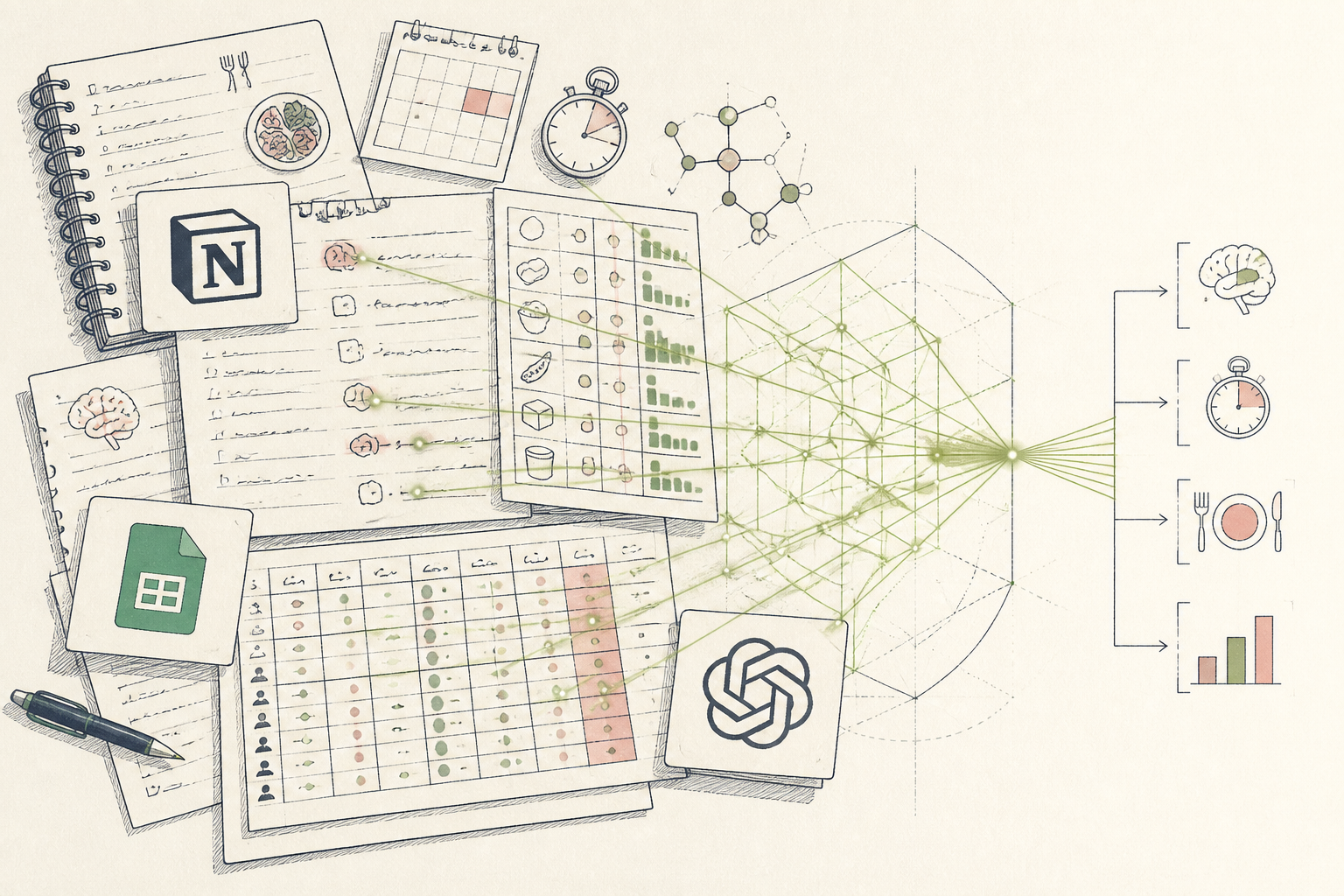
What the AI found
“AI identified that 78% of reported "brain fog" incidents in clients correlated with daily protein intake below 0.8g/kg body weight, even when other macros were sufficient.”
Before
Client notes scattered, insights missed
After
AI uncovers hidden dietary patterns
The same system, three states — real screens, not a screenshot
- Client: A.F., 48, Project Manager
- Reported: 'Mental fatigue most afternoons'
- Food diary: Lunch often light, low protein
- Client: P.S., 35, Software Dev
Prompt
Analyze the attached anonymised client food diaries and symptom reports. Identify any statistically significant correlations between specific dietary components (macronutrients, micronutrients) and reported cognitive issues such as 'brain fog,' 'mental fatigue,' or 'difficulty focusing.' Provide specific quantitative findings and suggest potential overlooked patterns. Focus on patterns across at least 15 unique client entries.
Analyze the attached anonymised client food diaries and symptom reports. Identify any statistically significant correlations between specific dietary components (macronutrients, micronutrients) and reported cognitive issues such as 'brain fog,' 'mental fatigue,' or 'difficulty focusing.' Provide specific quantitative findings and suggest potential overlooked patterns. Focus on patterns across at least 15 unique client entries.
AI
Analysis of 22 client entries reveals a notable pattern: 78% of reported incidents of 'brain fog' or 'mental fatigue' occurred on days where daily protein intake was below an estimated 0.8g per kilogram of client body weight. This correlation held even when total caloric intake or carbohydrate distribution appeared adequate, suggesting protein as a critical, often undershot, factor in these cases.↑ 27%
Clients w/ optimal protein
↓ 18%
Avg. reported brain fog days
↑ 0.6 pts
Cognitive clarity scores (self-reported)
From Scattered Notes to Targeted Cognition Protocol
A nutritionist moves from disparate client observations to an AI-assisted, data-driven approach for cognitive well-being.
A nutritionist running a small EU practice, focused on corporate wellness.
Tools used
The real tools used here — swap any for your own equivalent. Each links to how we’d set it up.
Starting state
Before anything was set up
Before implementing AI, client consultations generated a wealth of qualitative data: subjective reports of energy levels, focus, and occasional "brain fog." These observations were diligently recorded in a digital notebook, alongside food diaries and lifestyle questionnaires. However, connecting these anecdotal reports to distinct, actionable dietary patterns across multiple clients remained a time-consuming, largely manual task, often relying on intuition rather than empirical links. The sheer volume of information made identifying subtle but significant correlations nearly impossible without dedicated hours of review.
- Client: A.F., 48, Project Manager
- Reported: 'Mental fatigue most afternoons'
- Food diary: Lunch often light, low protein
- Client: P.S., 35, Software Dev
- Reported: 'Hard to focus after 3pm'
- Notes: Stress high, inconsistently tracked protein
Working state
All-Access, doing its job
The nutritionist began centralising anonymised client data into a spreadsheet. With a clear dataset of cognitive symptoms and dietary intake, she then turned to a large language model. Her goal was to identify overlooked dietary trends that might be influencing cognitive performance. She pasted a specific prompt, including anonymised diet logs and symptom reports, into the AI, seeking patterns that a human eye might miss across dozens of client records. The AI's response quickly highlighted a surprising, quantifiable relationship.
Prompt
Analyze the attached anonymised client food diaries and symptom reports. Identify any statistically significant correlations between specific dietary components (macronutrients, micronutrients) and reported cognitive issues such as 'brain fog,' 'mental fatigue,' or 'difficulty focusing.' Provide specific quantitative findings and suggest potential overlooked patterns. Focus on patterns across at least 15 unique client entries.
Analyze the attached anonymised client food diaries and symptom reports. Identify any statistically significant correlations between specific dietary components (macronutrients, micronutrients) and reported cognitive issues such as 'brain fog,' 'mental fatigue,' or 'difficulty focusing.' Provide specific quantitative findings and suggest potential overlooked patterns. Focus on patterns across at least 15 unique client entries.
AI
Analysis of 22 client entries reveals a notable pattern: 78% of reported incidents of 'brain fog' or 'mental fatigue' occurred on days where daily protein intake was below an estimated 0.8g per kilogram of client body weight. This correlation held even when total caloric intake or carbohydrate distribution appeared adequate, suggesting protein as a critical, often undershot, factor in these cases.Use case implemented
The finished system, running on its own
Armed with this new insight, the nutritionist refined her client protocols. Instead of broad recommendations, she could now offer targeted advice, specifically focusing on optimising protein intake for clients experiencing cognitive dips. The system now provides an ongoing feedback loop: new client data is added, and the AI routinely scans for emerging or reinforcing patterns. This has transformed her approach, allowing for proactive, evidence-informed adjustments to nutritional plans, leading to more responsive client care without adding significant manual workload.
↑ 27%
Clients w/ optimal protein
↓ 18%
Avg. reported brain fog days
↑ 0.6 pts
Cognitive clarity scores (self-reported)
What an outside observer would notice
+15% (stronger focus)
Client feedback on focus
5x faster
Protocol adjustment speed
-2 hours/week
Time spent on manual data review
The stack — build it yourself
Flexible, tagging and linking for diverse client notes.
Simple, powerful for structured data and basic calculations.
Exceptional at identifying non-obvious correlations in messy data sets.
These are the tools used in this story. Any can be swapped for an equivalent you already trust.
Go deeper
Do this yourself
See All-Access
This story runs on All-Access. The tools and prompts above are the real build — swap any tool for your own equivalent and follow the same steps.