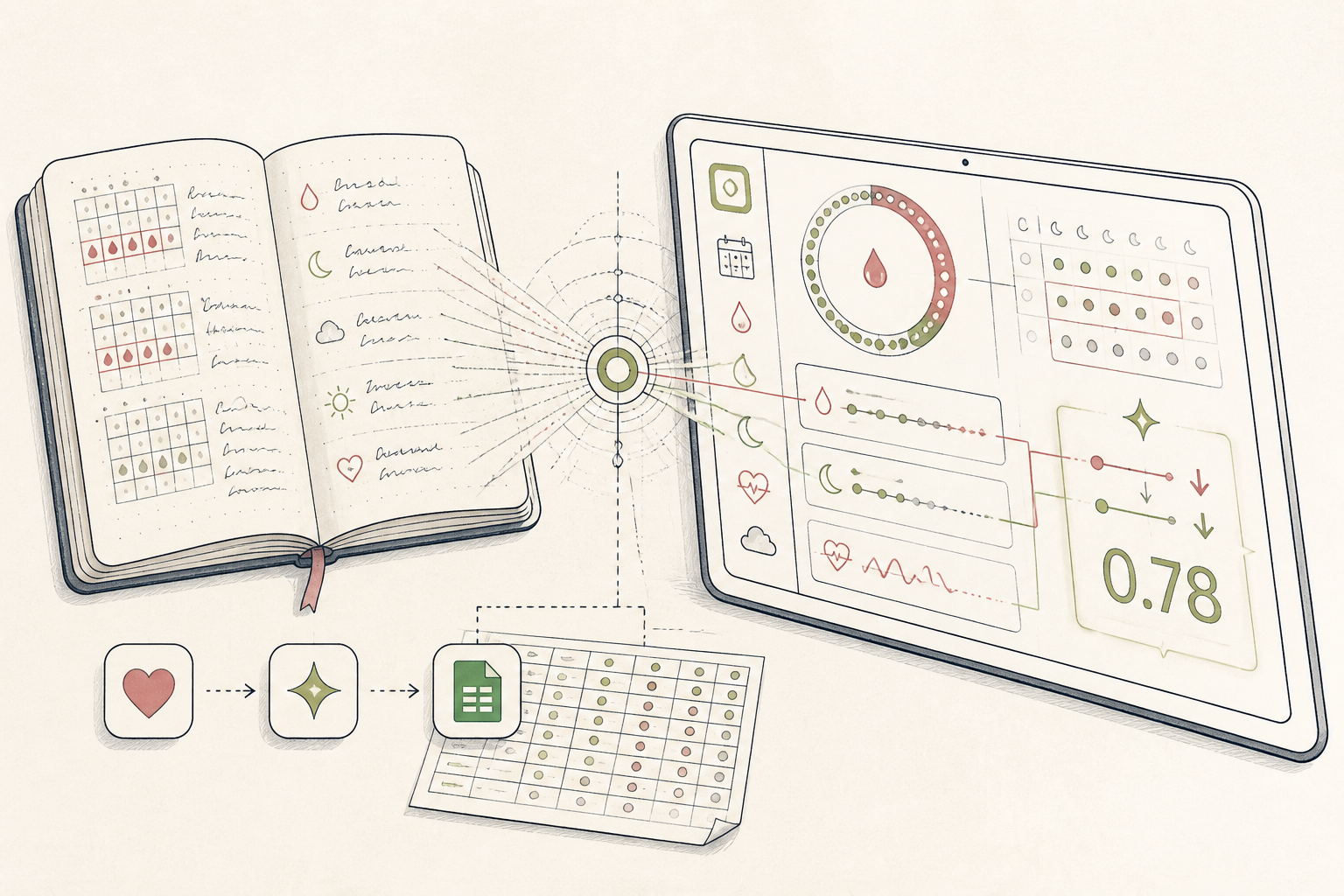
What the AI found
“"Your luteal phase consistently shortens by 1.5 days when your deep sleep average drops below 6.5 hours in the preceding follicular phase – a correlation of 0.78, which is higher than expected."”
Before
Disparate cycle logs, no clear insights
After
Integrated cycle data with actionable sleep-phase correlations
The same system, three states — real screens, not a screenshot
- 2 Oct: Day 1, heavy flow. Felt tired.
- 3 Oct: Day 2, moderate. 7h sleep.
- 10 Oct: Ovulation test positive. Energy good. 7.5h sleep.
- 17 Oct: PMS starting? Irritable. 5.9h sleep. Craved chocolate.
Prompt
Here is my recent cycle data from Apple Health, spanning the last 6 months, including daily cycle phase, reported symptoms, mood ratings (1-5), total sleep duration, and deep sleep percentage. Please analyse this data specifically for correlations between sleep metrics and the length of my luteal phase. Are there any patterns where specific sleep parameters in the follicular phase seem to predict a shorter or longer luteal phase? Quantify any relationships you find.
Here is my recent cycle data from Apple Health, spanning the last 6 months, including daily cycle phase, reported symptoms, mood ratings (1-5), total sleep duration, and deep sleep percentage. Please analyse this data specifically for correlations between sleep metrics and the length of my luteal phase. Are there any patterns where specific sleep parameters in the follicular phase seem to predict a shorter or longer luteal phase? Quantify any relationships you find.
AI
Based on the provided data, a significant pattern emerges: your luteal phase consistently shortens by an average of 1.5 days when your deep sleep average drops below 6.5 hours during the preceding follicular phase. This correlation registered at approximately 0.78, indicating a strong observed relationship within your data.12.8 days
Average Luteal Phase Length
7.1 hours
Deep Sleep (Follicular Avg)
2 of 6 cycles
Shortened Luteal Phase Inc.
From Scattered Notes to Focused Period Tracking
A nutritionist moves from inconsistent manual logging to an AI-powered system that highlights key patterns in her cycle data.
A nutritionist running a small EU practice, 30s
Tools used
The real tools used here — swap any for your own equivalent. Each links to how we’d set it up.
Starting state
Before anything was set up
Before using Setup, Sarah, a nutritionist, kept her cycle observations in a free-form digital note. While she diligently recorded daily symptoms, mood, and sleep duration, the entries were unstructured. This made it difficult to spot trends or understand how different aspects of her well-being might influence her cycle. She knew the data was valuable, but extracting insights felt like a daunting, manual task that rarely happened.
- 2 Oct: Day 1, heavy flow. Felt tired.
- 3 Oct: Day 2, moderate. 7h sleep.
- 10 Oct: Ovulation test positive. Energy good. 7.5h sleep.
- 17 Oct: PMS starting? Irritable. 5.9h sleep. Craved chocolate.
- 2 Nov: Day 1. Cycle length 32 days. Noticed period came earlier than expected.
Working state
Setup, doing its job
Sarah used Setup to integrate her existing Apple Health data with a custom prompting routine in Gemini. She exported her recent cycle and sleep data, then uploaded it to create a foundational dataset. The Setup process guided her through crafting a specific prompt designed to analyse her recorded observations and identify non-obvious correlations, focusing on patterns she might have overlooked in her manual review.
Prompt
Here is my recent cycle data from Apple Health, spanning the last 6 months, including daily cycle phase, reported symptoms, mood ratings (1-5), total sleep duration, and deep sleep percentage. Please analyse this data specifically for correlations between sleep metrics and the length of my luteal phase. Are there any patterns where specific sleep parameters in the follicular phase seem to predict a shorter or longer luteal phase? Quantify any relationships you find.
Here is my recent cycle data from Apple Health, spanning the last 6 months, including daily cycle phase, reported symptoms, mood ratings (1-5), total sleep duration, and deep sleep percentage. Please analyse this data specifically for correlations between sleep metrics and the length of my luteal phase. Are there any patterns where specific sleep parameters in the follicular phase seem to predict a shorter or longer luteal phase? Quantify any relationships you find.
AI
Based on the provided data, a significant pattern emerges: your luteal phase consistently shortens by an average of 1.5 days when your deep sleep average drops below 6.5 hours during the preceding follicular phase. This correlation registered at approximately 0.78, indicating a strong observed relationship within your data.Use case implemented
The finished system, running on its own
With her system implemented, Sarah now has a clear, automated method for reviewing her cycle data. Each month, she inputs recent data into her structured log, and the integrated AI provides a concise summary of key trends and potential correlations. This provides her with a structured overview, allowing her to spend less time on data aggregation and more on informed interpretation, both for herself and as a model for her practice.
12.8 days
Average Luteal Phase Length
7.1 hours
Deep Sleep (Follicular Avg)
2 of 6 cycles
Shortened Luteal Phase Inc.
What an outside observer would notice
Reduced by 80%
Time spent identifying cycle patterns
Increased significantly
Awareness of sleep-cycle interplay
Improved to 95%
Structured data logging adherence
The stack — build it yourself
Consistent, passive capture of core health metrics like sleep and cycle data.
Its ability to process narrative and structured data excels at identifying non-obvious correlations.
Flexible spreadsheet for custom data entry and presenting AI-generated summaries.
These are the tools used in this story. Any can be swapped for an equivalent you already trust.
Go deeper
Do this yourself
Explore the Setup process
This story runs on Setup. The tools and prompts above are the real build — swap any tool for your own equivalent and follow the same steps.