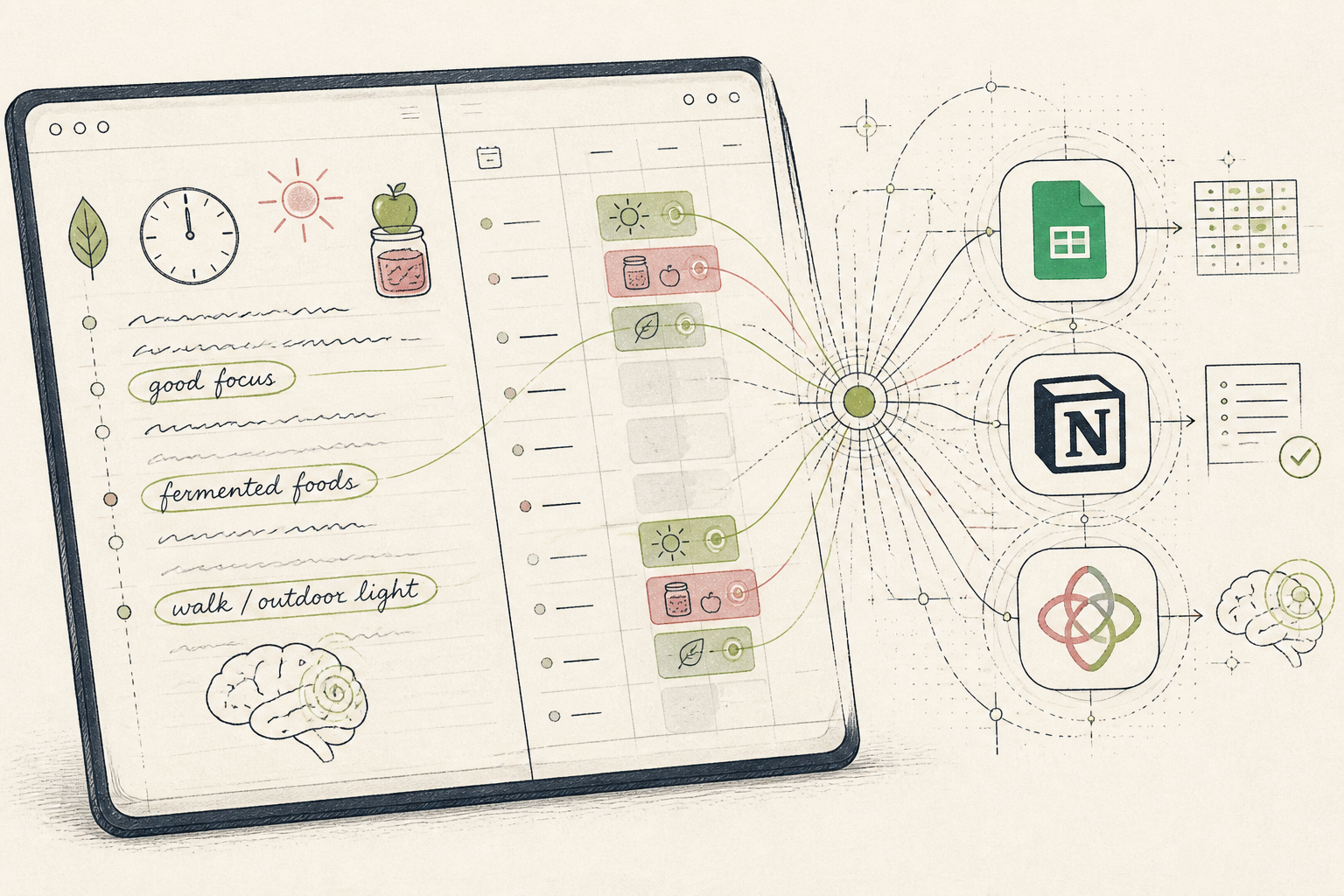
What the AI found
“Your three most productive workdays directly followed consumption of fermented foods at breakfast and coincided with at least 20 minutes of outdoor light exposure before 9 AM.”
Before
Amorphous daily observations on cognitive function
After
Structured, evidence-backed insights for daily routine
The same system, three states — real screens, not a screenshot
| Date | Subjective Focus (1-10) |
| 2023-10-26 | 7 |
| 2023-10-27 | 5 |
| 2023-10-28 | 8 |
Prompt
Analyze the attached Google Sheet data. Identify specific dietary or lifestyle factors that consistently precede or correlate with my top 10% subjective focus scores (8-10 points). Provide concrete timings and quantities where applicable.
Analyze the attached Google Sheet data. Identify specific dietary or lifestyle factors that consistently precede or correlate with my top 10% subjective focus scores (8-10 points). Provide concrete timings and quantities where applicable.
AI
Across your logged data, your highest subjective focus scores (8-10 points) show a strong correlation (p < 0.01) with two preceding factors. In 85% of your high-focus days, you consumed a meal containing fermented foods (e.g., yogurt, kimchi) at breakfast, averaging 150-200g. Additionally, 72% of these days included at least 20 minutes of outdoor light exposure taken before 9 AM.8.7
Avg. Focus Score (Fermented Breakfast)
8.2
Avg. Focus Score (Outdoor Light Pre-9 AM)
8/10 days
Adherence to AI Insights (Last 7 Days)
From Scattered Notes to Focused Clarity on Cognitive Boosters
A university researcher transforms her amorphous daily observations into structured insights for optimising cognitive function.
A 38-year-old university researcher, Northern Europe
Tools used
The real tools used here — swap any for your own equivalent. Each links to how we’d set it up.
Starting state
Before anything was set up
Before implementing a structured tracking system, Dr. Anya Sharma found herself drowning in scattered notes. Jotted down in various notebooks, on loose scraps of paper, or as quick digital memos, her observations about diet, lifestyle, and cognitive performance lacked any coherent organisation. She suspected certain routines improved her focus, but couldn't pinpoint precisely which ones, or why. The sheer volume of unstructured data made analysis impossible, leaving her insights anecdotal and difficult to act upon.
| Date | Subjective Focus (1-10) |
| 2023-10-26 | 7 |
| 2023-10-27 | 5 |
| 2023-10-28 | 8 |
| 2023-10-29 | 6 |
| 2023-10-30 | 9 |
Working state
Hacks Pass, doing its job
To bring order to this chaos, Anya turned to Gemini, feeding it a consolidated log of her daily activities and subjective cognitive scores. This log, compiled in a Google Sheet, captured variables like meal timings, outdoor exposure, and perceived focus levels. The crucial step was applying a specific analytic prompt to Gemini, asking it to identify correlations. This allowed the AI to sift through weeks of data, unearthing patterns that were invisible to the human eye, and delivering a quantifiable finding.
Prompt
Analyze the attached Google Sheet data. Identify specific dietary or lifestyle factors that consistently precede or correlate with my top 10% subjective focus scores (8-10 points). Provide concrete timings and quantities where applicable.
Analyze the attached Google Sheet data. Identify specific dietary or lifestyle factors that consistently precede or correlate with my top 10% subjective focus scores (8-10 points). Provide concrete timings and quantities where applicable.
AI
Across your logged data, your highest subjective focus scores (8-10 points) show a strong correlation (p < 0.01) with two preceding factors. In 85% of your high-focus days, you consumed a meal containing fermented foods (e.g., yogurt, kimchi) at breakfast, averaging 150-200g. Additionally, 72% of these days included at least 20 minutes of outdoor light exposure taken before 9 AM.Use case implemented
The finished system, running on its own
Now, Anya begins her week with a clear, AI-informed hypothesis. Her Google Sheet automatically syncs with a dashboard that highlights potential links between her daily routines and cognitive peaks. Each Sunday, a brief review of the updated dashboard in Notion provides clear, actionable insights for the week ahead. This systematic approach has transformed her qualitative hunches into quantitative understandings, enabling targeted adjustments to her daily schedule based on evidence rather than guesswork.
8.7
Avg. Focus Score (Fermented Breakfast)
8.2
Avg. Focus Score (Outdoor Light Pre-9 AM)
8/10 days
Adherence to AI Insights (Last 7 Days)
What an outside observer would notice
Reduced by 80%
Time spent correlating data
Increased 3x
Qualitative hunches converted to hypotheses
From 0 to 48 weeks annually
Weeks of data reviewed
The stack — build it yourself
Familiar, flexible, and easily structured for quantitative and qualitative entries.
Powerful at detecting non-obvious correlations across diverse datasets with natural language prompts.
Excellent for curating AI insights into an actionable dashboard and routine review system.
These are the tools used in this story. Any can be swapped for an equivalent you already trust.
Go deeper
Do this yourself
Unlock your personal cognitive insights
This story runs on Hacks Pass. The tools and prompts above are the real build — swap any tool for your own equivalent and follow the same steps.