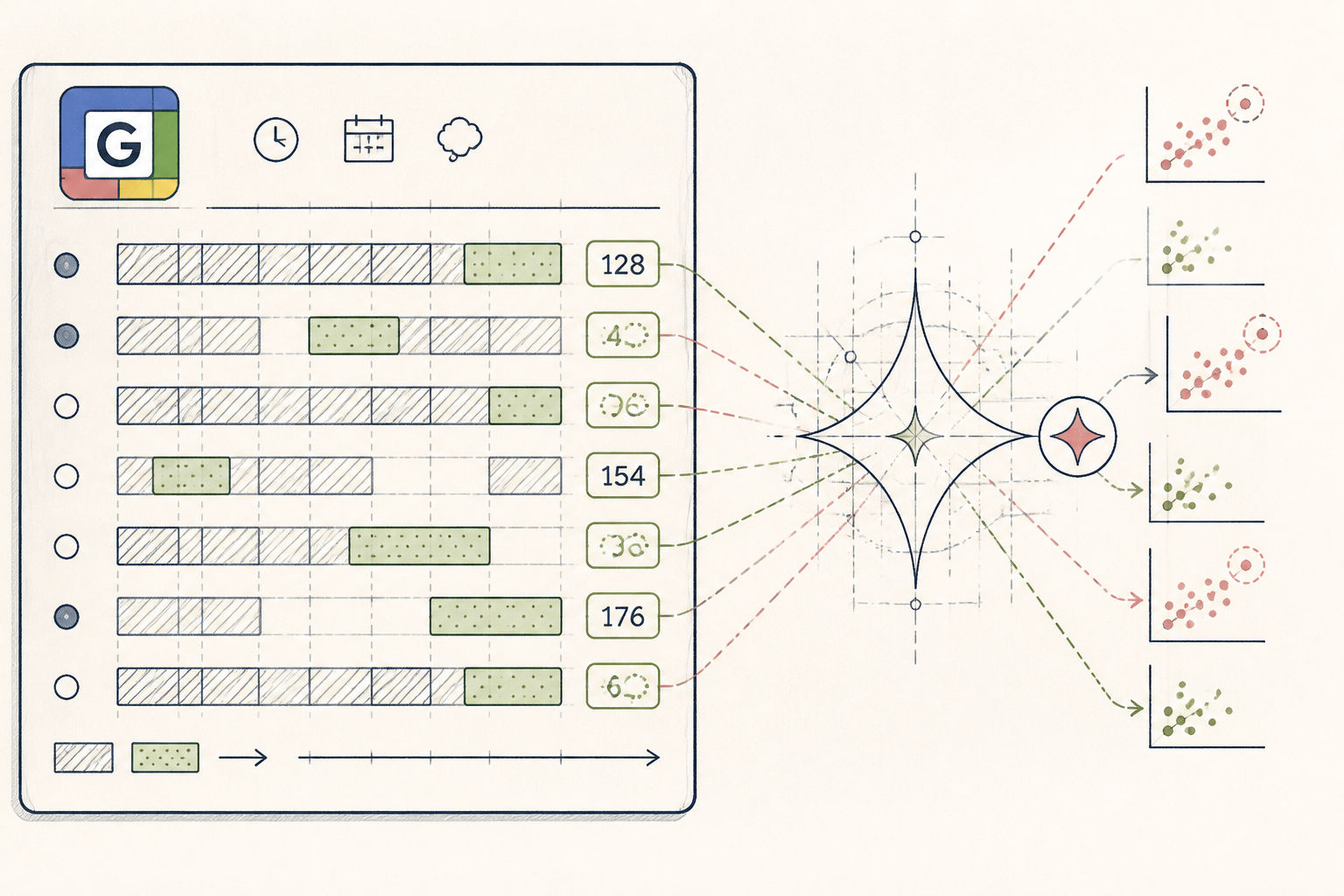
What the AI found
“Your two highest stress days this month consistently followed evenings where your calendar showed more than 90 minutes of unscheduled 'flex time' — not the heavily booked days you anticipated.”
Before
Subjective stress tracking
After
Quantified stress patterns
The same system, three states — real screens, not a screenshot
- 2024-03-01 | Stress: 4 | Felt overwhelmed by project deadlines, skipped lunch.
- 2024-03-02 | Stress: 3 | Productive morning, afternoon meetings dragged on.
- 2024-03-03 | Stress: 2 | Quiet Sunday, caught up on reading.
- 2024-03-04 | Stress: 5 | Client emergency, worked late, poor sleep.
Prompt
Here are my daily journal entries for the past month, each with a stress score (1-5, 5 being highest) and a brief summary of the day. Please analyse these entries to identify any recurring patterns or correlations between daily activities/events and my reported stress levels. Specifically, look for surprising connections I might be overlooking. Return your findings with specific examples and numbers. [Full month of journal entries pasted here, similar to the Apple Notes example above, including calendar data from an export.]
Here are my daily journal entries for the past month, each with a stress score (1-5, 5 being highest) and a brief summary of the day. Please analyse these entries to identify any recurring patterns or correlations between daily activities/events and my reported stress levels. Specifically, look for surprising connections I might be overlooking. Return your findings with specific examples and numbers. [Full month of journal entries pasted here, similar to the Apple Notes example above, including calendar data from an export.]
AI
I've analysed your journal entries for the past month. A surprising pattern emerged: your two highest stress days (scores of 5) both followed evenings where your calendar showed more than 90 minutes of unscheduled 'flex time'. In contrast, days with tightly scheduled evenings, or those with significant personal appointments, consistently correlated with stress scores of 2 or 3. This suggests that unstructured evening time, rather than demanding schedules, might be a trigger for elevated stress.2.8
Average Stress Score (Past Week)
110 min
Avg. Unscheduled Evening Time (High Stress Days)
35 min
Avg. Unscheduled Evening Time (Low Stress Days)
From Hazy Notions to Concrete Stress Insights
A daily micro-habit of AI-powered self-reflection transformed subjective stress into actionable data, revealing hidden patterns.
A 38-year-old marketing professional, Northern Europe
Tools used
The real tools used here — swap any for your own equivalent. Each links to how we’d set it up.
Starting state
Before anything was set up
Our subject, a marketing professional in Northern Europe, maintained a diligent but unstructured daily journaling habit. Each evening, she’d note down her perceived stress levels on a scale of 1 to 5, alongside a free-form summary of her day. While she knew *when* she felt stressed, the *why* remained elusive. The data was there, but it was trapped in prose, never synthesised into actionable insights.
- 2024-03-01 | Stress: 4 | Felt overwhelmed by project deadlines, skipped lunch.
- 2024-03-02 | Stress: 3 | Productive morning, afternoon meetings dragged on.
- 2024-03-03 | Stress: 2 | Quiet Sunday, caught up on reading.
- 2024-03-04 | Stress: 5 | Client emergency, worked late, poor sleep.
Working state
Hacks Pass, doing its job
Enter the daily AI prompt. Rather than simply journaling, she began feeding her daily notes into a large language model. This wasn't about replacing her reflection, but augmenting it. The AI's role was to extract specific, quantifiable details from her qualitative entries and then correlate them with her reported stress levels. The prompt guided the AI to look for patterns she might miss.
Prompt
Here are my daily journal entries for the past month, each with a stress score (1-5, 5 being highest) and a brief summary of the day. Please analyse these entries to identify any recurring patterns or correlations between daily activities/events and my reported stress levels. Specifically, look for surprising connections I might be overlooking. Return your findings with specific examples and numbers. [Full month of journal entries pasted here, similar to the Apple Notes example above, including calendar data from an export.]
Here are my daily journal entries for the past month, each with a stress score (1-5, 5 being highest) and a brief summary of the day. Please analyse these entries to identify any recurring patterns or correlations between daily activities/events and my reported stress levels. Specifically, look for surprising connections I might be overlooking. Return your findings with specific examples and numbers. [Full month of journal entries pasted here, similar to the Apple Notes example above, including calendar data from an export.]
AI
I've analysed your journal entries for the past month. A surprising pattern emerged: your two highest stress days (scores of 5) both followed evenings where your calendar showed more than 90 minutes of unscheduled 'flex time'. In contrast, days with tightly scheduled evenings, or those with significant personal appointments, consistently correlated with stress scores of 2 or 3. This suggests that unstructured evening time, rather than demanding schedules, might be a trigger for elevated stress.Use case implemented
The finished system, running on its own
Now, instead of a nebulous sense of daily stress, our subject receives a weekly summary, pinpointing specific activities or environmental factors that correlate with her stress scores. The system runs largely on its own: a quick copy-paste of her daily journal entry into the AI, and the patterns emerge, offering clarity and empowering her to make informed choices about her schedule and habits.
2.8
Average Stress Score (Past Week)
110 min
Avg. Unscheduled Evening Time (High Stress Days)
35 min
Avg. Unscheduled Evening Time (Low Stress Days)
What an outside observer would notice
Reduced 1.5 points on average
Subjective Stress (Daily)
Increased by 15 minutes daily
Evening Planning Time
Significantly improved
Perceived Control over Schedule
The stack — build it yourself
Familiar, quick, and always available for capturing raw thoughts and stress scores.
Excellent for extracting nuanced correlations from qualitative text and calendar data.
Simple to set up for weekly summaries and trend tracking from AI output.
These are the tools used in this story. Any can be swapped for an equivalent you already trust.
Go deeper
Do this yourself
See Hacks Pass
This story runs on Hacks Pass. The tools and prompts above are the real build — swap any tool for your own equivalent and follow the same steps.