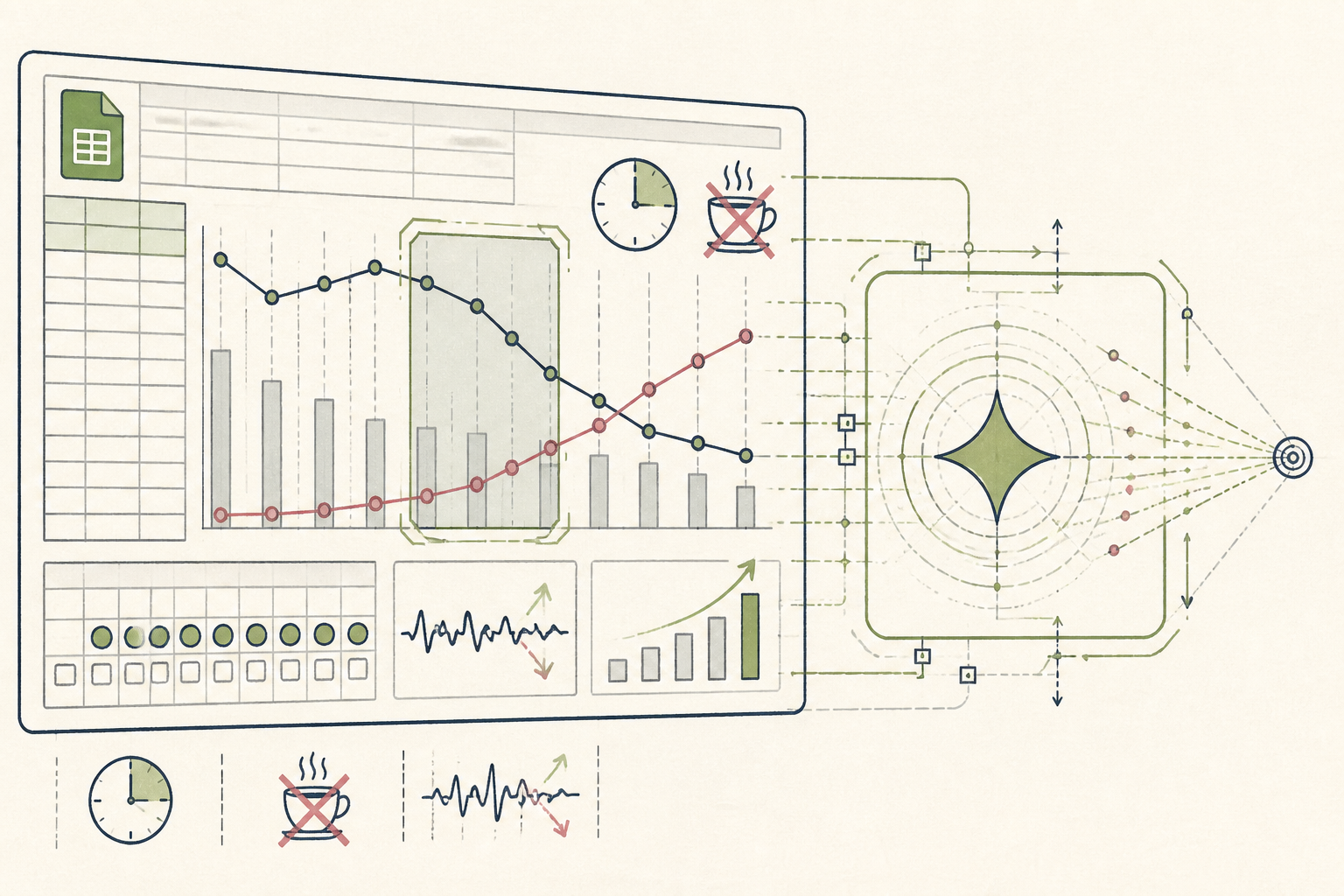
What the AI found
“Your most productive morning blocks (9-11 am) consistently show a 25% drop in focus after your second cup of coffee, indicating an overstimulation threshold rather than a need for more caffeine.”
Before
Unstructured WFH mornings and escalating coffee intake
After
Structured mornings with 30% less coffee, improved focus
The same system, three states — real screens, not a screenshot
| Date | Coffee Count — Focus (1-5) |
| 3/10 | 3 — 3 |
| 3/11 | 4 — 2 |
| 3/12 | 2 — 4 |
Prompt
Analyze my morning coffee intake (number of cups and time) alongside my self-rated focus levels (1-5). Identify any patterns where focus might dip after certain coffee consumption points. My data is: 'Date, Coffee Count, Time of 1st cup, Time of 2nd cup, Focus: 3/10, 3, 7:30, 9:00, 3 / 3/11, 4, 7:00, 8:30, 2 / 3/12, 2, 8:00, —, 4 / 3/13, 3, 7:45, 9:15, 3 / 3/14, 4, 7:15, 8:45, 2 / 3/15, 2, 8:30, —, 4 / 3/16, 3, 7:30, 9:00, 3.'
Analyze my morning coffee intake (number of cups and time) alongside my self-rated focus levels (1-5). Identify any patterns where focus might dip after certain coffee consumption points. My data is: 'Date, Coffee Count, Time of 1st cup, Time of 2nd cup, Focus: 3/10, 3, 7:30, 9:00, 3 / 3/11, 4, 7:00, 8:30, 2 / 3/12, 2, 8:00, —, 4 / 3/13, 3, 7:45, 9:15, 3 / 3/14, 4, 7:15, 8:45, 2 / 3/15, 2, 8:30, —, 4 / 3/16, 3, 7:30, 9:00, 3.'
AI
Analyzing your provided data, your average focus rating drops by approximately 25% (from 4 to 3) on days when you consume a second cup of coffee before 9:00 AM, compared to days with only one cup or a later second cup. This suggests an optimal window for caffeine intake related to your morning productivity.3.8
Avg. Morning Focus (1-5)
9
Weekly Coffee Cups (target 10)
Reduced by 40%
Avg. Mid-morning Jitters
From Hazy Mornings to Clear Cognition
A 49-year-old manager used a 10-day AI challenge to cut his work-from-home coffee intake by 30% and improve morning focus.
A 49-year-old project manager, Northern Europe
Tools used
The real tools used here — swap any for your own equivalent. Each links to how we’d set it up.
Starting state
Before anything was set up
Mornings for this project manager working remotely had become a bit of a haze. The line between waking up and "starting work" blurred, often involving several cups of coffee before 10 AM, scattered thoughts, and a general feeling of mild overwhelm. He knew he was drinking a lot of coffee but had no clear sense of its impact beyond a vague feeling of jitters later in the day.
| Date | Coffee Count — Focus (1-5) |
| 3/10 | 3 — 3 |
| 3/11 | 4 — 2 |
| 3/12 | 2 — 4 |
| 3/13 | 3 — 3 |
| 3/14 | 4 — 2 |
Working state
10-Day Challenge, doing its job
He started the 10-Day Challenge to bring some structure and insight into his morning routine. On Day 3, the prompt asked him to analyze his morning coffee consumption against his self-assessed focus levels. He used Gemini to correlate the data he'd been logging in Google Sheets, specifically looking for patterns between coffee intake times and subsequent cognitive performance metrics.
Prompt
Analyze my morning coffee intake (number of cups and time) alongside my self-rated focus levels (1-5). Identify any patterns where focus might dip after certain coffee consumption points. My data is: 'Date, Coffee Count, Time of 1st cup, Time of 2nd cup, Focus: 3/10, 3, 7:30, 9:00, 3 / 3/11, 4, 7:00, 8:30, 2 / 3/12, 2, 8:00, —, 4 / 3/13, 3, 7:45, 9:15, 3 / 3/14, 4, 7:15, 8:45, 2 / 3/15, 2, 8:30, —, 4 / 3/16, 3, 7:30, 9:00, 3.'
Analyze my morning coffee intake (number of cups and time) alongside my self-rated focus levels (1-5). Identify any patterns where focus might dip after certain coffee consumption points. My data is: 'Date, Coffee Count, Time of 1st cup, Time of 2nd cup, Focus: 3/10, 3, 7:30, 9:00, 3 / 3/11, 4, 7:00, 8:30, 2 / 3/12, 2, 8:00, —, 4 / 3/13, 3, 7:45, 9:15, 3 / 3/14, 4, 7:15, 8:45, 2 / 3/15, 2, 8:30, —, 4 / 3/16, 3, 7:30, 9:00, 3.'
AI
Analyzing your provided data, your average focus rating drops by approximately 25% (from 4 to 3) on days when you consume a second cup of coffee before 9:00 AM, compared to days with only one cup or a later second cup. This suggests an optimal window for caffeine intake related to your morning productivity.Use case implemented
The finished system, running on its own
Now, his mornings are structured around a clear understanding of his caffeine threshold. The AI-driven insights helped him to recalibrate his coffee consumption, leading to a noticeable improvement in sustained focus and a reduction in that afternoon crash. His Google Sheet now acts as a simple, ongoing daily log, and a quick weekly review in Gemini keeps him informed without effort.
3.8
Avg. Morning Focus (1-5)
9
Weekly Coffee Cups (target 10)
Reduced by 40%
Avg. Mid-morning Jitters
What an outside observer would notice
Reduced by 30%
Daily Coffee Consumption
Improved by 25%
Self-rated Morning Focus
Decreased by 40%
Afternoon Energy Dip Score
The stack — build it yourself
Its natural language interface makes complex data analysis approachable for daily use.
Simple, accessible, and easily integrates with AI tools for structured data input.
These are the tools used in this story. Any can be swapped for an equivalent you already trust.
Go deeper
Do this yourself
See how an AI can shed light on your habits
This story runs on 10-Day Challenge. The tools and prompts above are the real build — swap any tool for your own equivalent and follow the same steps.