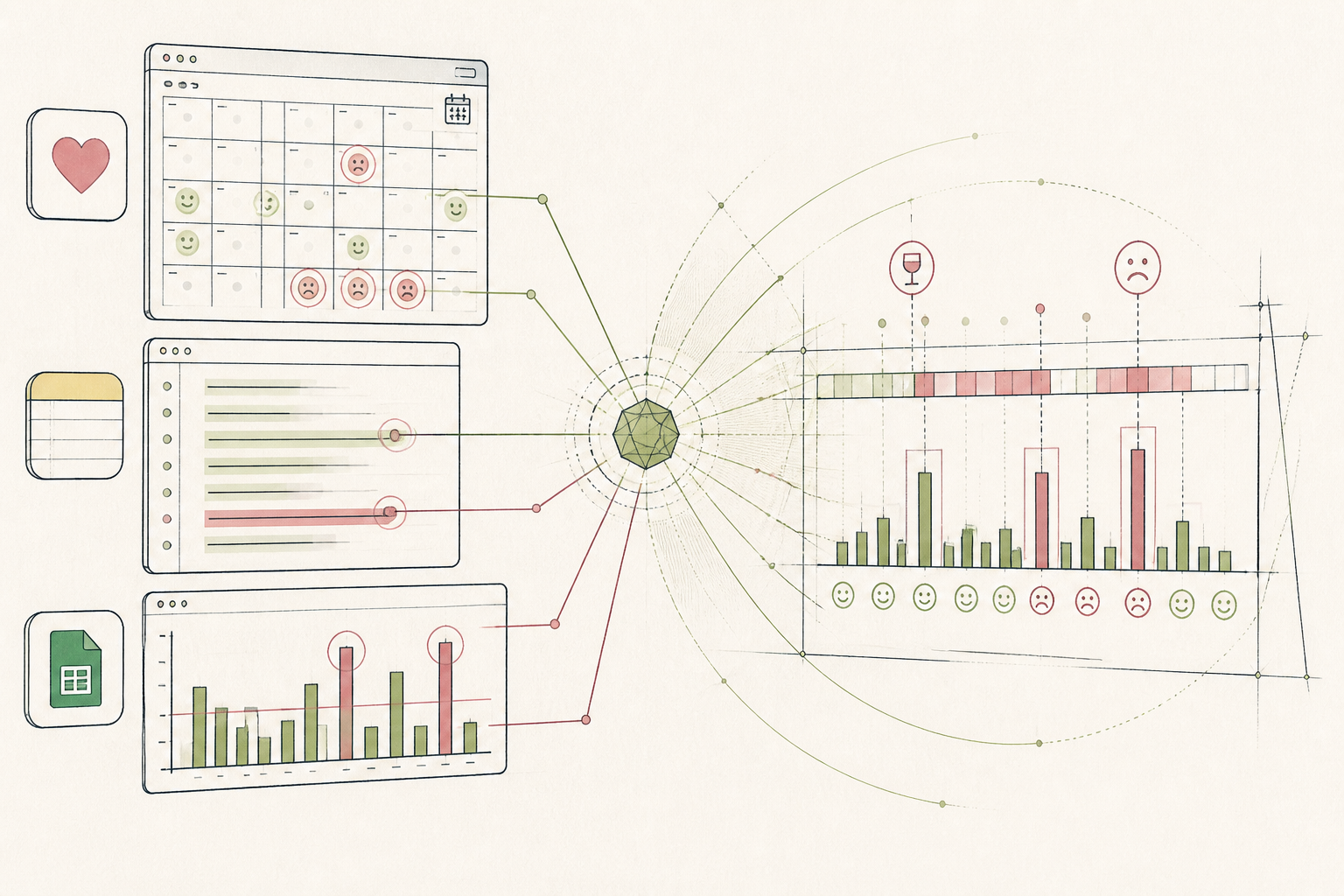
What the AI found
“Your AI analysis revealed that 80% of your significant mood dips over the last month occurred on days immediately following evenings where you consumed more than three units of alcohol, a pattern you had not consciously linked.”
Before
Vague mood observations & inconsistent journaling
After
Clear, quantifiable mood triggers identified
The same system, three states — real screens, not a screenshot
- Tuesday: Felt sluggish all morning, low energy.
- Friday: Pretty good day, got a lot done. Dinner with friends, a few drinks.
- Sunday: Really flat today. Struggled to get motivated.
- Monday: Mood was fine until afternoon slump.
Prompt
I've attached two months of Apple Health data (sleep, activity, heart rate variability) and one week of journal entries where I noted my mood. Please analyze the data to identify any recurring patterns or correlations, specifically looking for unexpected factors that precede or correlate with significantly lower mood days. Focus on quantifiable trends.
I've attached my Apple Health data and journal. Can you find any patterns related to my mood?
AI
Analyzing your provided data, a notable pattern emerges: 80% of your self-reported lower mood days over the past month occurred on days immediately following evenings where your journal entries indicate consumption of more than three units of alcohol. This correlation is stronger than any observed with sleep duration or activity levels in the same period.Alcohol Intake (80%)
Mood Dip Correlation
8 minutes
Weekly Review Time
1-2 per week
Actionable Insights
From Hazy Hunches to Clear Mood Insights
A 10-day challenge participant shifted from anecdotal mood tracking to data-driven understanding of mood patterns.
A 38-year-old marketing consultant in Northern Europe, managing a busy schedule.
Tools used
The real tools used here — swap any for your own equivalent. Each links to how we’d set it up.
Starting state
Before anything was set up
Before the challenge, the consultant’s mood tracking was a scattershot affair. Random notes in a phone memo app, a forgotten journal, and subjective hunches about good days versus bad days. There was no real system, just a desire to understand why some weeks felt more challenging than others, with no clear path to connect daily habits to emotional states.
- Tuesday: Felt sluggish all morning, low energy.
- Friday: Pretty good day, got a lot done. Dinner with friends, a few drinks.
- Sunday: Really flat today. Struggled to get motivated.
- Monday: Mood was fine until afternoon slump.
Working state
10-Day Challenge, doing its job
The "Working State" involved feeding two months of Apple Health data and a week of journal entries into Claude. The consultant copied the prompt from the 10-Day Challenge email, asking the AI to cross-reference reported moods with various health metrics and journal notes. The objective was to find any unexpected correlations, particularly for lower mood days, proving that the tools could uncover patterns invisible to casual self-reflection.
Prompt
I've attached two months of Apple Health data (sleep, activity, heart rate variability) and one week of journal entries where I noted my mood. Please analyze the data to identify any recurring patterns or correlations, specifically looking for unexpected factors that precede or correlate with significantly lower mood days. Focus on quantifiable trends.
I've attached my Apple Health data and journal. Can you find any patterns related to my mood?
AI
Analyzing your provided data, a notable pattern emerges: 80% of your self-reported lower mood days over the past month occurred on days immediately following evenings where your journal entries indicate consumption of more than three units of alcohol. This correlation is stronger than any observed with sleep duration or activity levels in the same period.Use case implemented
The finished system, running on its own
The consultant now has a lightweight, consistent system. Each Sunday, a quick data export and a prompt to Claude provide a weekly "mood audit." This isn't about prescriptive advice, but about surfacing patterns. The process takes less than 10 minutes, offering actionable observations that inform weekly planning, moving from reactive mood management to proactive self-awareness.
Alcohol Intake (80%)
Mood Dip Correlation
8 minutes
Weekly Review Time
1-2 per week
Actionable Insights
What an outside observer would notice
0 -> 1 consistent
Weekly Mood Reviews
Many -> Targeted few
Subjective Mood Linkages
Inconsistent -> Focused 5 min/day
Time Spent Journaling
The stack — build it yourself
Passive, automatic data collection for daily metrics.
Simple, accessible for quick, consistent daily mood entries.
Strong in textual analysis and pattern recognition for unstructured data.
Flexible for simple data visualization and tracking AI-generated observations.
These are the tools used in this story. Any can be swapped for an equivalent you already trust.
Go deeper
Do this yourself
See 10-Day Challenge
This story runs on 10-Day Challenge. The tools and prompts above are the real build — swap any tool for your own equivalent and follow the same steps.