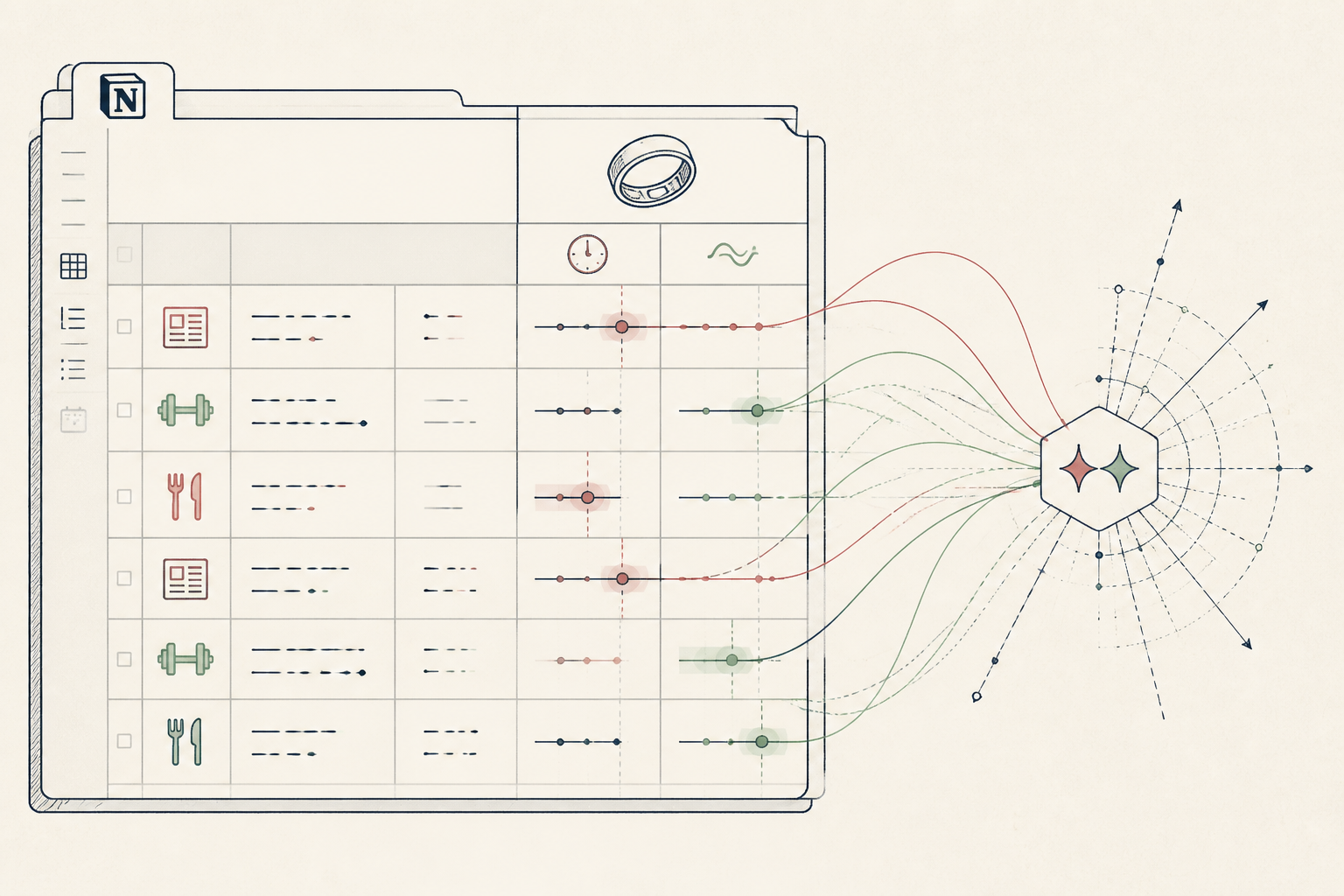
What the AI found
“Your Oura Ring data consistently shows that evenings with over 30 minutes of news consumption before bed correlate with a 15% increase in sleep latency and a 10% decrease in deep sleep duration.”
Before
Unstructured data in multiple apps
After
Clear, actionable sleep insights
The same system, three states — real screens, not a screenshot
| Date | 2023-10-26 |
| Sleep Score | 78 |
| Deep Sleep | 1h 45m |
| REM Sleep | 2h 10m |
Prompt
Analyze the attached Google Sheet containing Oura Ring sleep data and my Notion daily notes (evening activities column). Identify any specific evening activities that consistently correlate with negative impacts on sleep quality metrics like sleep latency and deep sleep duration. Quantify the impact.
Analyze the attached Google Sheet containing Oura Ring sleep data and my Notion daily notes (evening activities column). Identify any specific evening activities that consistently correlate with negative impacts on sleep quality metrics like sleep latency and deep sleep duration. Quantify the impact.
AI
Upon reviewing your data, I've identified a significant correlation: evenings where your Notion notes indicate more than 30 minutes of news consumption before bed show a consistent increase in sleep latency by approximately 15% (from an average of 18 minutes to 20.7 minutes) and a decrease in deep sleep duration by an average of 10% (from 1 hour 50 minutes to 1 hour 39 minutes).82 (↑3 pts)
Sleep Quality Index (7-day avg)
1h 55m (↑6m)
Deep Sleep Duration (7-day avg)
0 min (Past 3 days)
Evening News Consumption
From Haphazard Tracking to Targeted Sleep Improvement
A data analyst uses AI to connect seemingly unrelated daily habits to quantifiable sleep disturbances.
A 34-year-old data analyst, Northern Europe
Tools used
The real tools used here — swap any for your own equivalent. Each links to how we’d set it up.
Starting state
Before anything was set up
Our analyst, let's call her Anna, was meticulous about tracking. Oura Ring for sleep, Notion for daily notes, a Google Sheet for morning mood and energy. The data was all there, but scattered. She suspected screen time affected her sleep, but couldn't pinpoint what kind of screen time, or quantify the impact. Her notes were a jumble of observations, and the spreadsheet merely logged subjective feelings. Connecting the dots felt like a full-time job she didn't have.
| Date | 2023-10-26 |
| Sleep Score | 78 |
| Deep Sleep | 1h 45m |
| REM Sleep | 2h 10m |
| Total Sleep | 7h 20m |
| Latency | 20m |
Working state
Membership, doing its job
Anna exported a month's worth of Oura sleep data and her Notion notes into a Google Sheet. She then used the Wellness & AI Membership to access a prompt in Gemini, asking it to cross-reference her qualitative evening notes with her objective sleep metrics. The AI began to process the raw, unstructured data, searching for patterns and correlations that would reveal specific influences on her sleep quality. This wasn't just about identifying a trend; it was about quantifying the impact of her evening routines.
Prompt
Analyze the attached Google Sheet containing Oura Ring sleep data and my Notion daily notes (evening activities column). Identify any specific evening activities that consistently correlate with negative impacts on sleep quality metrics like sleep latency and deep sleep duration. Quantify the impact.
Analyze the attached Google Sheet containing Oura Ring sleep data and my Notion daily notes (evening activities column). Identify any specific evening activities that consistently correlate with negative impacts on sleep quality metrics like sleep latency and deep sleep duration. Quantify the impact.
AI
Upon reviewing your data, I've identified a significant correlation: evenings where your Notion notes indicate more than 30 minutes of news consumption before bed show a consistent increase in sleep latency by approximately 15% (from an average of 18 minutes to 20.7 minutes) and a decrease in deep sleep duration by an average of 10% (from 1 hour 50 minutes to 1 hour 39 minutes).Use case implemented
The finished system, running on its own
With the insights from Gemini, Anna implemented a simple daily review in Notion. Each morning, a small dashboard updated with a "Sleep Quality Index" alongside a flagged "Evening Activity Impact" if a specific habit had negatively affected her sleep. She now had a clear, evidence-based understanding of what to adjust. The system provided objective feedback, turning vague hunches into concrete adjustments, giving her agency over her sleep without the constant manual data crunching. The AI became her nightly data detective, quietly working in the background.
82 (↑3 pts)
Sleep Quality Index (7-day avg)
1h 55m (↑6m)
Deep Sleep Duration (7-day avg)
0 min (Past 3 days)
Evening News Consumption
What an outside observer would notice
Decreased by 15%
Sleep Latency
Increased by 10%
Deep Sleep Duration
Reduced by 80%
Evening News Consumption
The stack — build it yourself
Provides accurate, passive tracking of key sleep metrics like latency and deep sleep without requiring manual input.
Flexible for unstructured notes on daily habits and acts as a central hub for reviewing AI-generated insights.
Excellent for combining and cleaning data from disparate sources before AI analysis.
Its natural language processing excels at finding patterns and quantifying impacts within mixed qualitative and quantitative datasets.
These are the tools used in this story. Any can be swapped for an equivalent you already trust.
Go deeper
Do this yourself
Explore the full success story
This story runs on Membership. The tools and prompts above are the real build — swap any tool for your own equivalent and follow the same steps.