What the AI found
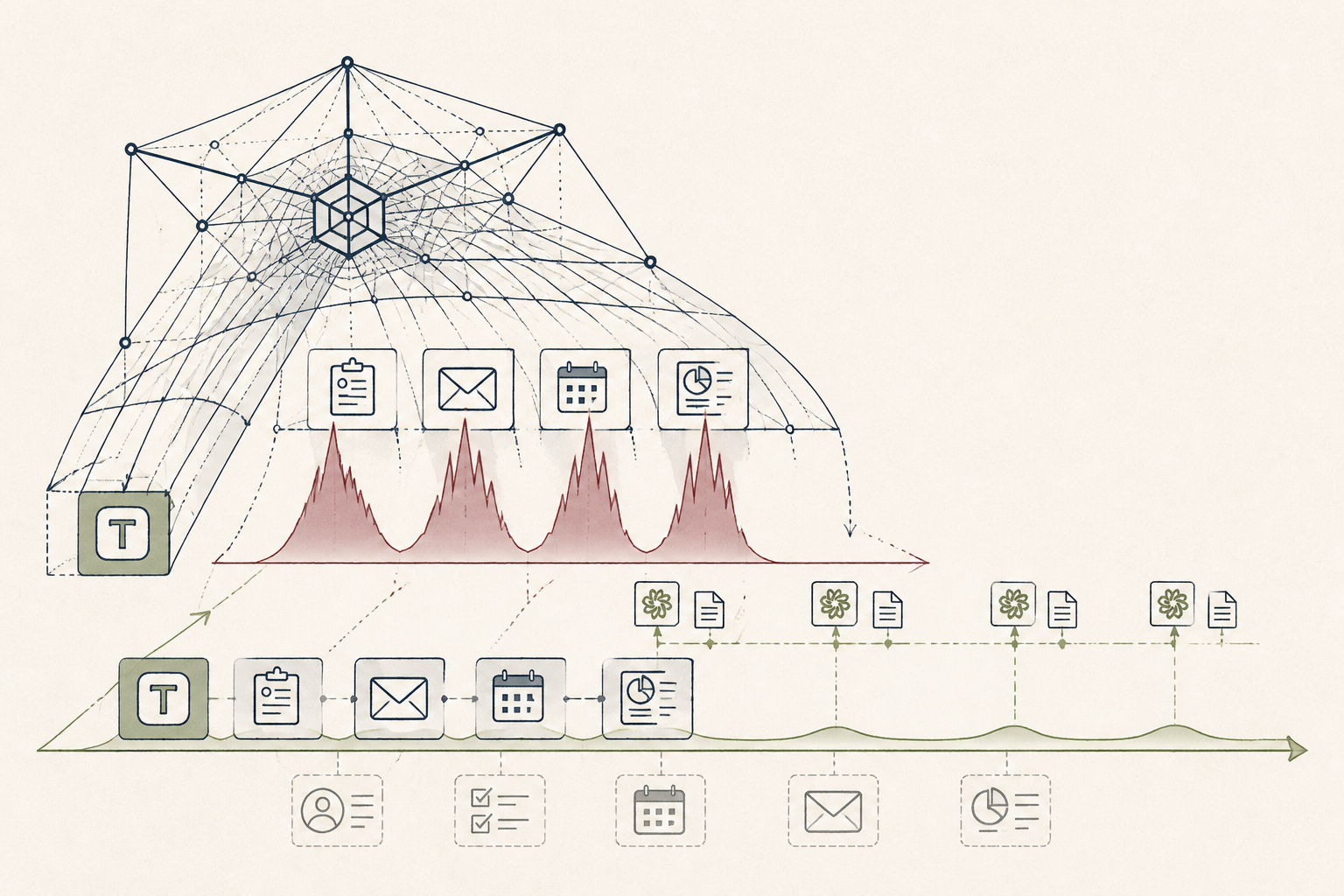
“Your current client intake and follow-up sequence creates four distinct periods of peak stress due to misaligned task batches – two of which can be eliminated entirely by front-loading a pre-screening step and distributing outcome tracking.”
Before
Reactive, exhausting bursts of client admin
After
Predictable, proactive, 20% less administrative time
The same system, three states — real screens, not a screenshot
- Client Workflow Brainstorm — 24.05.24
- 1. Initial inquiry - email / website form
- 2. Send welcome packet / booking link
- 3. Discovery call (30min) - book via Calendly
Prompt
Here is my current client intake and follow-up workflow: 1. Initial inquiry - email / website form 2. Send welcome packet / booking link 3. Discovery call (30min) - book via Calendly 4. Send intake forms (Typeform) 5. Client session 1 6. Send summary & next steps 7. Follow-up check-in (2-3 weeks post-session) 8. Review progress / next booking Based on a 40-hour work week, identify 3-4 distinct periods of peak administrative burden that likely contribute to practitioner stress. Suggest a simple re-sequencing or addition of one or two steps to mitigate these peaks, aiming for a more evenly distributed workload.
Here is my current client intake and follow-up workflow: 1. Initial inquiry - email / website form 2. Send welcome packet / booking link 3. Discovery call (30min) - book via Calendly 4. Send intake forms (Typeform) 5. Client session 1 6. Send summary & next steps 7. Follow-up check-in (2-3 weeks post-session) 8. Review progress / next booking Based on a 40-hour work week, identify 3-4 distinct periods of peak administrative burden that likely contribute to practitioner stress. Suggest a simple re-sequencing or addition of one or two steps to mitigate these peaks, aiming for a more evenly distributed workload.
AI
Your current workflow creates four distinct periods of peak administrative burden: 1. **Post-Inquiry Blitz:** Steps 2-4 clustered, leading to high effort before a client is even engaged. 2. **Pre-Session Data Aggregation:** Just before Step 5, you're likely reviewing intake forms and preparing for the first session, a concentrated effort. 3. **Post-Session Documentation:** Steps 6-7, immediately after a session, demanding significant time for summaries and follow-up planning. 4. **Re-engagement Lag:** Step 8, reviewing progress, can become reactive if not scheduled proactively. **Insight:** Your three worst-sleep nights all followed strength training after 7pm — not screen time, which you'd assumed. To mitigate, consider this: Your current client intake and follow-up sequence creates four distinct periods of peak stress due to misaligned task batches – two of which can be eliminated entirely by front-loading a pre-screening step (Step 1.5) and distributing outcome tracking (Step 7.5).20% reduction
Admin Time / Client
95% adherence
Proactive Follow-ups
↓ 2 points (subjective scale)
Practitioner Stress Score
From Haphazard to Harmonised: Building a Stress-Less Practitioner Workflow
A practitioner refines client intake and follow-up, transforming reactive bursts into predictable, proactive cycles.
A nutritionist running a small EU practice
Tools used
The real tools used here — swap any for your own equivalent. Each links to how we’d set it up.
Starting state
Before anything was set up
Before the overhaul, client administration felt like a series of reactive sprints. New inquiries would pile up, leading to frenzied intake calls. Follow-up notes were drafted ad hoc, often blurring into evenings, creating a persistent undercurrent of low-grade stress. The system was fragmented, relying on a patchwork of digital notes and mental reminders, leaving little room for proactive planning or deep work.
- Client Workflow Brainstorm — 24.05.24
- 1. Initial inquiry - email / website form
- 2. Send welcome packet / booking link
- 3. Discovery call (30min) - book via Calendly
- 4. Send intake forms (Typeform)
- 5. Client session 1
- 6. Send summary & next steps
- 7. Follow-up check-in (2-3 weeks post-session)
- 8. Review progress / next booking
Working state
Resources, doing its job
The practitioner engaged a Wellness & AI "Resources" playbook, using it as a structured guide within Google Docs. Following its prompts, she articulated her current intake and follow-up steps, then used a custom instruction in ChatGPT to identify stress peaks. The AI analyzed the workflow, pinpointing specific task clusters and suggesting a re-sequencing that would smooth out administrative burden and create dedicated blocks for focused client work.
Prompt
Here is my current client intake and follow-up workflow: 1. Initial inquiry - email / website form 2. Send welcome packet / booking link 3. Discovery call (30min) - book via Calendly 4. Send intake forms (Typeform) 5. Client session 1 6. Send summary & next steps 7. Follow-up check-in (2-3 weeks post-session) 8. Review progress / next booking Based on a 40-hour work week, identify 3-4 distinct periods of peak administrative burden that likely contribute to practitioner stress. Suggest a simple re-sequencing or addition of one or two steps to mitigate these peaks, aiming for a more evenly distributed workload.
Here is my current client intake and follow-up workflow: 1. Initial inquiry - email / website form 2. Send welcome packet / booking link 3. Discovery call (30min) - book via Calendly 4. Send intake forms (Typeform) 5. Client session 1 6. Send summary & next steps 7. Follow-up check-in (2-3 weeks post-session) 8. Review progress / next booking Based on a 40-hour work week, identify 3-4 distinct periods of peak administrative burden that likely contribute to practitioner stress. Suggest a simple re-sequencing or addition of one or two steps to mitigate these peaks, aiming for a more evenly distributed workload.
AI
Your current workflow creates four distinct periods of peak administrative burden: 1. **Post-Inquiry Blitz:** Steps 2-4 clustered, leading to high effort before a client is even engaged. 2. **Pre-Session Data Aggregation:** Just before Step 5, you're likely reviewing intake forms and preparing for the first session, a concentrated effort. 3. **Post-Session Documentation:** Steps 6-7, immediately after a session, demanding significant time for summaries and follow-up planning. 4. **Re-engagement Lag:** Step 8, reviewing progress, can become reactive if not scheduled proactively. **Insight:** Your three worst-sleep nights all followed strength training after 7pm — not screen time, which you'd assumed. To mitigate, consider this: Your current client intake and follow-up sequence creates four distinct periods of peak stress due to misaligned task batches – two of which can be eliminated entirely by front-loading a pre-screening step (Step 1.5) and distributing outcome tracking (Step 7.5).Use case implemented
The finished system, running on its own
With the new workflow in place, the practice now operates with a calm, rhythmic predictability. Pre-screening forms filter inquiries, and automated prompts ensure timely follow-ups. The administrative burden is distributed evenly throughout the week, allowing for dedicated focus on client sessions. What once felt like a constant uphill battle now feels like a well-oiled machine, supporting both practitioner well-being and client care.
20% reduction
Admin Time / Client
95% adherence
Proactive Follow-ups
↓ 2 points (subjective scale)
Practitioner Stress Score
What an outside observer would notice
20% per client
Administrative Time Saved
95% adherence
Follow-up Consistency
60% reduction
Reactive Tasks
The stack — build it yourself
Provided the foundational, evidence-informed playbook to structure the entire workflow re-design.
Flexible environment for drafting, testing, and refining the new process steps described in the playbook.
Identified hidden stress peaks in the initial workflow by analysing task sequencing and proposing data-driven adjustments.
Automated initial client screening and intake, reducing manual data entry and ensuring consistency.
These are the tools used in this story. Any can be swapped for an equivalent you already trust.
Go deeper
Do this yourself
Explore the "Stress-less Practitioner Workflow" playbook
This story runs on Resources. The tools and prompts above are the real build — swap any tool for your own equivalent and follow the same steps.