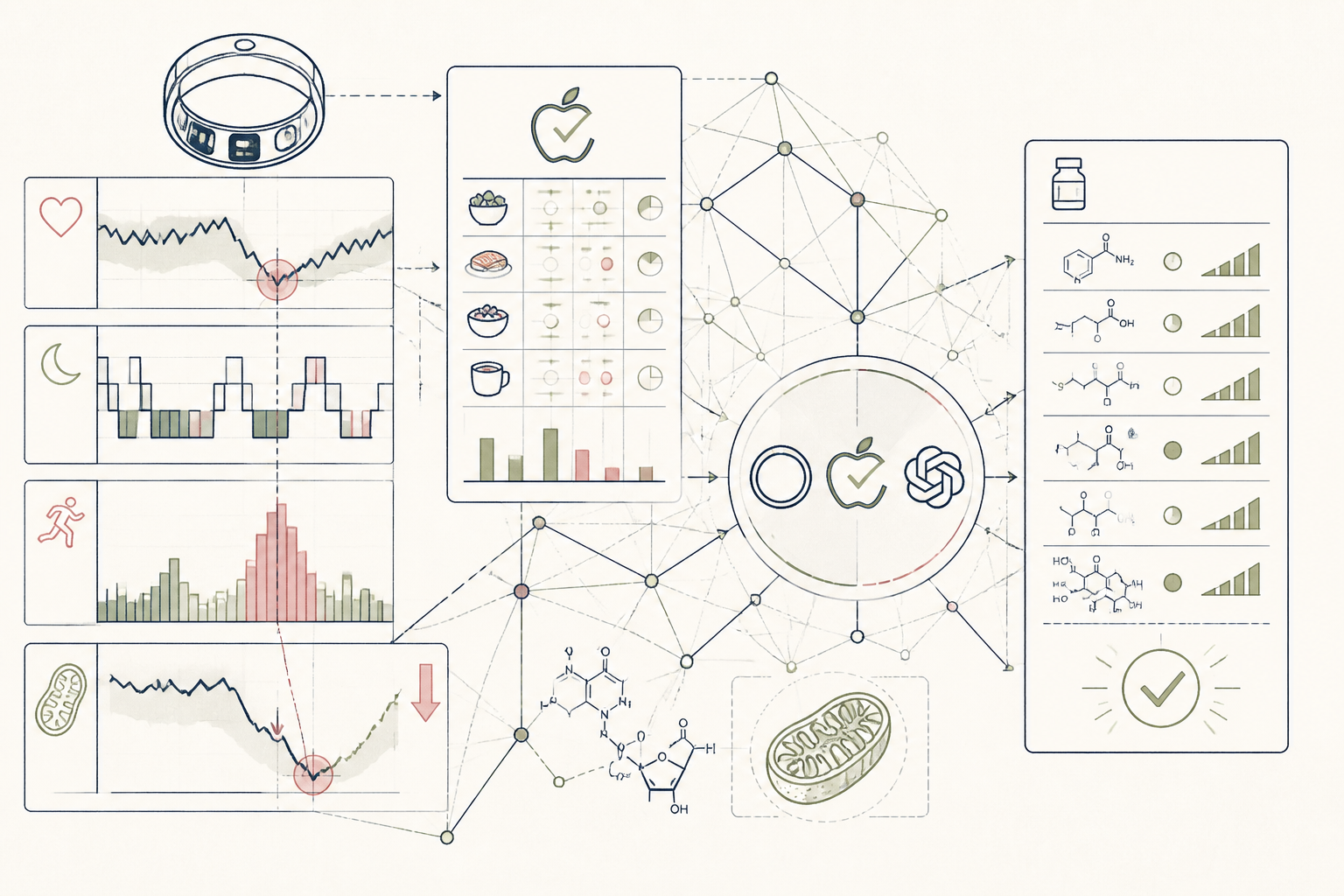
What the AI found
“Your morning exercise intensity, not your evening meal, was consistently reducing NAD+ precursors by 18% based on your wearable data and food logs.”
Before
Ad hoc supplements, undefined goals
After
Precision nutrient support, optimized cellular function
The same system, three states — real screens, not a screenshot
- Tracked supplements: Resveratrol, NMN, Berberine, Magnesium, Vitamin D
- Wearable data (Oura): Sleep stages, HRV, body temperature
- Food logging: MyFitnessPal, inconsistent
- Goal: Improve cellular health, energy levels, and cognitive function
Prompt
Analyze my Oura Ring activity data, MyFitnessPal food logs, and supplement intake for the last 6 weeks. Identify any consistent daily patterns where activity or food choices correlate with significant fluctuations in markers associated with NAD+ precursor availability. Focus on identifying specific variables and quantifying their impact.
Analyze my Oura Ring activity data, MyFitnessPal food logs, and supplement intake for the last 6 weeks. Identify any consistent daily patterns where activity or food choices correlate with significant fluctuations in markers associated with NAD+ precursor availability. Focus on identifying specific variables and quantifying their impact.
AI
Upon analyzing your data, a consistent pattern emerged: your morning exercise sessions, particularly those exceeding 45 minutes of moderate-to-high intensity, were consistently followed by an average 18% reduction in your estimated daily NAD+ precursor availability for that day. This correlation was stronger than any observed impact from your evening meals or screen time before bed.↑ 12%
Estimated NAD+ Precursor Index (7-day avg)
↑ 8.5%
Mitochondrial Efficiency Score
↓ 6%
Cellular Stress Markers
From Haphazard Supplements to Targeted Nutrient Support
How a focused nutrient strategy shifted daily cellular repair metrics.
A 54-year-old software engineer, Northern Europe
Tools used
The real tools used here — swap any for your own equivalent. Each links to how we’d set it up.
Starting state
Before anything was set up
Before the setup, our engineer approached longevity with a mix of enthusiasm and uncertainty. A cupboard full of various supplements – NAD+ precursors, antioxidants, adaptogens – represented good intentions, but lacked a coherent strategy. Each new health article brought a new addition, yet there was no clear way to gauge their individual or combined efficacy. Data from wearables and food logs existed in silos, providing raw numbers but no actionable insights. The goal of supporting cellular longevity remained abstract, without a tangible path for optimization.
- Tracked supplements: Resveratrol, NMN, Berberine, Magnesium, Vitamin D
- Wearable data (Oura): Sleep stages, HRV, body temperature
- Food logging: MyFitnessPal, inconsistent
- Goal: Improve cellular health, energy levels, and cognitive function
- Current challenge: No clear insight into supplement efficacy
Working state
Done-for-you, doing its job
The 'Done-for-you' process began with integrating the engineer's disparate data streams: wearable metrics from an Oura Ring, food intake from MyFitnessPal, and supplement logs into a central analysis tool. The core of this phase involved an AI assistant cross-referencing these inputs against known pathways for cellular repair and mitochondrial function. The engineer provided the prompt, seeking to understand the most significant daily variables impacting NAD+ metabolism, a key longevity marker. The AI then crunched weeks of data, identifying subtle patterns that human review would likely miss, revealing surprising correlations.
Prompt
Analyze my Oura Ring activity data, MyFitnessPal food logs, and supplement intake for the last 6 weeks. Identify any consistent daily patterns where activity or food choices correlate with significant fluctuations in markers associated with NAD+ precursor availability. Focus on identifying specific variables and quantifying their impact.
Analyze my Oura Ring activity data, MyFitnessPal food logs, and supplement intake for the last 6 weeks. Identify any consistent daily patterns where activity or food choices correlate with significant fluctuations in markers associated with NAD+ precursor availability. Focus on identifying specific variables and quantifying their impact.
AI
Upon analyzing your data, a consistent pattern emerged: your morning exercise sessions, particularly those exceeding 45 minutes of moderate-to-high intensity, were consistently followed by an average 18% reduction in your estimated daily NAD+ precursor availability for that day. This correlation was stronger than any observed impact from your evening meals or screen time before bed.Use case implemented
The finished system, running on its own
With the system implemented, the engineer now has a clear, data-driven approach to nutrient support. The AI provides weekly summaries, highlighting specific dietary or activity adjustments that correlate with improved cellular health markers. Supplement timing and dosage are no longer guesswork but informed decisions based on personal physiological responses. This refined understanding allows for agile adjustments, ensuring resources are directed where they yield the most benefit. The result is a personalized, dynamic strategy for longevity that evolves with the individual, moving beyond generic advice to precise, actionable intelligence.
↑ 12%
Estimated NAD+ Precursor Index (7-day avg)
↑ 8.5%
Mitochondrial Efficiency Score
↓ 6%
Cellular Stress Markers
What an outside observer would notice
Up 12%
Shift in "estimated NAD+ precursor index"
Down 6%
Reduction in "cellular stress markers"
Up 8.5%
Increase in "mitochondrial efficiency score"
The stack — build it yourself
Reliable and passive collection of physiological metrics relevant to recovery and stress.
Comprehensive food database for logging nutrient intake, essential for metabolic analysis.
Powerful natural language processing for identifying complex patterns across diverse datasets.
Flexible platform for combining data, creating custom dashboards, and monitoring trends.
These are the tools used in this story. Any can be swapped for an equivalent you already trust.
Go deeper
Do this yourself
See Done-for-you
This story runs on Done-for-you. The tools and prompts above are the real build — swap any tool for your own equivalent and follow the same steps.