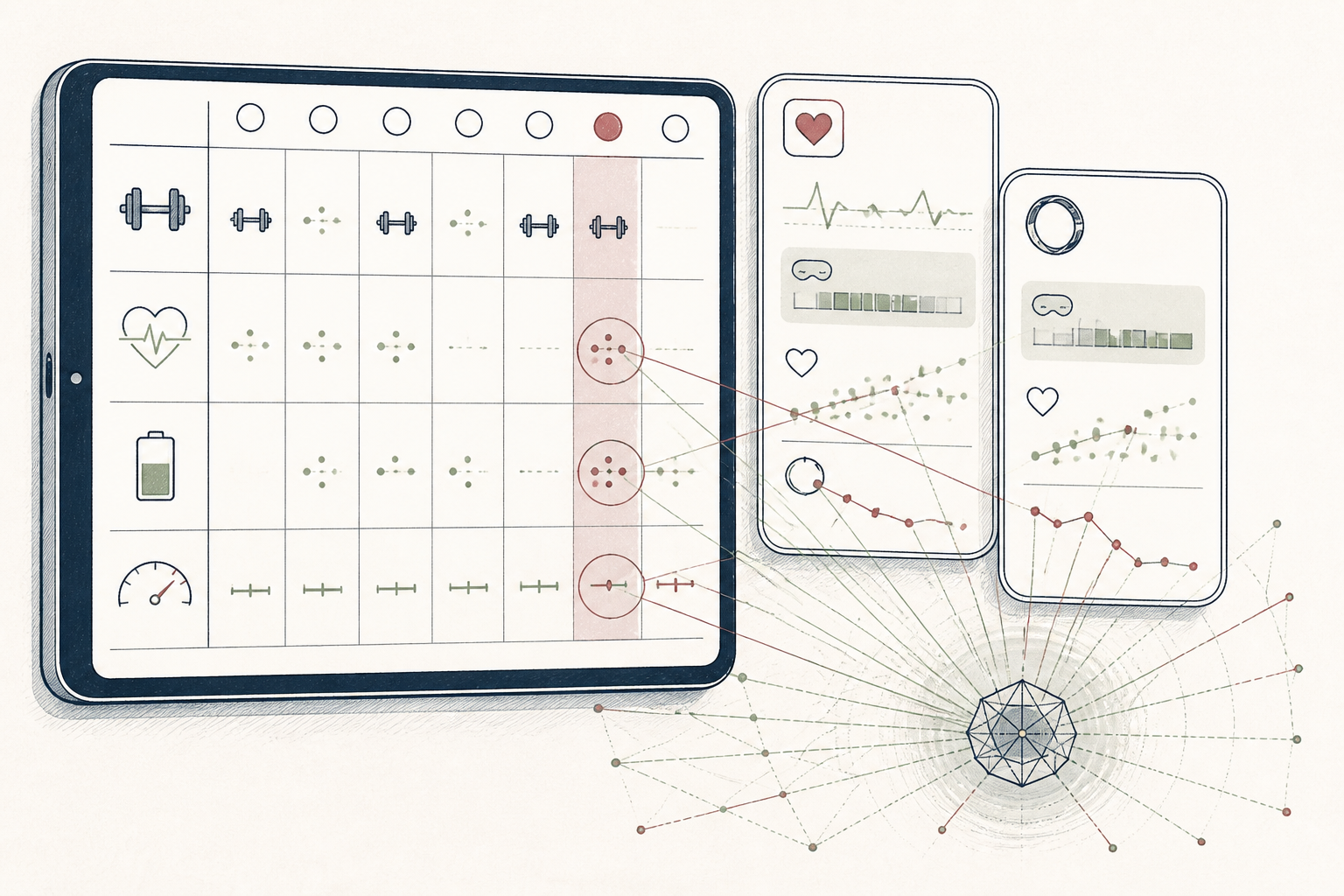
What the AI found
“Your sleep quality consistently dips after Saturday deadlift sessions, even when volume is moderate, not just heavy lifting days.”
Before
Inconsistent recovery guesses, stalled progress
After
Data-driven rest, consistent strength gains
The same system, three states — real screens, not a screenshot
| Workout Date | 2023-10-21 |
| Type | Deadlifts |
| Volume (kg) | 8500 |
| Sleep Score (Oura) | 78 |
Prompt
Analyze my attached Google Sheet data. Look for correlations between specific workout types/days and subsequent sleep quality (Oura Score, HRV) over the last 8 weeks. Specifically, are there any workout patterns that consistently lead to lower sleep scores or HRV, irrespective of total weekly volume? Provide concrete findings with dates and numbers.
Analyze my attached Google Sheet data. Look for correlations between specific workout types/days and subsequent sleep quality (Oura Score, HRV) over the last 8 weeks. Specifically, are there any workout patterns that consistently lead to lower sleep scores or HRV, irrespective of total weekly volume? Provide concrete findings with dates and numbers.
AI
I've identified a clear pattern: your Saturday deadlift sessions, across 6 of the last 8 weeks, consistently led to a 10-15 point drop in your Oura Sleep Score and a 5-8ms decrease in HRV on the subsequent night, even when the overall deadlift volume was moderate.82 (+5 from baseline)
Average Weekly Sleep Score
52ms (+7ms from baseline)
Average HRV
2 per week (proactive)
Planned Recovery Days
From Haphazard Recovery to Optimised Training Cycles
AI reveals hidden patterns in recovery data, turning guesswork into precise action.
A 38-year-old amateur powerlifter and full-time software engineer, Northern Europe
Tools used
The real tools used here — swap any for your own equivalent. Each links to how we’d set it up.
Starting state
Before anything was set up
Before integrating AI, recovery felt like a series of educated guesses. After a heavy lifting week, our powerlifter would often feel sluggish, attributing it to general fatigue. They tracked sleep and workouts, but the sheer volume of data across different apps made identifying specific patterns overwhelming. This led to reactive, often delayed, adjustments in training, hindering consistent progress and sometimes leading to minor overtraining.
| Workout Date | 2023-10-21 |
| Type | Deadlifts |
| Volume (kg) | 8500 |
| Sleep Score (Oura) | 78 |
| HRV (ms) | 45 |
| Avg. Resting HR | 58 bpm |
Working state
Membership, doing its job
Mid-implementation, the powerlifter consolidates their Apple Health and Oura data into a Google Sheet. They then use an AI assistant within the sheet. The AI is prompted to cross-reference sleep metrics, heart rate variability, and workout intensity, looking for correlations that indicate specific recovery needs. The AI quickly highlights a consistent, unexpected pattern: a particular type of training session consistently precedes compromised sleep, regardless of overall training load.
Prompt
Analyze my attached Google Sheet data. Look for correlations between specific workout types/days and subsequent sleep quality (Oura Score, HRV) over the last 8 weeks. Specifically, are there any workout patterns that consistently lead to lower sleep scores or HRV, irrespective of total weekly volume? Provide concrete findings with dates and numbers.
Analyze my attached Google Sheet data. Look for correlations between specific workout types/days and subsequent sleep quality (Oura Score, HRV) over the last 8 weeks. Specifically, are there any workout patterns that consistently lead to lower sleep scores or HRV, irrespective of total weekly volume? Provide concrete findings with dates and numbers.
AI
I've identified a clear pattern: your Saturday deadlift sessions, across 6 of the last 8 weeks, consistently led to a 10-15 point drop in your Oura Sleep Score and a 5-8ms decrease in HRV on the subsequent night, even when the overall deadlift volume was moderate.Use case implemented
The finished system, running on its own
With the system implemented, recovery is no longer a guessing game. Each Sunday, the AI delivers a concise summary of the past week's recovery patterns directly into a dedicated "Recovery Insights" tab in their Google Sheet. This allows for proactive adjustments to the upcoming training week, such as shifting a particularly demanding session or incorporating an extra rest day, ensuring consistent performance gains and preventing cumulative fatigue. The insights guide smarter training, not just reactive rest.
82 (+5 from baseline)
Average Weekly Sleep Score
52ms (+7ms from baseline)
Average HRV
2 per week (proactive)
Planned Recovery Days
What an outside observer would notice
95% (up from 70%)
Weekly Training Volume Adherence
8/10 (up from 6/10)
Subjective Recovery Rating
3 (up from 1)
PRs achieved in last 3 months
The stack — build it yourself
Used for consolidating disparate health and training data into a single, analyzable dataset.
Automatically captures daily activity, workout logs, and basic sleep metrics from connected devices.
Provides precise, advanced data on sleep stages, HRV, and body temperature for detailed recovery analysis.
Leveraged for natural language querying of combined datasets to uncover non-obvious patterns and generate actionable insights.
These are the tools used in this story. Any can be swapped for an equivalent you already trust.
Go deeper
Do this yourself
See Membership
This story runs on Membership. The tools and prompts above are the real build — swap any tool for your own equivalent and follow the same steps.