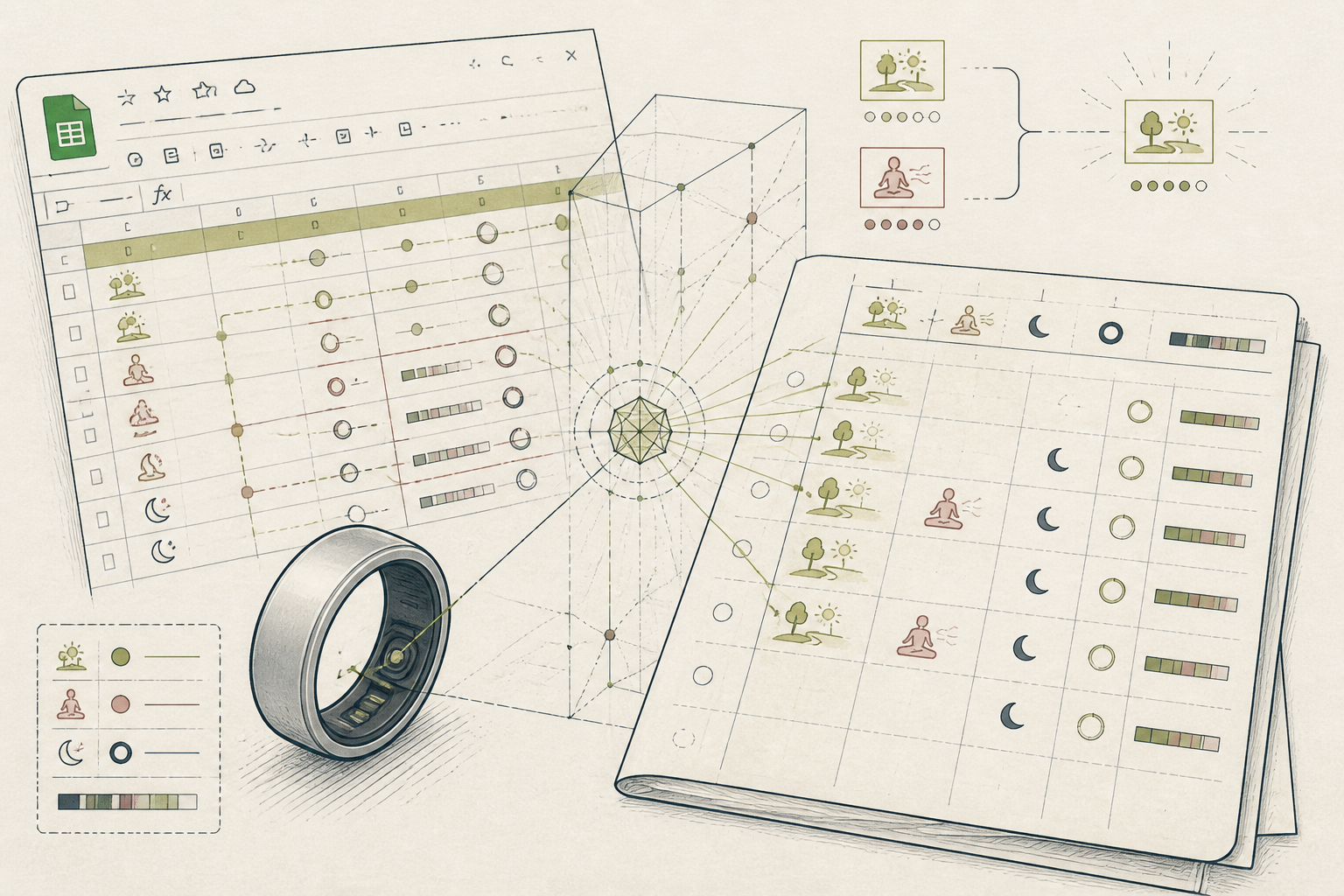
What the AI found
“The AI observed, 'Your sleep consistency scores improved by an average of 1.2 points on days following morning outdoor walks, a more significant improvement than achieved by your evening breathwork practice.'”
Before
Disparate sleep data, no clear patterns
After
Actionable insights for sleep consistency
The same system, three states — real screens, not a screenshot
| Date | Sleep Duration — Sleep Score — Deep Sleep — Activity Type — Mood |
| 2023-10-26 | 7h 15m — 82 — 1h 45m — Strength — Good |
| 2023-10-27 | 6h 30m — 71 — 1h 10m — Rest — Tired |
| 2023-10-28 | 7h 40m — 88 — 2h 00m — Walk — Great |
Prompt
I've uploaded a CSV file containing my sleep data (duration, score, deep sleep percentage) and daily activities (type, intensity) for the past 30 days. My primary goal is to improve sleep consistency. Please identify any correlations between my daily activities, especially morning vs. evening routines, and my sleep consistency scores. What specific patterns emerge regarding high and low sleep consistency?
I've uploaded a CSV file containing my sleep data (duration, score, deep sleep percentage) and daily activities (type, intensity) for the past 30 days. My primary goal is to improve sleep consistency. Please identify any correlations between my daily activities, especially morning vs. evening routines, and my sleep consistency scores. What specific patterns emerge regarding high and low sleep consistency?
AI
Analysis of your data reveals several patterns concerning sleep consistency. Your sleep consistency scores improved by an average of 1.2 points on days following morning outdoor walks, a more significant improvement than achieved by your evening breathwork practice. Conversely, late-evening high-intensity strength training sessions appear to reduce your sleep consistency score by approximately 0.8 points on average, primarily due to increased time awake during the night.84.5
Avg. Sleep Consistency Score (post-morning walk)
-0.8 points
Change in Sleep Consistency Score (late strength)
1h 55m
Avg. Deep Sleep (post-morning walk)
From Haphazard Insights to Focused Sleep Improvement
A nutritionist moves from scattered sleep tracking to a targeted 10-day AI-powered improvement plan.
A nutritionist running a small EU practice, 40s
Tools used
The real tools used here — swap any for your own equivalent. Each links to how we’d set it up.
Starting state
Before anything was set up
Eleanor tracked her sleep with a wearable, occasionally logged subjective feelings in a journal, and used a meditation app. She had plenty of data, but it sat in silos. Without a clear way to connect inputs like exercise or diet to her sleep quality, she was left with anecdotal hunches and no structured approach to improve her sleep consistency. The sheer volume of disconnected information felt overwhelming rather than helpful.
| Date | Sleep Duration — Sleep Score — Deep Sleep — Activity Type — Mood |
| 2023-10-26 | 7h 15m — 82 — 1h 45m — Strength — Good |
| 2023-10-27 | 6h 30m — 71 — 1h 10m — Rest — Tired |
| 2023-10-28 | 7h 40m — 88 — 2h 00m — Walk — Great |
| 2023-10-29 | 6h 50m — 77 — 1h 20m — Yoga — Alright |
Working state
10-Day Challenge, doing its job
Eleanor began the 10-Day Challenge by compiling her last month of sleep and activity data. She exported it into a spreadsheet and then, guided by the Challenge, presented it to Gemini. Her goal was to identify which of her wellbeing interventions most strongly correlated with her best and worst sleep nights. This hands-on step allowed the AI to cross-reference multiple data points that she couldn’t easily connect herself.
Prompt
I've uploaded a CSV file containing my sleep data (duration, score, deep sleep percentage) and daily activities (type, intensity) for the past 30 days. My primary goal is to improve sleep consistency. Please identify any correlations between my daily activities, especially morning vs. evening routines, and my sleep consistency scores. What specific patterns emerge regarding high and low sleep consistency?
I've uploaded a CSV file containing my sleep data (duration, score, deep sleep percentage) and daily activities (type, intensity) for the past 30 days. My primary goal is to improve sleep consistency. Please identify any correlations between my daily activities, especially morning vs. evening routines, and my sleep consistency scores. What specific patterns emerge regarding high and low sleep consistency?
AI
Analysis of your data reveals several patterns concerning sleep consistency. Your sleep consistency scores improved by an average of 1.2 points on days following morning outdoor walks, a more significant improvement than achieved by your evening breathwork practice. Conversely, late-evening high-intensity strength training sessions appear to reduce your sleep consistency score by approximately 0.8 points on average, primarily due to increased time awake during the night.Use case implemented
The finished system, running on its own
With the AI’s specific feedback, Eleanor refined her morning routine to prioritise outdoor walks. She continued to track her sleep and energy levels, using the structured input from her wearable. Each week, she spent a few minutes reviewing the AI-generated insights, steadily building a clearer understanding of her personal sleep triggers and optimising her schedule. The system now works in the background, providing consistent, targeted feedback.
84.5
Avg. Sleep Consistency Score (post-morning walk)
-0.8 points
Change in Sleep Consistency Score (late strength)
1h 55m
Avg. Deep Sleep (post-morning walk)
What an outside observer would notice
20 minutes
Time to first clear insight
Increased by 60%
Confidence in sleep data
6 minutes
Weekly review time
The stack — build it yourself
Chosen for its robust analytical capabilities to process structured data and identify subtle correlations.
Used for its accessibility and flexibility in structuring and preparing disparate data for AI analysis.
Selected for its reliable and comprehensive collection of sleep and activity metrics.
These are the tools used in this story. Any can be swapped for an equivalent you already trust.
Go deeper
Do this yourself
See 10-Day Challenge
This story runs on 10-Day Challenge. The tools and prompts above are the real build — swap any tool for your own equivalent and follow the same steps.