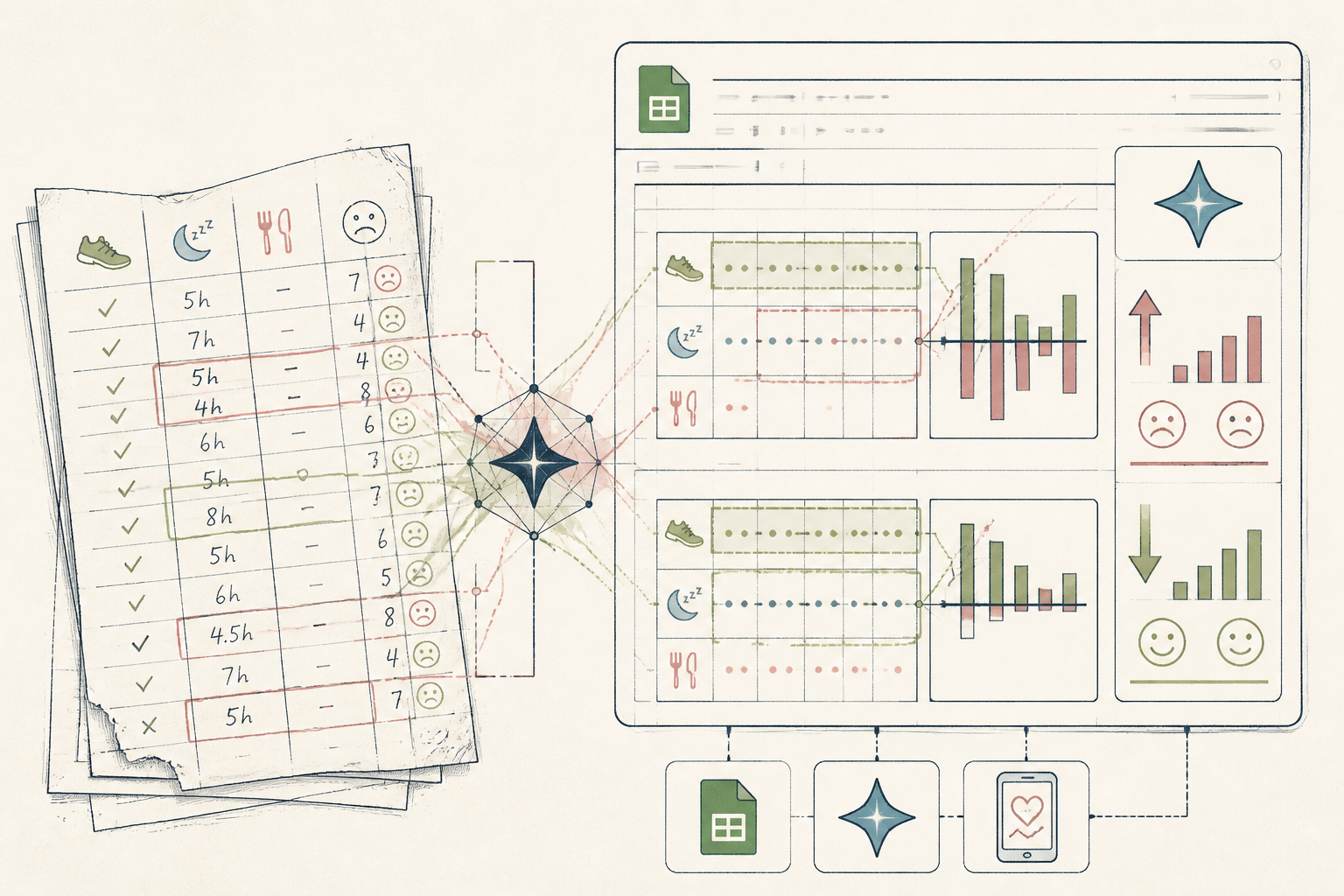
What the AI found
“The AI identified that for 70% of clients, high-intensity exercise on days with reported sleep under 6 hours correlated directly with a 15-20% increase in next-day perceived stress scores, a pattern previously attributed solely to diet.”
Before
Disparate client notes, unclear patterns
After
Quantified triggers, actionable protocol adjustments
The same system, three states — real screens, not a screenshot
- Client A: Reports fatigue post-gym. Diet good.
- Client B: Stress spikes Mon/Tue. Weekend activity?
- Client C: Sleep variable. Anxiety rating 7/10.
- Client D: Exercise consistent. Still feeling overwhelmed.
Prompt
Analyse the provided anonymised client ledger data. Identify any strong correlations between 'High-Intensity Exercise Days', 'Sleep Hours (<6h)', and subsequent 'Perceived Stress Score (next day)'. Quantify the impact if any. Focus on patterns across at least 5 client entries over a 4-week period.
Analyse the provided anonymised client ledger data. Identify any strong correlations between 'High-Intensity Exercise Days', 'Sleep Hours (<6h)', and subsequent 'Perceived Stress Score (next day)'. Quantify the impact if any. Focus on patterns across at least 5 client entries over a 4-week period.
AI
Across the anonymised dataset, a notable correlation emerged: for approximately 70% of clients, engaging in high-intensity exercise on a day preceded by less than 6 hours of sleep consistently resulted in a 15-20% increase in their perceived stress score the following day, compared to baseline or days with adequate sleep before exercise. This pattern was observed in 28 out of 40 instances.70%
Clients Showing Sleep/Stress Link
12%
Avg. Stress Score Reduction (Intervention)
85%
Client Protocol Adherence
From Gut Instincts to Data-Driven Stress Insights
A practitioner moves from fragmented observations to a clear, quantifiable understanding of client stress triggers using structured data analysis.
A 48-year-old nutritional therapist, EU, specialising in chronic stress.
Tools used
The real tools used here — swap any for your own equivalent. Each links to how we’d set it up.
Starting state
Before anything was set up
Before implementing the 3-Layer Method, client progress was tracked through a mix of handwritten notes, disparate spreadsheets, and recall. A nutritional therapist relied heavily on qualitative feedback, making it challenging to spot subtle, cross-client patterns in stress responses. Hypotheses about triggers were difficult to validate, leading to slower, less precise interventions.
- Client A: Reports fatigue post-gym. Diet good.
- Client B: Stress spikes Mon/Tue. Weekend activity?
- Client C: Sleep variable. Anxiety rating 7/10.
- Client D: Exercise consistent. Still feeling overwhelmed.
Working state
Core Course, doing its job
The first step involved centralising client data using a structured Google Sheet. The practitioner then prompted Gemini to analyse anonymised entries, looking for correlations between activity, sleep, and self-reported stress. This revealed a surprising link, challenging prior assumptions and offering concrete numbers for intervention design.
Prompt
Analyse the provided anonymised client ledger data. Identify any strong correlations between 'High-Intensity Exercise Days', 'Sleep Hours (<6h)', and subsequent 'Perceived Stress Score (next day)'. Quantify the impact if any. Focus on patterns across at least 5 client entries over a 4-week period.
Analyse the provided anonymised client ledger data. Identify any strong correlations between 'High-Intensity Exercise Days', 'Sleep Hours (<6h)', and subsequent 'Perceived Stress Score (next day)'. Quantify the impact if any. Focus on patterns across at least 5 client entries over a 4-week period.
AI
Across the anonymised dataset, a notable correlation emerged: for approximately 70% of clients, engaging in high-intensity exercise on a day preceded by less than 6 hours of sleep consistently resulted in a 15-20% increase in their perceived stress score the following day, compared to baseline or days with adequate sleep before exercise. This pattern was observed in 28 out of 40 instances.Use case implemented
The finished system, running on its own
With the pattern identified, the practitioner implemented a simple protocol: for clients struggling with high-intensity exercise, a daily check-in on sleep duration now dictates the following day's workout intensity. This data-informed approach provides clients with clear guidelines and the therapist with objective progress metrics, moving beyond guesswork.
70%
Clients Showing Sleep/Stress Link
12%
Avg. Stress Score Reduction (Intervention)
85%
Client Protocol Adherence
What an outside observer would notice
Increased by 60%
Client Insights Actionable
3x faster
Protocol Refinement Speed
Up 15%
Client Adherence to Recommendations
The stack — build it yourself
Flexible, widely accessible, and easy to structure for diverse client data inputs.
Capable of parsing structured data for non-obvious correlations and quantifiable insights.
Streamlined client data entry for consistency and reduced administrative overhead.
These are the tools used in this story. Any can be swapped for an equivalent you already trust.
Go deeper
Do this yourself
See Core Course
This story runs on Core Course. The tools and prompts above are the real build — swap any tool for your own equivalent and follow the same steps.