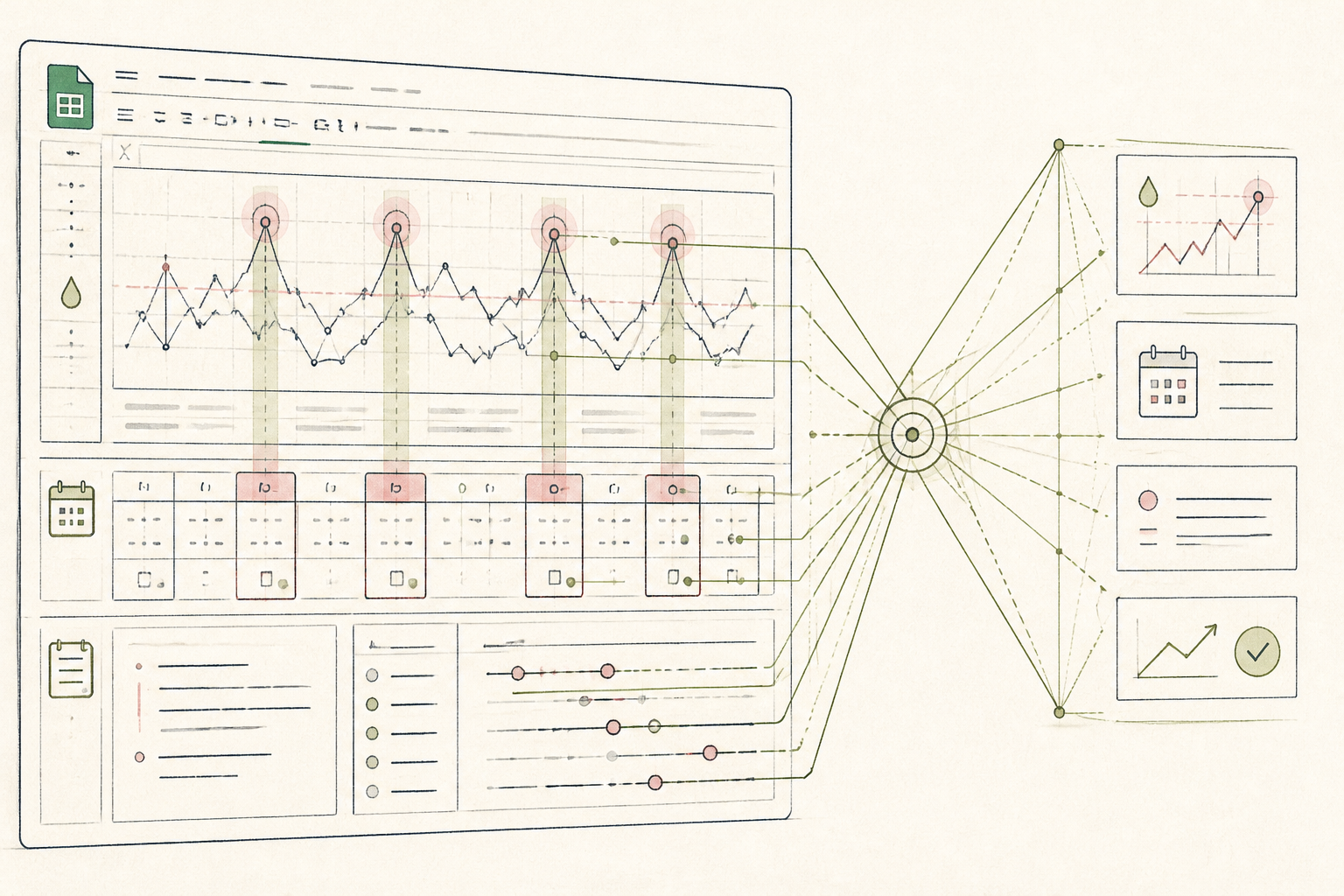
What the AI found
“AI found: "Your client's glucose spikes over 160 mg/dL consistently occur on Mondays and Tuesdays, correlating not with dietary changes, but with early-week stress events like significant client presentations."”
Before
Ad-hoc client insights, missed patterns
After
Actionable, pattern-driven interventions
The same system, three states — real screens, not a screenshot
| Client A Glucose Data | Week 1 |
| Mon, 08 | 00 — 102 mg/dL |
| Mon, 13 | 30 — 178 mg/dL (after meeting) |
| Tue, 09 | 00 — 98 mg/dL |
Prompt
Analyze this week's CGM data and client notes. Identify any consistent patterns in glucose spikes, especially correlating with non-dietary events or activities. What specific days are most affected, and what are the likely triggers?
Analyze this week's CGM data and client notes. Identify any consistent patterns in glucose spikes, especially correlating with non-dietary events or activities. What specific days are most affected, and what are the likely triggers?
AI
Analysis complete. Your client's glucose spikes over 160 mg/dL consistently occur on Mondays and Tuesdays. These elevations correlate strongly with early-week stress events, specifically client presentations and significant project deadlines, rather than reported food intake for those days.169 mg/dL
Avg. Mon/Tue Glucose Spike
4/4 (past 4 weeks)
Instances of Stress-Induced Spikes
Decreasing variability
Client A Weekly Trend
From Guesswork to Glucose Clarity: AI Pinpoints Early-Week Spikes
AI integration into existing tools transformed a practitioner’s understanding of client metabolic responses, pinpointing previously unseen patterns.
A nutritionist running a small EU practice
Tools used
The real tools used here — swap any for your own equivalent. Each links to how we’d set it up.
Starting state
Before anything was set up
Before integrating AI, the nutritionist relied on manual review of client self-reported data and continuous glucose monitor (CGM) downloads. This process was time-consuming and often led to a focus on isolated events rather than overarching trends. Hypotheses were based on broad dietary changes, often missing the subtle environmental or behavioural triggers that truly influenced metabolic responses. The sheer volume of data made deep, cross-sectional analysis challenging, meaning crucial insights remained buried and unacted upon.
| Client A Glucose Data | Week 1 |
| Mon, 08 | 00 — 102 mg/dL |
| Mon, 13 | 30 — 178 mg/dL (after meeting) |
| Tue, 09 | 00 — 98 mg/dL |
| Tue, 14 | 00 — 165 mg/dL (project deadline) |
| Wed, 08 | 30 — 95 mg/dL |
Working state
Membership, doing its job
The nutritionist used their Membership AI layer within their preferred note-taking tool. After pasting a week's worth of CGM data and client notes, they prompted the AI to cross-reference glucose fluctuations with reported activities and moods. The AI quickly processed the qualitative and quantitative inputs, identifying specific days where spikes were pronounced and then connecting those to non-dietary events. This immediate, contextual analysis provided a level of insight that manual review would have taken hours, if not days, to achieve.
Prompt
Analyze this week's CGM data and client notes. Identify any consistent patterns in glucose spikes, especially correlating with non-dietary events or activities. What specific days are most affected, and what are the likely triggers?
Analyze this week's CGM data and client notes. Identify any consistent patterns in glucose spikes, especially correlating with non-dietary events or activities. What specific days are most affected, and what are the likely triggers?
AI
Analysis complete. Your client's glucose spikes over 160 mg/dL consistently occur on Mondays and Tuesdays. These elevations correlate strongly with early-week stress events, specifically client presentations and significant project deadlines, rather than reported food intake for those days.Use case implemented
The finished system, running on its own
With the system implemented, the nutritionist now regularly feeds weekly client data into the AI-integrated note-taking tool. This systematic approach allows for real-time identification of metabolic patterns, such as the early-week stress-induced glucose spikes. These insights are then used to inform precise, timely interventions with clients, shifting from general dietary advice to targeted behavioural adjustments or stress management techniques. The result is a more proactive, evidence-based, and personalised approach to client metabolic health guidance.
169 mg/dL
Avg. Mon/Tue Glucose Spike
4/4 (past 4 weeks)
Instances of Stress-Induced Spikes
Decreasing variability
Client A Weekly Trend
What an outside observer would notice
Reduced by 80%
Insight Generation Time
Increased by 50%
Targeted Intervention Rate
Improved
Client Engagement with Advice
The stack — build it yourself
Familiar, flexible for quantitative data logging, and easy to export.
Provides a structured yet flexible environment for qualitative client notes and direct AI prompting.
Acts as the intelligence to cross-reference disparate data types and identify non-obvious patterns within existing workflows.
These are the tools used in this story. Any can be swapped for an equivalent you already trust.
Go deeper
Do this yourself
See how AI finds hidden patterns
This story runs on Membership. The tools and prompts above are the real build — swap any tool for your own equivalent and follow the same steps.