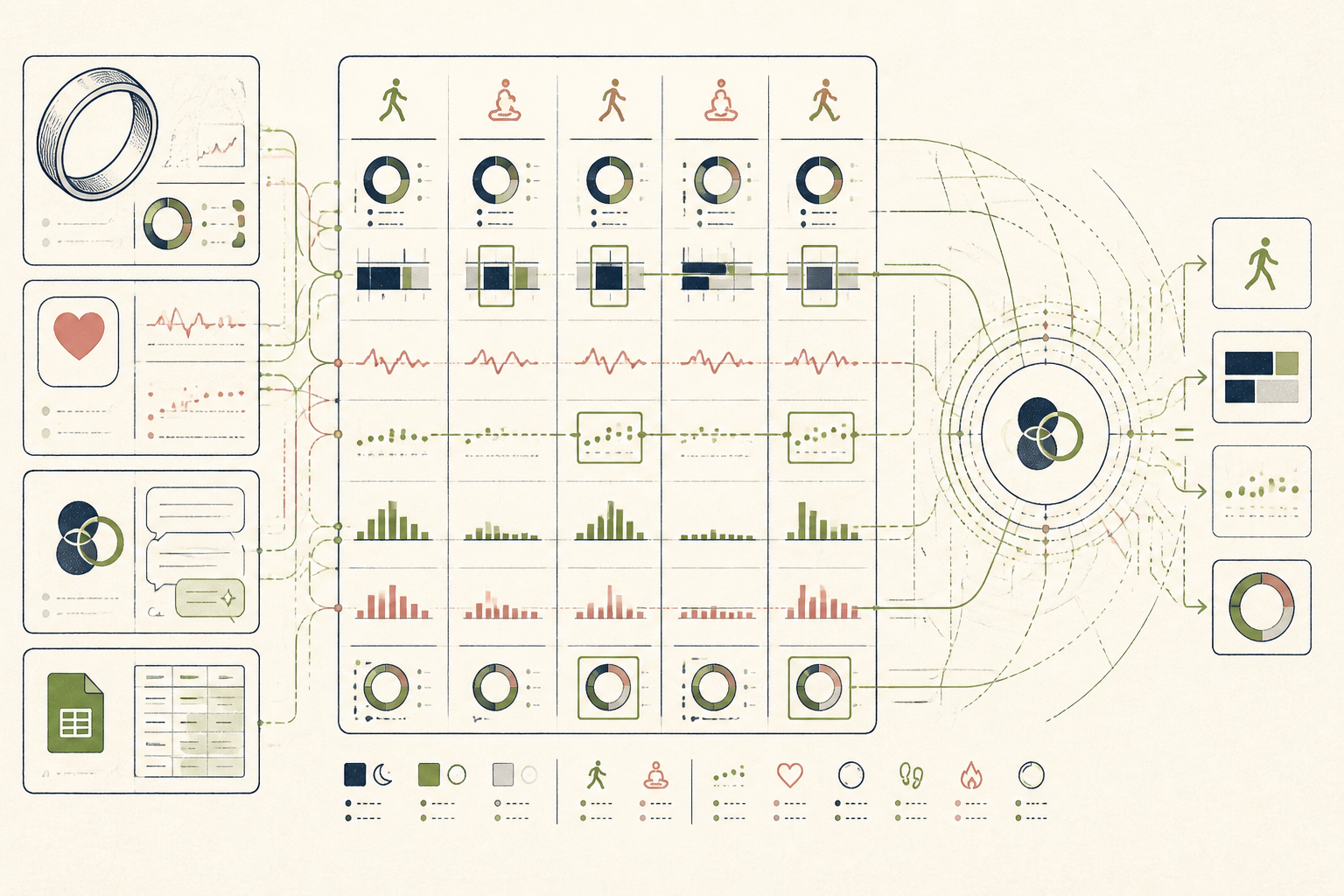
What the AI found
“Your most restorative sleep nights consistently followed days with a 'recovery walk' of at least 45 minutes, even more so than planned rest days, by an average of 18 minutes of deep sleep.”
Before
Disparate data across 4 apps, no clear patterns
After
One consolidated view, clear recovery insights
The same system, three states — real screens, not a screenshot
- Morning energy: 7/10
- Workout: Zone 2 run, 45 min
- Evening: read for an hour, no screens
- Notes on sleep: felt restless at 3 AM
Prompt
Analyze my attached CSV data for the last month. Look for correlations between my daily activities (especially 'recovery walks' and 'strength training') and my sleep quality metrics (deep sleep, REM sleep, total sleep). Highlight any surprising or significant patterns.
Here's my data, can you find connections between activity and sleep?
AI
Your data shows that days with a 'recovery walk' of at least 45 minutes consistently preceded nights with 18 minutes more deep sleep on average than even passive rest days. This correlation was stronger than any other activity type.1 hr 12 min
Average Deep Sleep following Recovery Walk
54 min
Average Deep Sleep following Rest Day
+18 min
Recovery Walk Impact on Deep Sleep
From Fragmented Health Data to a Clear Recovery Signal
A nutritionist integrates disparate health data into a single AI-powered overview, revealing a clear pattern in her recovery.
A nutritionist running a small EU practice, 38
Tools used
The real tools used here — swap any for your own equivalent. Each links to how we’d set it up.
Starting state
Before anything was set up
Chiara, a nutritionist in the EU, tracked her health meticulously across several apps: Oura for sleep, Apple Health for activity, and a custom food log in Google Sheets. Each morning, she’d open them all, hoping a clear pattern in her recovery would emerge from the sea of data. It rarely did. She felt data-rich but insight-poor, spending more time switching apps than understanding her own trends.
- Morning energy: 7/10
- Workout: Zone 2 run, 45 min
- Evening: read for an hour, no screens
- Notes on sleep: felt restless at 3 AM
Working state
10-Day Challenge, doing its job
The 10-Day Challenge guided Chiara to consolidate her data. After exporting a month of sleep, activity, and dietary notes, she used Gemini to cross-reference them. The key was a specific prompt designed to connect her subjective recovery notes with objective biometric data. This step, which took about 15 minutes, transformed raw data points into a coherent narrative about her recovery.
Prompt
Analyze my attached CSV data for the last month. Look for correlations between my daily activities (especially 'recovery walks' and 'strength training') and my sleep quality metrics (deep sleep, REM sleep, total sleep). Highlight any surprising or significant patterns.
Here's my data, can you find connections between activity and sleep?
AI
Your data shows that days with a 'recovery walk' of at least 45 minutes consistently preceded nights with 18 minutes more deep sleep on average than even passive rest days. This correlation was stronger than any other activity type.Use case implemented
The finished system, running on its own
Now, every Sunday, Chiara feeds her week’s data into her custom Gemini prompt. The AI provides a concise, actionable summary of her recovery metrics and potential correlations. This integrated approach, born from the 10-Day Challenge, replaced a fragmented, time-consuming review process with a focused, insightful one. She now trusts her weekly recovery insights, using them to inform her training and client advice.
1 hr 12 min
Average Deep Sleep following Recovery Walk
54 min
Average Deep Sleep following Rest Day
+18 min
Recovery Walk Impact on Deep Sleep
What an outside observer would notice
6 minutes
Weekly review time
4 to 1
Data sources consolidated
3-5
Identified recovery signals per week
The stack — build it yourself
Its ability to process structured and unstructured text was critical for cross-referencing subjective notes with quantitative biometrics.
A flexible, exportable location for all daily inputs, ensuring data ownership and ease of AI ingestion.
Provided objective, continuous biometric data that could be easily exported.
These are the tools used in this story. Any can be swapped for an equivalent you already trust.
Go deeper
Do this yourself
Start your 10-Day Challenge
This story runs on 10-Day Challenge. The tools and prompts above are the real build — swap any tool for your own equivalent and follow the same steps.