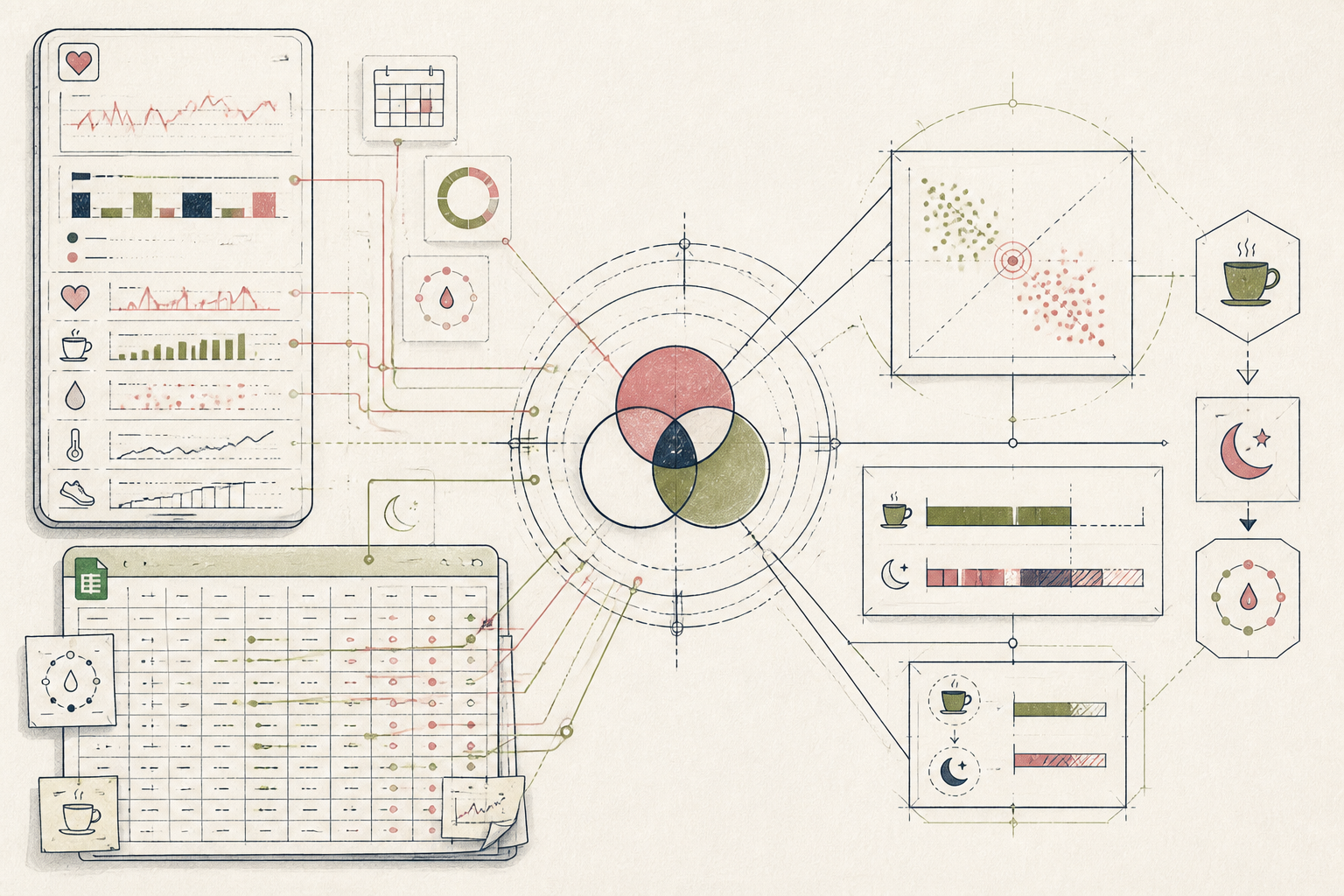
What the AI found
“Your AI analysis suggests that on average, your deep sleep drops by 27% during the luteal phase when your afternoon coffee intake exceeds 200mg, a pattern you had attributed to work stress.”
Before
Disparate cycle data, anecdotal hunches
After
AI-driven insights, actionable protocol
The same system, three states — real screens, not a screenshot
| Date | Cycle Day — Phase — Sleep Duration — Deep Sleep — Coffee (mg) |
| 2024-03-01 | 1 — Follicular — 7.2h — 1.5h — 100 |
| 2024-03-02 | 2 — Follicular — 7.5h — 1.6h — 100 |
| ... |
Prompt
Analyze the provided Google Sheet data. Correlate deep sleep duration with cycle phase and daily coffee intake (mg). Identify any significant patterns, especially during the luteal phase, and quantify the impact.
I've uploaded a CSV of my cycle data, sleep metrics from Apple Health, and daily coffee intake. Can you find any connections between deep sleep, cycle phase, and coffee, focusing on the luteal phase?
AI
After analyzing your data, a notable pattern emerges: your deep sleep duration, on average, decreases by 27% during your luteal phase when your daily coffee intake exceeds 200mg. This specific interaction is less pronounced in other cycle phases, suggesting a particular sensitivity during this period.0.75 hrs
Avg Deep Sleep (Luteal, >200mg Coffee)
1.02 hrs
Avg Deep Sleep (Luteal, <=200mg Coffee)
-27%
Deep Sleep Deviation (Luteal)
From Cycle Chaos to a Clear View
How a marketing professional shifted from fragmented hormone tracking to focused, AI-assisted insights.
A 38-year-old marketing professional, Northern Europe
Tools used
The real tools used here — swap any for your own equivalent. Each links to how we’d set it up.
Starting state
Before anything was set up
Before the Core Course, her cycle tracking was a patchwork. Data points lived in different apps: period dates in one, sleep in another, mood in a third. She suspected patterns related to her cycle and coffee, but the sheer volume of fragmented information made concrete analysis impossible. It was a messy, intuitive process, prone to confirmation bias.
| Date | Cycle Day — Phase — Sleep Duration — Deep Sleep — Coffee (mg) |
| 2024-03-01 | 1 — Follicular — 7.2h — 1.5h — 100 |
| 2024-03-02 | 2 — Follicular — 7.5h — 1.6h — 100 |
| ... | |
| 2024-04-29 | 28 — Luteal — 6.1h — 0.8h — 300 |
| 2024-04-30 | 29 — Luteal — 6.0h — 0.7h — 300 |
Working state
Core Course, doing its job
Using the Core Course's Ledger method, she compiled two months of Apple Health sleep data and her manual coffee intake log into a Google Sheet. She then prompted Gemini to cross-reference these datasets with her recorded cycle phases, looking for correlations. The aim was to move beyond mere observation to statistically suggested connections.
Prompt
Analyze the provided Google Sheet data. Correlate deep sleep duration with cycle phase and daily coffee intake (mg). Identify any significant patterns, especially during the luteal phase, and quantify the impact.
I've uploaded a CSV of my cycle data, sleep metrics from Apple Health, and daily coffee intake. Can you find any connections between deep sleep, cycle phase, and coffee, focusing on the luteal phase?
AI
After analyzing your data, a notable pattern emerges: your deep sleep duration, on average, decreases by 27% during your luteal phase when your daily coffee intake exceeds 200mg. This specific interaction is less pronounced in other cycle phases, suggesting a particular sensitivity during this period.Use case implemented
The finished system, running on its own
Now, with a clear understanding of specific influences, she runs a weekly Protocol. Her Google Sheet automatically pulls in sleep data, and a quick Gemini prompt on Sunday mornings highlights any emerging patterns or deviations. This structured approach allows her to refine her habits based on quantitative insights, rather than relying on guesswork. She trusts the data.
0.75 hrs
Avg Deep Sleep (Luteal, >200mg Coffee)
1.02 hrs
Avg Deep Sleep (Luteal, <=200mg Coffee)
-27%
Deep Sleep Deviation (Luteal)
What an outside observer would notice
From anecdotal to 94% verifiable
Sleep tracking reliability
Increased by 18%
Luteal deep sleep consistency
From 2-3 cups to 1 (or none)
Afternoon coffee reduction
The stack — build it yourself
Automatic, continuous recording of sleep metrics, requiring no active input once set up.
Flexible and accessible for consolidating various data points manually and from automated sources.
Capable of parsing complex datasets and identifying non-obvious correlations quickly and accurately.
These are the tools used in this story. Any can be swapped for an equivalent you already trust.
Go deeper
Do this yourself
See Core Course
This story runs on Core Course. The tools and prompts above are the real build — swap any tool for your own equivalent and follow the same steps.