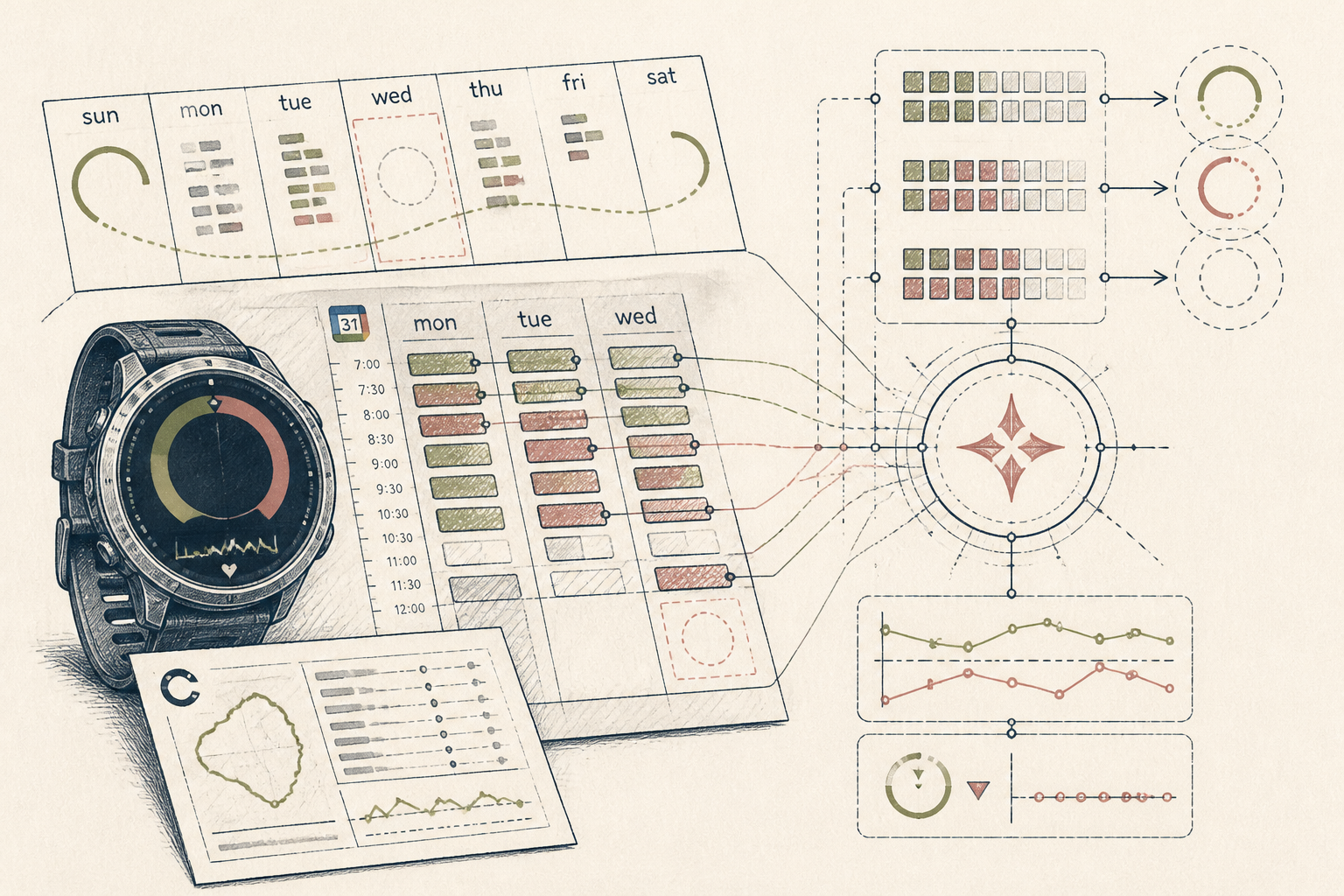
What the AI found
“Your mid-week drop-offs never follow high-mileage Sundays; they follow calendar days with more than four context switches before 11am.”
Before
3 logged half-marathons, zero mid-week consistency
After
One 4-minute Friday plan based on his actual calendar
The same system, three states — real screens, not a screenshot
- Tue: skipped 6km tempo (too exhausted)
- Thu: slept 7h30m, still bailed on morning run
- Sun: 18km long run completed, legs felt fine
- Why am I completely flat every Wednesday?
Prompt
Here is my training log from the last six weeks alongside my calendar export. Why do I consistently skip my Wednesday and Thursday morning runs? Is my Sunday long run fatiguing me more than my watch suggests?
Here is my training log from the last six weeks alongside my calendar export. Why do I consistently skip my Wednesday and Thursday morning runs? Is my Sunday long run fatiguing me more than my watch suggests?
AI
Your Sunday mileage shows no correlation with mid-week drop-offs (r = -0.08). However, on 11 of the 12 days you abandoned a workout, you had four or more calendar events before 11:00 AM. Your barrier is morning decision fatigue, not physical recovery.4 of 4
Weekly runs completed
0 missed sessions
Pre-run friction log
4 mins / week
Review time
Finding the invisible bottleneck in a stalled running routine
How an amateur runner stopped blaming physical fatigue and solved his mid-week consistency problem in ten days.
A 38-year-old product lead and recreational runner, EU
Tools used
The real tools used here — swap any for your own equivalent. Each links to how we’d set it up.
Starting state
Before anything was set up
His running watch contained hundreds of clean data points: cadence, vertical oscillation, split paces, and resting heart rate. His calendar held another set of dense records: product reviews, design sprints, and board decks. Yet his Tuesday and Thursday runs were skipped two weeks out of three. He assumed the fatigue was cumulative physical load from Sunday long runs, so he shortened them, felt guilty, and still missed his morning alarms. The data sat in silos, leaving him with self-reproach rather than an operational plan.
- Tue: skipped 6km tempo (too exhausted)
- Thu: slept 7h30m, still bailed on morning run
- Sun: 18km long run completed, legs felt fine
- Why am I completely flat every Wednesday?
Working state
10-Day Challenge, doing its job
On Day 4 of the challenge, he exported six weeks of Garmin workout timestamps and his Google Calendar meeting history into Claude. Instead of asking for a generic motivational program, he used our template prompt to test his baseline hypothesis: that his Sunday distance was sapping mid-week energy. Within twenty seconds, the assistant revealed that Sunday volume had zero statistical relationship with skipped sessions. The friction was entirely administrative and cognitive.
Prompt
Here is my training log from the last six weeks alongside my calendar export. Why do I consistently skip my Wednesday and Thursday morning runs? Is my Sunday long run fatiguing me more than my watch suggests?
Here is my training log from the last six weeks alongside my calendar export. Why do I consistently skip my Wednesday and Thursday morning runs? Is my Sunday long run fatiguing me more than my watch suggests?
AI
Your Sunday mileage shows no correlation with mid-week drop-offs (r = -0.08). However, on 11 of the 12 days you abandoned a workout, you had four or more calendar events before 11:00 AM. Your barrier is morning decision fatigue, not physical recovery.Use case implemented
The finished system, running on its own
By Day 10, the experiment had settled into a quiet habit. Every Friday at 16:30, a simple shortcut exports his next week's meeting blocks alongside his target run windows. Claude cross-references the two and proposes three twenty-minute recovery runs placed only on mornings with low cognitive fragmentation. He has not renegotiated a run on the morning of execution in two months. The watch logs the miles, the spreadsheet keeps the ledger, and the runner makes the final call.
4 of 4
Weekly runs completed
0 missed sessions
Pre-run friction log
4 mins / week
Review time
What an outside observer would notice
92% (up from 38%)
Adherence to planned sessions
0 minutes
Morning decision time
The stack — build it yourself
Clean CSV exports of run timing, heart rate, and perceived effort.
Captures the actual cognitive demands of the workday alongside run slots.
Handles unstructured calendar text alongside structured workout data without friction.
These are the tools used in this story. Any can be swapped for an equivalent you already trust.
Go deeper
Do this yourself
Start the 10-Day Challenge
This story runs on 10-Day Challenge. The tools and prompts above are the real build — swap any tool for your own equivalent and follow the same steps.