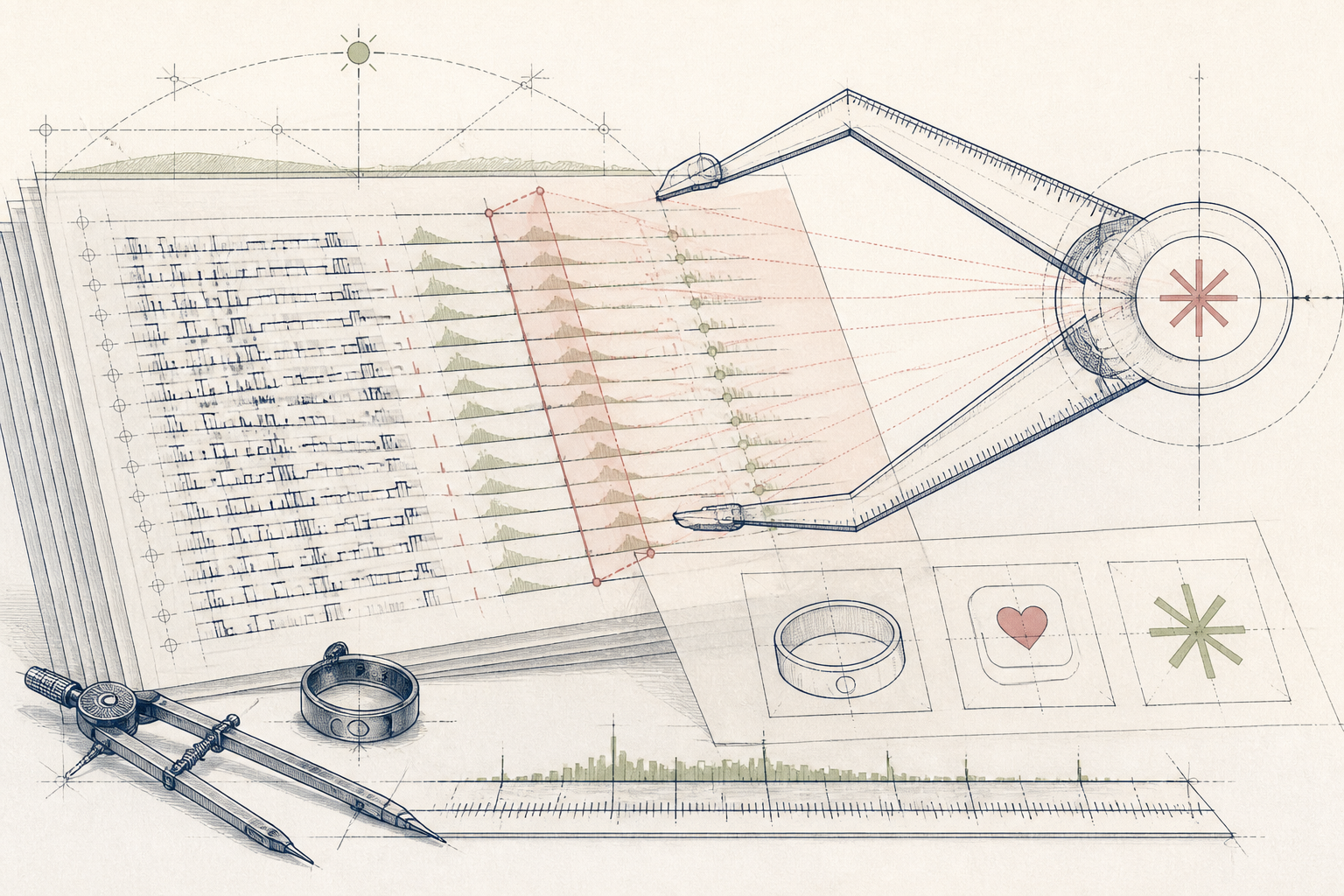
What the AI found
“Your 18 highest-fragmentation nights all followed days with zero outdoor daylight before 10am, regardless of screen time or evening tea.”
Before
14 months of Oura exports left untouched in Downloads
After
One 4-minute Sunday audit based on two clean feeds
The same system, three states — real screens, not a screenshot
| oura_export_2023_final.csv | 1.4 MB |
| sleep_log_notes_draft.txt | 4 KB |
| export_health_september.csv | 820 KB |
| weekly_averages_unopened.csv | 310 KB |
Prompt
Analyze this 60-day export of sleep stages, restlessness index, and daily context. Identify the strongest single statistical correlation with nights containing >3 wake events. Ignore subjective scores; look at timestamps and environmental exposures.
Here is 60 days of CSV data containing sleep fragmentation scores, evening habits, and daylight exposure timestamps. What variable explains the nights with more than 3 wake episodes?
AI
Your 18 highest-fragmentation nights all followed days with zero outdoor daylight before 10am, regardless of screen time or evening tea. On mornings with >20 mins outdoor light, average wakes fell to 1.1.34 mins
Morning daylight avg
1.2 / night
Wake episodes (avg)
4 mins
Weekly review time
Finding the daytime lever behind fourteen months of broken sleep
How one draftsperson consolidated fourteen months of wearable logs into a four-minute routine that isolated the real cause of his fragmented nights.
A 44-year-old architectural draftsperson, Northern Europe
Tools used
The real tools used here — swap any for your own equivalent. Each links to how we’d set it up.
Starting state
Before anything was set up
Fourteen months of sleep ring data sat archived in his Downloads folder. Every morning he looked at his readiness score over black coffee, noted the red wake spikes with mild irritation, and resolved to cut blue light earlier that evening. His bedroom was dark, cool, and silent, yet he routinely woke four times between 02:00 and 05:00. He had three different health tracking applications on his phone, none linked, each generating proprietary charts he never cross-referenced.
| oura_export_2023_final.csv | 1.4 MB |
| sleep_log_notes_draft.txt | 4 KB |
| export_health_september.csv | 820 KB |
| weekly_averages_unopened.csv | 310 KB |
Working state
All-Access, doing its job
Using the All-Access self-serve templates, he merged his CSV exports from Oura with Apple Health's ambient daylight metrics into Claude. Instead of asking for general sleep advice, he supplied sixty days of raw figures and prompted the model to evaluate the nights with more than three wake episodes against daytime variables. Within twelve seconds, the assistant isolated the correlation: the disruption had nothing to do with late screens or dinner timing, but an absolute absence of morning outdoor lux.
Prompt
Analyze this 60-day export of sleep stages, restlessness index, and daily context. Identify the strongest single statistical correlation with nights containing >3 wake events. Ignore subjective scores; look at timestamps and environmental exposures.
Here is 60 days of CSV data containing sleep fragmentation scores, evening habits, and daylight exposure timestamps. What variable explains the nights with more than 3 wake episodes?
AI
Your 18 highest-fragmentation nights all followed days with zero outdoor daylight before 10am, regardless of screen time or evening tea. On mornings with >20 mins outdoor light, average wakes fell to 1.1.Use case implemented
The finished system, running on its own
The setup now runs on a quiet Sunday cadence. At 18:00, Apple Health exports a seven-day window alongside a one-line daily journal into Claude. The model checks against his personal baseline, identifies whether morning outdoor exposure dipped below twenty minutes, and outputs a three-line summary. No dashboards left open, no wearable obsessing during breakfast. He reviews the short ledger, adjusts his morning walking window for the week ahead, and archives the file.
34 mins
Morning daylight avg
1.2 / night
Wake episodes (avg)
4 mins
Weekly review time
What an outside observer would notice
4 minutes
Weekly data review time
Down from 4.1 to 1.2
Nightly wake episodes
34 min daily avg
Morning outdoor light
The stack — build it yourself
Reliable sleep stage and nocturnal movement tracking without manual logging.
Aggregates outdoor daylight sensor metrics alongside ring exports in one place.
Large context window handles messy CSV dumps and spots non-obvious multi-factor correlations.
These are the tools used in this story. Any can be swapped for an equivalent you already trust.
Go deeper
Do this yourself
See the setup
This story runs on All-Access. The tools and prompts above are the real build — swap any tool for your own equivalent and follow the same steps.