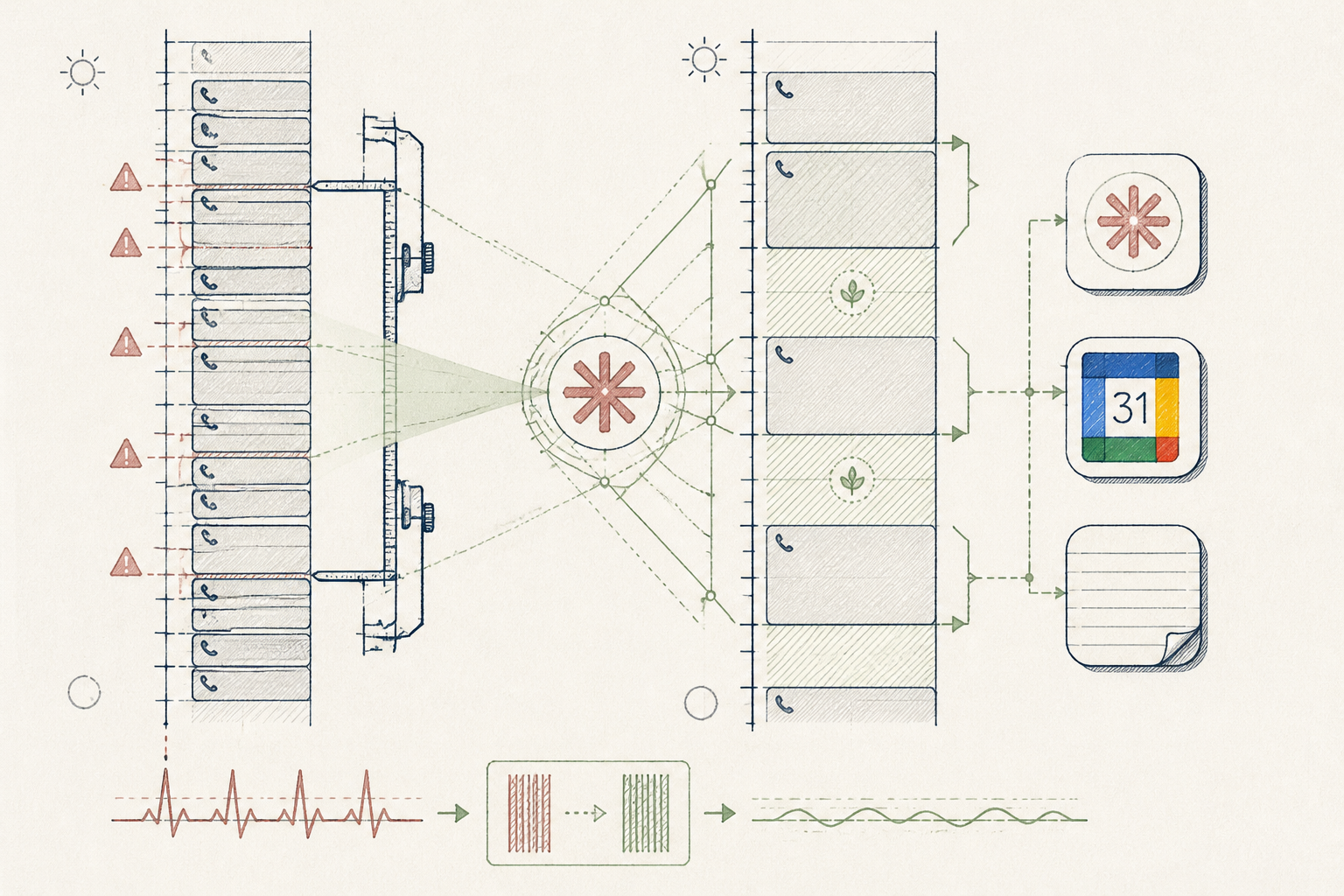
What the AI found
“Your peak stress scores don't correlate with meeting volume; they spike when calendar gaps drop below 18 minutes between calls.”
Before
vague dread, late meetings, scattered notes
After
one 4-minute Friday reset and protected lunches
The same system, three states — real screens, not a screenshot
- Mon: brain dead by 3pm, heavy chest
- Tue: 7 calls, felt fine strangely?
- Wed: completely exhausted, skipped gym
- Thu: headache, late dinner, can't unwind
Prompt
Here is my last 3 weeks of calendar data (CSV) and my evening 1-5 stress ratings from Apple Notes. Look for correlations between high stress days (rating 4 or 5) and schedule variables like total hours, meeting count, or gap length.
Here is my last 3 weeks of calendar data (CSV) and my evening 1-5 stress ratings from Apple Notes. Look for correlations between high stress days (rating 4 or 5) and schedule variables like total hours, meeting count, or gap length.
AI
Your peak stress scores don't correlate with meeting volume; they spike when calendar gaps drop below 18 minutes between calls. Days with 8 hours of calls showed low fatigue (avg 2.1) if gaps exceeded 25 minutes. Days with back-to-back blocks under 18 minutes averaged 4.6 on stress.64 bpm (-9 bpm)
Avg Friday HR
4/4 days maintained
Protected breaks
2.1 / 5 (down from 4.4)
Subjective fatigue
Finding the calendar gap that broke his afternoons
How an afternoon audit of calendar density replaced chronic fatigue with a calm buffer rule.
A 38-year-old product lead, Northern Europe
Tools used
The real tools used here — swap any for your own equivalent. Each links to how we’d set it up.
Starting state
Before anything was set up
He finished every workday feeling wiped out, with tight shoulders and an uneasy sense that his schedule was unmanageable. He kept vague notes on his phone—scribbled ratings from 1 to 5, half-remembered complaints about back-to-back presentations, and sporadic observations on poor sleep. Nothing linked together. He assumed sixty hours of meetings per week was simply unsustainable, but he could not pinpoint which days broke him or why.
- Mon: brain dead by 3pm, heavy chest
- Tue: 7 calls, felt fine strangely?
- Wed: completely exhausted, skipped gym
- Thu: headache, late dinner, can't unwind
Working state
Setup, doing its job
During a guided setup session, he exported three weeks of calendar entries alongside his quick notes. Instead of building a complex dashboard, he pasted the combined data into Claude with a clear prompt: compare meeting duration, call count, and break lengths against his recorded exhaustion. Within seconds, the AI mapped the distribution, identifying an unrecognised threshold that divided calm days from sensory overload.
Prompt
Here is my last 3 weeks of calendar data (CSV) and my evening 1-5 stress ratings from Apple Notes. Look for correlations between high stress days (rating 4 or 5) and schedule variables like total hours, meeting count, or gap length.
Here is my last 3 weeks of calendar data (CSV) and my evening 1-5 stress ratings from Apple Notes. Look for correlations between high stress days (rating 4 or 5) and schedule variables like total hours, meeting count, or gap length.
AI
Your peak stress scores don't correlate with meeting volume; they spike when calendar gaps drop below 18 minutes between calls. Days with 8 hours of calls showed low fatigue (avg 2.1) if gaps exceeded 25 minutes. Days with back-to-back blocks under 18 minutes averaged 4.6 on stress.Use case implemented
The finished system, running on its own
Three weeks later, the system runs with almost no friction. A basic Google Calendar rule automatically adds a 20-minute buffer after any meeting lasting over 45 minutes. On Friday afternoons, a shortcut exports the week's calendar blocks and logged stress ratings into a private folder. The analysis takes four minutes. The constant low-grade dread has dissolved into legible data: the volume of work was never the issue, only the density of transitions.
64 bpm (-9 bpm)
Avg Friday HR
4/4 days maintained
Protected breaks
2.1 / 5 (down from 4.4)
Subjective fatigue
What an outside observer would notice
100% scheduled (>20m)
Meeting buffers
4 minutes on Friday
Weekly review time
Down 52% over 21 days
Self-rated afternoon drag
The stack — build it yourself
Handles long, unstructured CSV exports cleanly with zero hallucinated timestamps.
Native calendar export offers clean event duration and gap data without extra tools.
Frictionless 1-5 subjective score logged via lock screen widget each evening.
These are the tools used in this story. Any can be swapped for an equivalent you already trust.
Go deeper
Do this yourself
Explore the Setup framework
This story runs on Setup. The tools and prompts above are the real build — swap any tool for your own equivalent and follow the same steps.