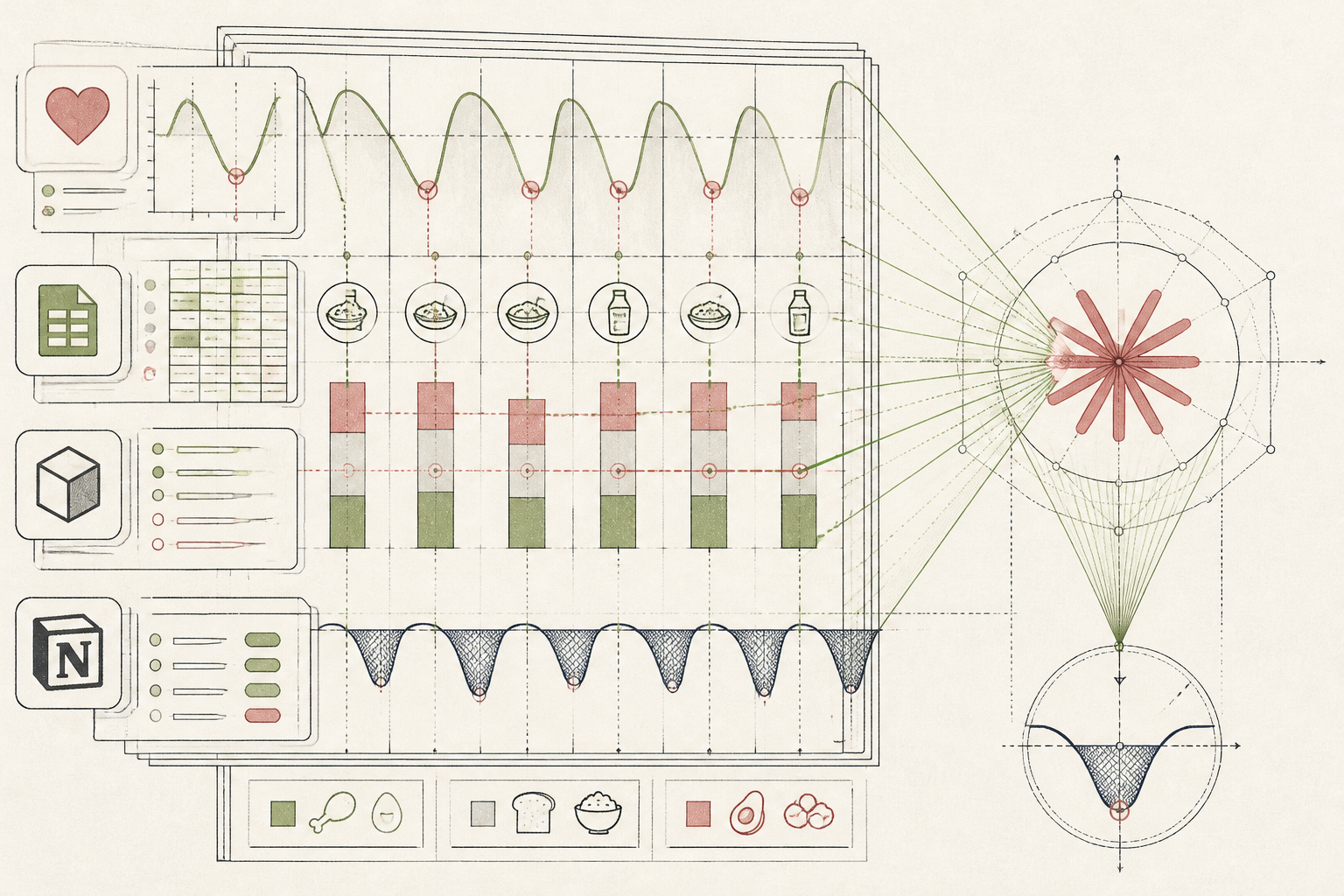
What the AI found
“Your afternoon energy dip correlates with lunch protein density, not carbohydrate volume, dropping lowest on days with under 22g protein before 1pm.”
Before
four coffees daily, unpredictable 3pm energy crash
After
one 4-minute Friday brief and steady 3pm focus
The same system, three states — real screens, not a screenshot
- Tired again around 15:30. Fourth espresso.
- Cut carbs yesterday (salad only) -> still felt flat at 16:00.
- Oura says sleep 7h 40m, readiness 82. Doesn't match afternoon brain fog.
- Need to track food properly but no time for complex apps.
Prompt
Here is the past month of timestamped meal logs, caffeine records, and 3pm focus ratings from the Sheets pipeline. Cross-reference the lowest quartile energy days against meal composition and sleep duration. What distinguishes them?
Here is the past month of timestamped meal logs, caffeine records, and 3pm focus ratings from the Sheets pipeline. Cross-reference the lowest quartile energy days against meal composition and sleep duration. What distinguishes them?
AI
Across 28 logged workdays, sleep duration showed negligible correlation with your afternoon slump (r = 0.11). Carbohydrate quantity was also neutral. However, in 100% of days where 3pm focus dropped to 2/5 or below, your lunch contained under 22g of protein. On days above 28g protein, afternoon focus averaged 4.3/5, regardless of bread or pasta intake.4.2 avg
3pm energy rating (1-5)
2 flat
Daily espresso count
>= 28g
Lunch protein baseline
Eliminating the Afternoon Slump with Done-for-You Energy Tracking
How a bespoke energy tracking pipeline pinpointed the true trigger of an afternoon slump.
A 39-year-old architectural consultant, Northern Europe
Tools used
The real tools used here — swap any for your own equivalent. Each links to how we’d set it up.
Starting state
Before anything was set up
His desk was littered with empty espresso cups by mid-afternoon. Client calls scheduled past 15:00 felt uphill, clouded by heavy lethargy that he attributed to lunchtime carbohydrates or interrupted sleep. Yet his sleep scores showed consistent restorative baseline numbers. He kept fragmented scribbles in his phone notes—sporadic food mentions, coffee tallies, and frustration—but lacked the bandwidth to structure the logs or deduce why some afternoons remained clear while others collapsed.
- Tired again around 15:30. Fourth espresso.
- Cut carbs yesterday (salad only) -> still felt flat at 16:00.
- Oura says sleep 7h 40m, readiness 82. Doesn't match afternoon brain fog.
- Need to track food properly but no time for complex apps.
Working state
Done-for-you, doing its job
The Done-for-You deployment eliminated manual setup. We configured an automated Google Sheet intake connected to a short text-message shortcut, standardizing his meal timestamps and subjective 3pm alertness ratings on a 1-to-5 scale. At the four-week mark, we piped the consolidated data into Claude to evaluate confounding factors. Instead of confirming his suspicion about lunchtime starches, the model mapped an exact nutritional boundary that predicted every severe afternoon crash.
Prompt
Here is the past month of timestamped meal logs, caffeine records, and 3pm focus ratings from the Sheets pipeline. Cross-reference the lowest quartile energy days against meal composition and sleep duration. What distinguishes them?
Here is the past month of timestamped meal logs, caffeine records, and 3pm focus ratings from the Sheets pipeline. Cross-reference the lowest quartile energy days against meal composition and sleep duration. What distinguishes them?
AI
Across 28 logged workdays, sleep duration showed negligible correlation with your afternoon slump (r = 0.11). Carbohydrate quantity was also neutral. However, in 100% of days where 3pm focus dropped to 2/5 or below, your lunch contained under 22g of protein. On days above 28g protein, afternoon focus averaged 4.3/5, regardless of bread or pasta intake.Use case implemented
The finished system, running on its own
The handed-over setup runs silently in Notion. Every morning, an automated template surfaces target lunch thresholds based on the day's calendar load. By 3pm, the sudden lethargy that once derailed his client sessions is gone. His coffee consumption settled at two morning cups without an explicit cutback goal. The weekly handover brief arrives every Friday at 16:00, requiring four minutes of review to verify patterns, adjust weekend recovery parameters, and keep the routine entirely self-directed.
4.2 avg
3pm energy rating (1-5)
2 flat
Daily espresso count
>= 28g
Lunch protein baseline
What an outside observer would notice
Down from 4 cups to 2
Afternoon coffee intake
4 minutes every Friday
Weekly review time
The stack — build it yourself
Captures daily activity and sleep timing without requiring deliberate data entry.
Lightweight storage for simple lunch timestamps and perceived afternoon focus scores.
Synthesizes messy qualitative notes with structured meal and energy markers accurately.
Clean, distraction-free environment for the finished Friday brief and daily benchmarks.
These are the tools used in this story. Any can be swapped for an equivalent you already trust.
Go deeper
Do this yourself
Explore the handover architecture
This story runs on Done-for-you. The tools and prompts above are the real build — swap any tool for your own equivalent and follow the same steps.