What the AI found
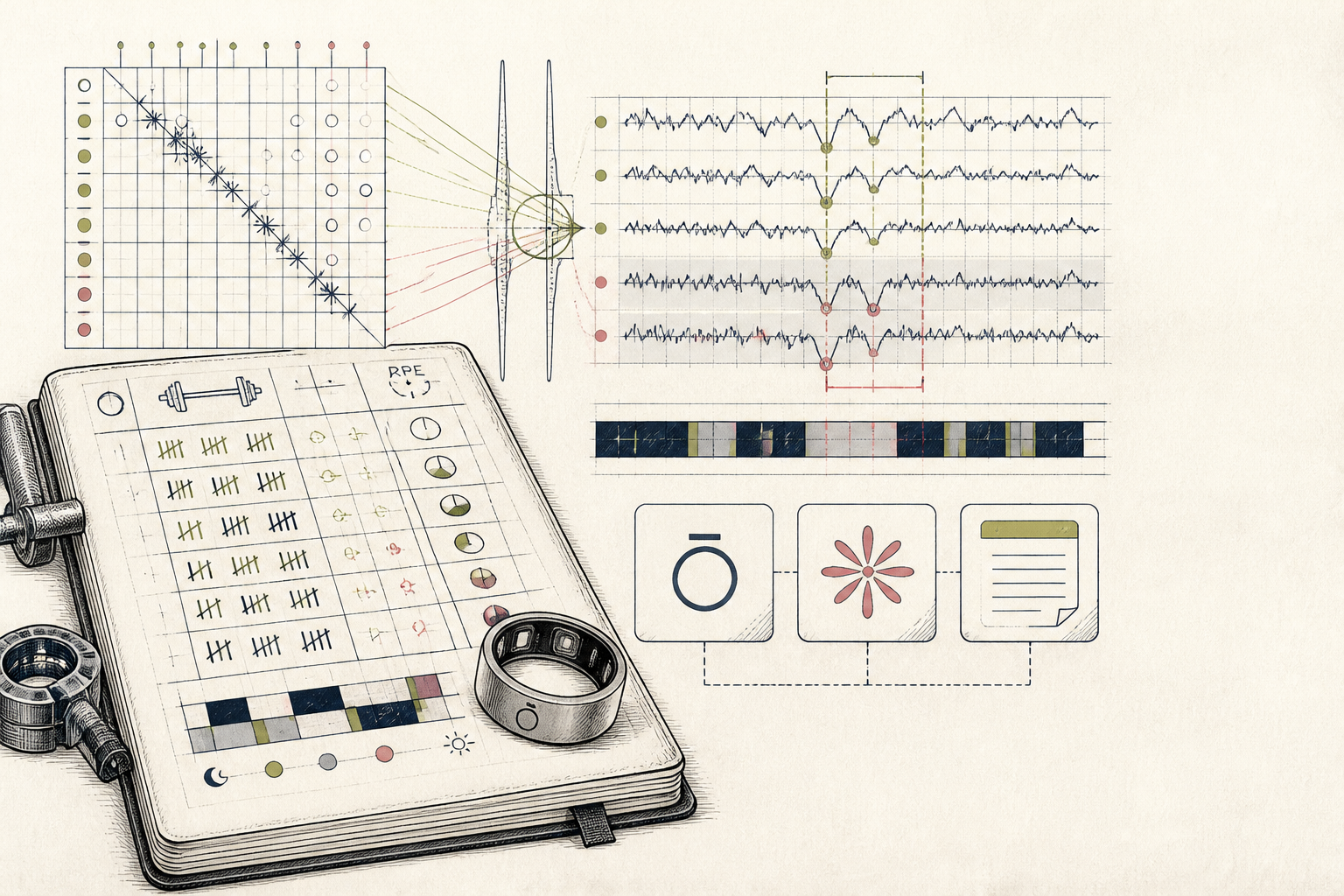
“Your HRV drops 18% only when heavy deadlifts follow poor sleep, but remains stable if volume drops by just two working sets.”
Before
Two years of Oura charts never cross-referenced
After
One ten-minute Sunday log that predicted fatigue
The same system, three states — real screens, not a screenshot
- Oct 12 — Legs felt heavy. Missed final set at 180kg.
- Oct 19 — Slept 6h15m. Oura said readiness 64. Still pulled.
- Nov 02 — Wrecked for three days after deadlifts.
- Nov 14 — Rest day didn't help. Heart rate up all night.
Prompt
Here are the last 90 days of my Oura sleep CSV merged with my lifting log from Apple Notes. Identify the specific variable that precedes my lowest 5 HRV recovery days.
Here are the last 90 days of my Oura sleep CSV merged with my lifting log from Apple Notes. Identify the specific variable that precedes my lowest 5 HRV recovery days.
AI
Your three worst recovery dips do not correlate with total weekly tonnage. Instead, your HRV drops 18% only when heavy deadlifts follow poor sleep, but remains stable if volume drops by just two working sets.| Weekly readiness average | 82/100 |
| Volume adjustment triggered | -2 sets Tuesday |
| Predicted HRV baseline | 64 ms (actual: 62 ms) |
Connecting wearable data to lifting logs in ten days
How a powerlifter linked two years of wearable data to his lifting journal in fifteen minutes a day.
A 38-year-old software architect and powerlifter, EU
Tools used
The real tools used here — swap any for your own equivalent. Each links to how we’d set it up.
Starting state
Before anything was set up
Two years of Oura ring scores sat isolated in a smartphone drawer while eight notebooks of barbell percentages gathered dust on his desk. He felt chronically flat every third Thursday, assuming it was age or cumulative workload. His wearable gave him a single morning score between 1 and 100, but offered no clue how Tuesday's deadlifts interacted with Saturday's broken sleep. He was tracking everything and understanding almost nothing.
- Oct 12 — Legs felt heavy. Missed final set at 180kg.
- Oct 19 — Slept 6h15m. Oura said readiness 64. Still pulled.
- Nov 02 — Wrecked for three days after deadlifts.
- Nov 14 — Rest day didn't help. Heart rate up all night.
Working state
10-Day Challenge, doing its job
On Day 4 of the 10-Day Challenge, he exported his raw CSV from Oura and pasted ninety days of workout notes into Claude. Instead of asking for generic fitness tips, he used the challenge's structured correlation prompt. Within seconds, the model cut through the noise of bedtime consistency and caffeine logs to pinpoint the exact compound movement and sleep threshold driving his mid-week exhaustion.
Prompt
Here are the last 90 days of my Oura sleep CSV merged with my lifting log from Apple Notes. Identify the specific variable that precedes my lowest 5 HRV recovery days.
Here are the last 90 days of my Oura sleep CSV merged with my lifting log from Apple Notes. Identify the specific variable that precedes my lowest 5 HRV recovery days.
AI
Your three worst recovery dips do not correlate with total weekly tonnage. Instead, your HRV drops 18% only when heavy deadlifts follow poor sleep, but remains stable if volume drops by just two working sets.Use case implemented
The finished system, running on its own
By day ten, the system took eight minutes on Sunday evening. He dumped his raw export from Oura and his session notes from Apple Notes into Claude using a template generated during the challenge. The model flagged next week's recovery liabilities before he packed his gym bag. He no longer woke up guessing whether his legs would hold up under the barbell; the numbers showed him exactly when to pull back.
| Weekly readiness average | 82/100 |
| Volume adjustment triggered | -2 sets Tuesday |
| Predicted HRV baseline | 64 ms (actual: 62 ms) |
| Weekly review time | 8 minutes |
What an outside observer would notice
8 minutes
Sunday review time
0 in 6 weeks
Missed lift sessions
Down 40%
Subjective morning fatigue
The stack — build it yourself
Exports clean CSV data for sleep stages, resting heart rate, and nightly HRV.
Large context window handles months of raw biometric tables alongside freeform text.
Low-friction text capture of lifting sets and subjective fatigue between sessions.
These are the tools used in this story. Any can be swapped for an equivalent you already trust.
Go deeper
Do this yourself
Start the 10-Day Challenge
This story runs on 10-Day Challenge. The tools and prompts above are the real build — swap any tool for your own equivalent and follow the same steps.