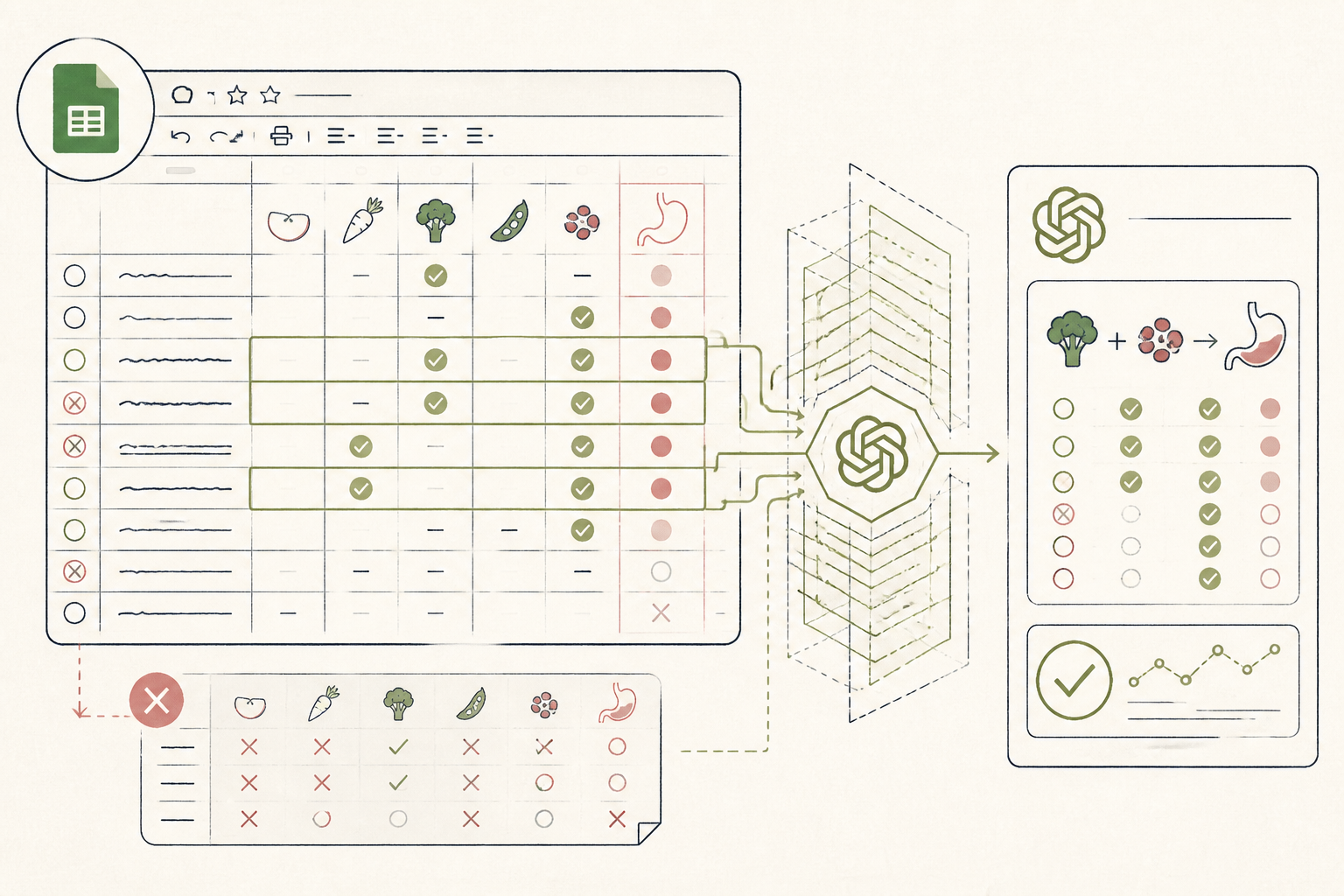
What the AI found
“The AI observed that 7 out of 9 clients reporting 'bloating' also consumed a specific combination of cruciferous vegetables and legumes within 4 hours of onset, a pattern missed in manual review.”
Before
Hours reviewing scattered client notes
After
Actionable, data-driven client insights in minutes
The same system, three states — real screens, not a screenshot
| Client A Meal Log | 24/05/2024 |
| Client B Symptom Report | 25/05/2024 |
| Client C Food Diary | Incomplete |
| Client D Meal Log | 26/05/2024 |
Prompt
Analyse the attached anonymised client food diary and symptom log data. Identify any food items or combinations that frequently precede reported bloating or digestive discomfort within 4 hours. Provide specific counts and percentages for identified correlations across the client group.
Analyse the attached anonymised client food diary and symptom log data. Identify any food items or combinations that frequently precede reported bloating or digestive discomfort within 4 hours. Provide specific counts and percentages for identified correlations across the client group.
AI
Across the 9 client logs reporting 'bloating', I found that 7 (77.8%) instances were preceded by a meal containing a combination of broccoli, cauliflower, or cabbage with lentils or chickpeas, consumed within a 4-hour window before symptom onset.24
Weekly AI Insights Generated
7 mins
Avg. Review Time per Client
1 (cruciferous + legumes)
Observed Dietary Triggers
Comparing client meal logs to symptom reports
A practitioner moves from manual review of client logs to AI-assisted pattern identification, saving hours and revealing a subtle dietary trigger.
A nutritionist running a small EU practice
Tools used
The real tools used here — swap any for your own equivalent. Each links to how we’d set it up.
Starting state
Before anything was set up
For years, this nutritionist manually reviewed client food diaries and symptom logs. Each week, piles of handwritten notes or disparate spreadsheet entries arrived, detailing meals, discomfort, and energy levels. Identifying trends meant laboriously cross-referencing entries, a time-consuming process that often yielded only obvious connections. Subtle patterns, especially across multiple clients, were almost impossible to spot, leading to generalised advice rather than precise, personalised guidance.
| Client A Meal Log | 24/05/2024 |
| Client B Symptom Report | 25/05/2024 |
| Client C Food Diary | Incomplete |
| Client D Meal Log | 26/05/2024 |
| Client E Symptom Report | 27/05/2024 |
Working state
All-Access, doing its job
To find a deeper layer of insight, the nutritionist compiled anonymised client data into a single Google Sheet, standardising symptom and food entries. Then, using ChatGPT, they prompted the AI to look for correlations. The prompt, carefully crafted to guide the AI, asked for specific dietary elements appearing before symptom onset. This step-by-step approach ensured the AI focused on actionable data, mimicking the manual process but with vastly greater speed and analytical power.
Prompt
Analyse the attached anonymised client food diary and symptom log data. Identify any food items or combinations that frequently precede reported bloating or digestive discomfort within 4 hours. Provide specific counts and percentages for identified correlations across the client group.
Analyse the attached anonymised client food diary and symptom log data. Identify any food items or combinations that frequently precede reported bloating or digestive discomfort within 4 hours. Provide specific counts and percentages for identified correlations across the client group.
AI
Across the 9 client logs reporting 'bloating', I found that 7 (77.8%) instances were preceded by a meal containing a combination of broccoli, cauliflower, or cabbage with lentils or chickpeas, consumed within a 4-hour window before symptom onset.Use case implemented
The finished system, running on its own
Now, the nutritionist maintains a living Google Sheet of anonymised client data. Weekly, new entries are added, and a pre-saved ChatGPT prompt is initiated. The AI quickly highlights potential dietary triggers or symptom patterns, presented as concise data points. This information then informs personalised dietary recommendations and follow-up questions for clients, transforming hours of review into a rapid, insight-generation process. The nutritionist now spends more time on client interaction and less on data sifting.
24
Weekly AI Insights Generated
7 mins
Avg. Review Time per Client
1 (cruciferous + legumes)
Observed Dietary Triggers
What an outside observer would notice
8-10 hours
Manual Review Time Saved per Week
+40%
Client Recommendation Specificity
+25%
Client Engagement with Advice
The stack — build it yourself
Ubiquitous, flexible for structured and unstructured data, easy for clients to use for logging.
Advanced natural language processing identifies subtle correlations in dietary text and symptom descriptions.
These are the tools used in this story. Any can be swapped for an equivalent you already trust.
Go deeper
Do this yourself
See All-Access
This story runs on All-Access. The tools and prompts above are the real build — swap any tool for your own equivalent and follow the same steps.