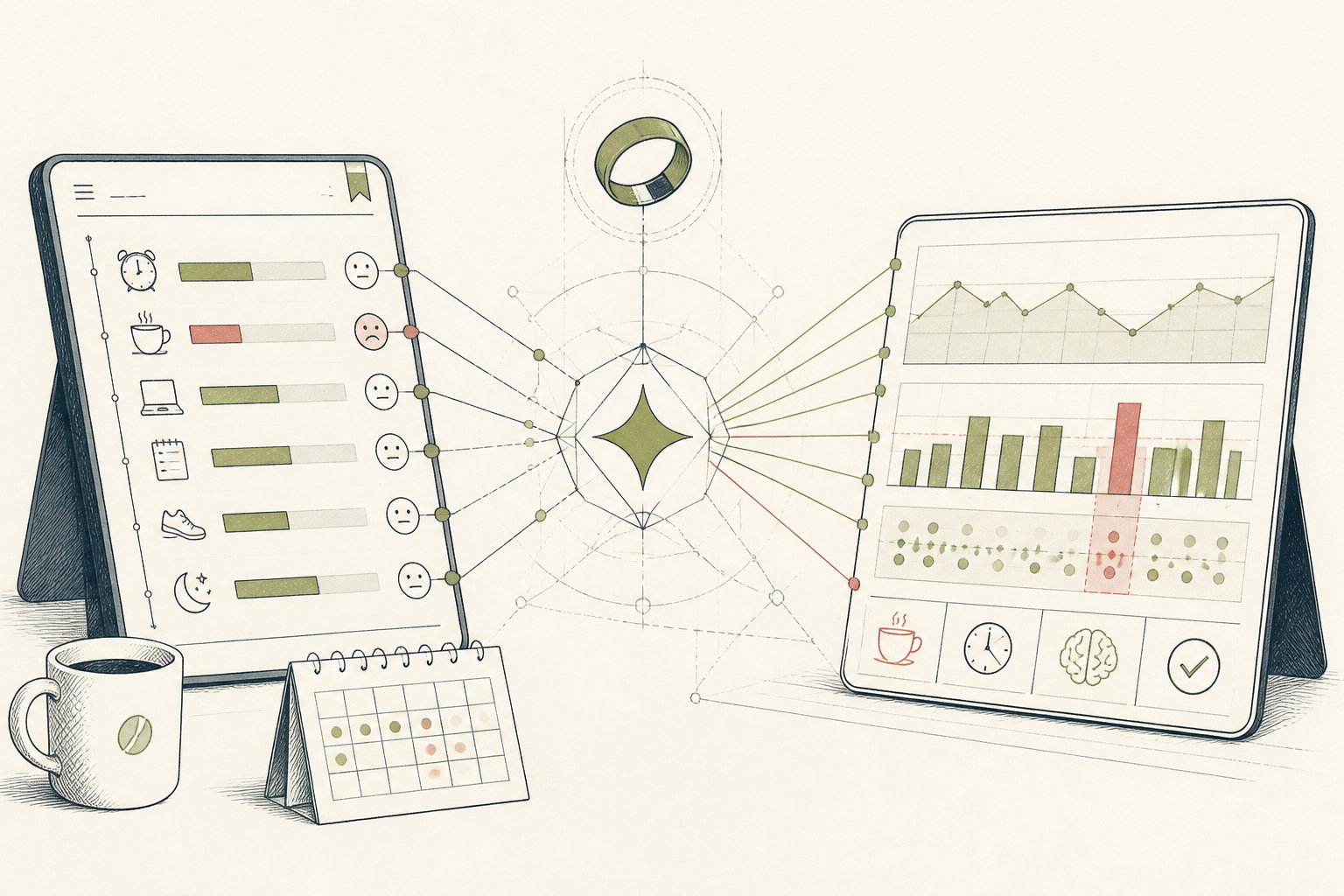
What the AI found
“Your peak focus duration dropped by an average of 40 minutes on days you consumed caffeine after 2 PM, compared to days without late caffeine.”
Before
Subjective "good" vs. "bad" days
After
Quantified focus impact of afternoon caffeine
The same system, three states — real screens, not a screenshot
- Monday: Good focus. Early start. No afternoon coffee.
- Tuesday: Felt foggy mid-afternoon. Had espresso after lunch.
- Wednesday: Decent. Did a deep work session.
- Thursday: Low energy. Poor sleep last night? Another late coffee.
Prompt
Here is my daily log (focus rating 1-5, tasks completed, afternoon caffeine yes/no) and sleep data (total hours, deep sleep, awake time) for the past 4 weeks. Please identify any correlations between afternoon caffeine intake, sleep metrics, and my subjective focus ratings/task completion. Quantify the impact.
Here is my daily log (focus rating 1-5, tasks completed, afternoon caffeine yes/no) and sleep data (total hours, deep sleep, awake time) for the past 4 weeks. Please identify any correlations between afternoon caffeine intake, sleep metrics, and my subjective focus ratings/task completion. Quantify the impact.
AI
Analysis of your last 4 weeks suggests a notable pattern. On days where you consumed caffeine after 2 PM, your average subjective focus rating dropped from 4.1 to 2.8, and the number of high-concentration tasks completed decreased by 35%. Furthermore, your reported peak focus duration was, on average, 40 minutes shorter on those days, irrespective of total sleep hours. Deep sleep percentage showed a minor, though not statistically significant, reduction of 3% on late-caffeine days.4.1
Average Focus Rating (No Late Caffeine)
2.8
Average Focus Rating (With Late Caffeine)
▼ 35%
High-Concentration Tasks Completed (Late Caffeine days)
Cognition Clarity: Decoding Daily Focus with AI
How a marketing strategist moved from vague self-assessments to precise, AI-driven insights about her daily cognitive performance.
A 38-year-old marketing strategist, Northern Europe
Tools used
The real tools used here — swap any for your own equivalent. Each links to how we’d set it up.
Starting state
Before anything was set up
Before the 10-Day Challenge, Sarah’s understanding of her daily cognitive performance was anecdotal. She’d broadly categorize days as "good" or "bad" for focus, attributing dips to general stress or poor sleep. She tracked sleep, but the connection to daily work quality remained elusive and unquantified, leaving her frustrated by inconsistent productivity without clear causes.
- Monday: Good focus. Early start. No afternoon coffee.
- Tuesday: Felt foggy mid-afternoon. Had espresso after lunch.
- Wednesday: Decent. Did a deep work session.
- Thursday: Low energy. Poor sleep last night? Another late coffee.
Working state
10-Day Challenge, doing its job
Sarah began by collating her daily log entries – short notes on her perceived focus, tasks completed, and any afternoon caffeine. She then fed this structured data, alongside her sleep metrics from her wearable, into a prompt in Gemini. The AI was tasked with cross-referencing these variables, looking for patterns that might explain her inconsistent focus levels.
Prompt
Here is my daily log (focus rating 1-5, tasks completed, afternoon caffeine yes/no) and sleep data (total hours, deep sleep, awake time) for the past 4 weeks. Please identify any correlations between afternoon caffeine intake, sleep metrics, and my subjective focus ratings/task completion. Quantify the impact.
Here is my daily log (focus rating 1-5, tasks completed, afternoon caffeine yes/no) and sleep data (total hours, deep sleep, awake time) for the past 4 weeks. Please identify any correlations between afternoon caffeine intake, sleep metrics, and my subjective focus ratings/task completion. Quantify the impact.
AI
Analysis of your last 4 weeks suggests a notable pattern. On days where you consumed caffeine after 2 PM, your average subjective focus rating dropped from 4.1 to 2.8, and the number of high-concentration tasks completed decreased by 35%. Furthermore, your reported peak focus duration was, on average, 40 minutes shorter on those days, irrespective of total sleep hours. Deep sleep percentage showed a minor, though not statistically significant, reduction of 3% on late-caffeine days.Use case implemented
The finished system, running on its own
Now, Sarah has a simple system. Each morning, she reviews the previous day’s brief AI analysis, integrating its findings into her planning. This ongoing feedback loop has transformed her self-awareness, allowing her to make small, informed adjustments to her daily routine, leading to more predictable high-focus periods. She no longer relies on guesswork.
4.1
Average Focus Rating (No Late Caffeine)
2.8
Average Focus Rating (With Late Caffeine)
▼ 35%
High-Concentration Tasks Completed (Late Caffeine days)
What an outside observer would notice
Increased by 1.3 points
Subjective Focus Rating Improvement
Increased by 35%
High-Concentration Tasks Completed
Reduced by 60%
Afternoon Caffeine Incidence
The stack — build it yourself
Chosen for its flexible, local-first plain text structure, ideal for quick, structured daily entries.
Selected for its granular sleep stage tracking and recovery metrics, providing objective data.
Utilized for its advanced analytical capabilities in cross-referencing diverse datasets and identifying subtle correlations.
Provided a customizable hub to display AI insights alongside daily plans, facilitating actionable review.
These are the tools used in this story. Any can be swapped for an equivalent you already trust.
Go deeper
Do this yourself
See 10-Day Challenge
This story runs on 10-Day Challenge. The tools and prompts above are the real build — swap any tool for your own equivalent and follow the same steps.