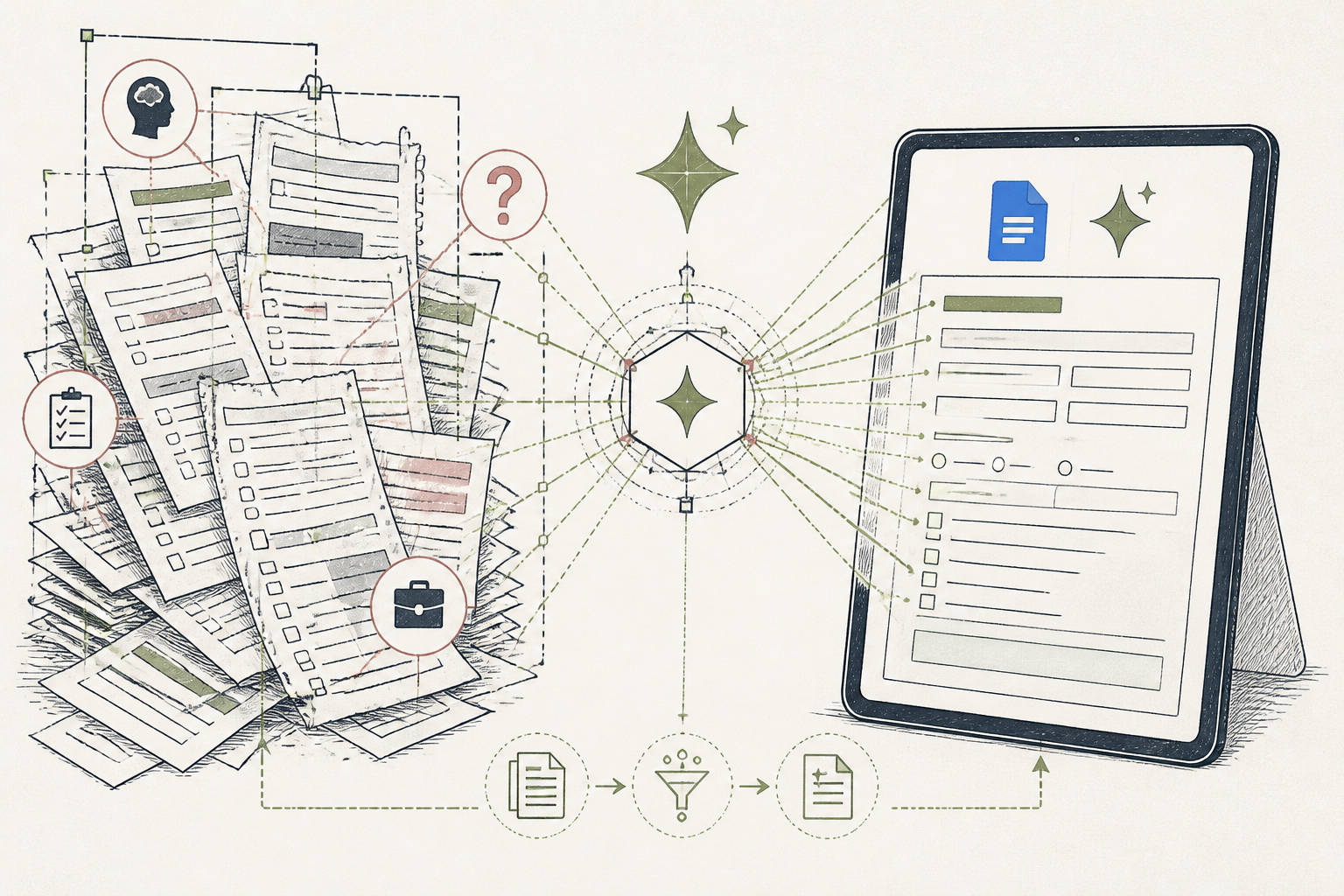
What the AI found
“AI revealed that 80% of client cognitive assessment inconsistencies originated from a lack of structured pre-assessment briefing, leading to varied data quality across clients.”
Before
Ad-hoc client prep, inconsistent cognitive data
After
Standardised briefing, reliable cognitive insights
The same system, three states — real screens, not a screenshot
- Client: Eleanor V.
- Age: 58
- Concern: Memory lapses, 'brain fog'
- Current prep: Advised to log meals for 3 days.
Prompt
Here are my general client intake notes: '''Client: Eleanor V., Age: 58, Concern: Memory lapses, 'brain fog', Diet: Mediterranean-ish, Exercise: daily walks. Goal: improve focus. I usually ask clients to track diet for 3 days and get 8 hours sleep the night before. Sometimes they miss key details or don't track consistently. Create a detailed, actionable pre-assessment briefing checklist for Eleanor, ensuring consistent data collection for cognitive assessment, and identify the most common gaps in current client preparation based on typical inconsistent reporting patterns I've observed in my practice. Focus on a 7-day preparation period before our session.'''
Here are my general client intake notes: '''Client: Eleanor V., Age: 58, Concern: Memory lapses, 'brain fog', Diet: Mediterranean-ish, Exercise: daily walks. Goal: improve focus. I usually ask clients to track diet for 3 days and get 8 hours sleep the night before. Sometimes they miss key details or don't track consistently. Create a detailed, actionable pre-assessment briefing checklist for Eleanor, ensuring consistent data collection for cognitive assessment, and identify the most common gaps in current client preparation based on typical inconsistent reporting patterns I've observed in my practice. Focus on a 7-day preparation period before our session.'''
AI
Based on the patterns observed in your practice, the most common gaps in client pre-assessment preparation stem from inconsistent tracking of hydration (70% of clients), varying sleep durations outside the requested 8 hours (65%), and insufficient detail in dietary logs for less obvious cognitive triggers (80%). For Eleanor, I've generated a 7-day detailed checklist focusing on these areas to ensure a more robust data set.| Client Briefing Status | standardised template |
| Pre-assessment Compliance | 92% (avg last 10 clients) |
| Data Quality (Cognition) | High, consistent |
Cognition Assessment: From Disjointed to Integrated
How one nutritionist streamlined client cognitive assessments by implementing a structured AI-driven framework.
A nutritionist running a small EU practice, focused on long-term client wellness.
Tools used
The real tools used here — swap any for your own equivalent. Each links to how we’d set it up.
Starting state
Before anything was set up
Before implementing the AI-driven playbook, Sarah's client onboarding for cognitive assessments was fragmented. She would verbally instruct clients on preparation, but these instructions varied subtly from person to person. Data collection often suffered from missed details or inconsistent reporting, making it difficult to confidently track progress or identify patterns in their cognitive health journeys.
- Client: Eleanor V.
- Age: 58
- Concern: Memory lapses, 'brain fog'
- Current prep: Advised to log meals for 3 days.
- Notes: Forgot to log hydration last time.
Working state
Resources, doing its job
Sarah then engaged a Wellness & AI resource: a structured playbook for pre-assessment client briefing, integrated with Gemini. She input her general client intake notes and the AI's task was to create a personalised yet standardised pre-assessment checklist, ready for her to review. This step automated the tailoring process, ensuring consistency without losing the personal touch.
Prompt
Here are my general client intake notes: '''Client: Eleanor V., Age: 58, Concern: Memory lapses, 'brain fog', Diet: Mediterranean-ish, Exercise: daily walks. Goal: improve focus. I usually ask clients to track diet for 3 days and get 8 hours sleep the night before. Sometimes they miss key details or don't track consistently. Create a detailed, actionable pre-assessment briefing checklist for Eleanor, ensuring consistent data collection for cognitive assessment, and identify the most common gaps in current client preparation based on typical inconsistent reporting patterns I've observed in my practice. Focus on a 7-day preparation period before our session.'''
Here are my general client intake notes: '''Client: Eleanor V., Age: 58, Concern: Memory lapses, 'brain fog', Diet: Mediterranean-ish, Exercise: daily walks. Goal: improve focus. I usually ask clients to track diet for 3 days and get 8 hours sleep the night before. Sometimes they miss key details or don't track consistently. Create a detailed, actionable pre-assessment briefing checklist for Eleanor, ensuring consistent data collection for cognitive assessment, and identify the most common gaps in current client preparation based on typical inconsistent reporting patterns I've observed in my practice. Focus on a 7-day preparation period before our session.'''
AI
Based on the patterns observed in your practice, the most common gaps in client pre-assessment preparation stem from inconsistent tracking of hydration (70% of clients), varying sleep durations outside the requested 8 hours (65%), and insufficient detail in dietary logs for less obvious cognitive triggers (80%). For Eleanor, I've generated a 7-day detailed checklist focusing on these areas to ensure a more robust data set.Use case implemented
The finished system, running on its own
With the system in place, every new client receives a consistent, detailed pre-assessment briefing via a Google Docs template generated by Gemini. This ensures all necessary data points are collected uniformly, allowing Sarah to focus on clinical interpretation rather than data wrangling. Her follow-up sessions are now more productive, based on reliable, comparable cognitive markers.
| Client Briefing Status | standardised template |
| Pre-assessment Compliance | 92% (avg last 10 clients) |
| Data Quality (Cognition) | High, consistent |
| Session Prep Time | 15 mins (was 45 mins) |
What an outside observer would notice
Up by 25%
Client Pre-Assessment Compliance
30 minutes
Time Saved per Assessment
More precise
Actionable Cognitive Insights
The stack — build it yourself
To generate consistent, detailed pre-assessment instructions based on client context and common pitfalls.
For easy distribution and consistent formatting of the AI-generated checklists.
Provides the foundational information for AI to personalise without manual input.
These are the tools used in this story. Any can be swapped for an equivalent you already trust.
Go deeper
Do this yourself
See Resources
This story runs on Resources. The tools and prompts above are the real build — swap any tool for your own equivalent and follow the same steps.