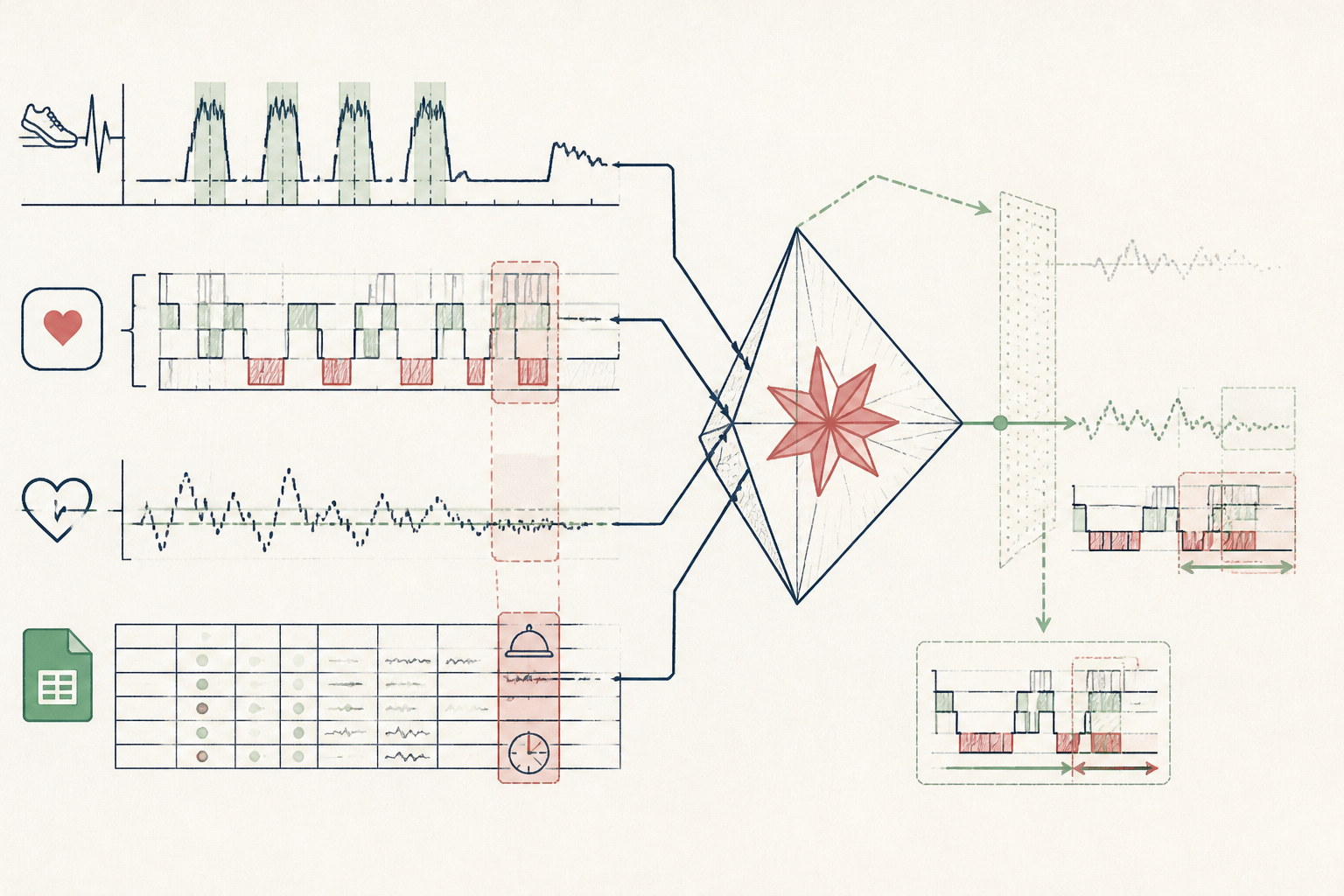
What the AI found
“Your lowest HRV recovery mornings did not follow hard intervals; they followed late-evening heavy meals within 90 minutes of sleep, reducing deep sleep by 38 minutes.”
Before
Five wearable scores, morning dread, zero pattern
After
One 15-minute Sunday review and steady HRV
The same system, three states — real screens, not a screenshot
- Monday: Garmin says 34 (poor), Whoop says 68% (green). Legs heavy.
- Wednesday: Skipped threshold run because resting HR spiked to 54.
- Friday: Slept 8 hrs, morning readiness red again. Why?
- Sunday: Cut caffeine at 12:00. Still waking up wired at 3 AM.
Prompt
Here is my 30-day export of nocturnal HRV, sleep stages, and workout load, paired with my evening meal timestamps. What single factor correlates most strongly with days where HRV dropped more than 15% below my 54ms rolling average?
Here is my 30-day export of nocturnal HRV, sleep stages, and workout load, paired with my evening meal timestamps. What single factor correlates most strongly with days where HRV dropped more than 15% below my 54ms rolling average?
AI
Your lowest HRV recovery mornings did not follow hard intervals; they followed late-evening heavy meals within 90 minutes of sleep, reducing deep sleep by 38 minutes. On high-intensity training days where dinner finished 2.5 hours before bed, your HRV rebounded normally to 56ms.58 ms (stable)
7-Day HRV Baseline
2.5 hrs pre-bed
Dinner Cut-Off Buffer
14 mins
Weekly Review Time
Calibrating Endurance Recovery Through Systematic Self-Tracking
How a runner isolated dinner timing over training load using Claude and a three-layer personal ledger.
A 44-year-old amateur distance runner, Northern Europe
Tools used
The real tools used here — swap any for your own equivalent. Each links to how we’d set it up.
Starting state
Before anything was set up
His bedside table held two charging docks: a GPS watch and a recovery strap. Every morning at 06:15 began with a quiet ritual of cognitive dissonance. One dashboard showed green; the other flashed amber. He kept compensatory notes in his phone, cutting afternoon espresso, adding magnesium, and shifting training intervals, yet his nocturnal heart-rate variability bounced erratically between 32 and 61 milliseconds without an obvious trigger. He was drowning in passive telemetry while remaining entirely blind to causation.
- Monday: Garmin says 34 (poor), Whoop says 68% (green). Legs heavy.
- Wednesday: Skipped threshold run because resting HR spiked to 54.
- Friday: Slept 8 hrs, morning readiness red again. Why?
- Sunday: Cut caffeine at 12:00. Still waking up wired at 3 AM.
Working state
Core Course, doing its job
Applying the Core Course's 3-Layer framework, he stopped looking at morning summary dials. Layer 1 reviewed current literature on nocturnal autonomic tone and meal timing. Layer 2 consolidated thirty days of raw sleep metrics, heart-rate variability, and dinner timestamps into a single structured spreadsheet. Layer 3 used Claude to audit the cross-tabulated dataset. Within sixty seconds, the model cut through his assumptions about mileage fatigue, isolating a routine behavioral habit that had derailed his sleep architecture.
Prompt
Here is my 30-day export of nocturnal HRV, sleep stages, and workout load, paired with my evening meal timestamps. What single factor correlates most strongly with days where HRV dropped more than 15% below my 54ms rolling average?
Here is my 30-day export of nocturnal HRV, sleep stages, and workout load, paired with my evening meal timestamps. What single factor correlates most strongly with days where HRV dropped more than 15% below my 54ms rolling average?
AI
Your lowest HRV recovery mornings did not follow hard intervals; they followed late-evening heavy meals within 90 minutes of sleep, reducing deep sleep by 38 minutes. On high-intensity training days where dinner finished 2.5 hours before bed, your HRV rebounded normally to 56ms.Use case implemented
The finished system, running on its own
The protocol runs on quiet autopilot. Every Sunday at 18:00, he exports a single CSV from Apple Health into Claude alongside a five-line subjective training log. The prompt tests one variable at a time across a rolling fourteen-day window. There are no frantic mid-week adjustments, no late-night wearable refreshes, and no speculative supplement purchases. Recovery is no longer an ambiguous morning verdict; it is an audit of two known physiological levers he directly controls.
58 ms (stable)
7-Day HRV Baseline
2.5 hrs pre-bed
Dinner Cut-Off Buffer
14 mins
Weekly Review Time
What an outside observer would notice
-42% month-on-month
HRV baseline variance
14 minutes on Sunday
Weekly protocol review
1 single change per week
Active variables tested
The stack — build it yourself
Consolidates passive nocturnal HRV, resting heart rate, and sleep staging into a local exportable repository.
Long context window handles unedited monthly CSV exports cleanly alongside natural-language training notes.
Minimal friction for recording one planned behavioural shift and logging subjective morning fatigue.
These are the tools used in this story. Any can be swapped for an equivalent you already trust.
Go deeper
Do this yourself
Explore the Core Course
This story runs on Core Course. The tools and prompts above are the real build — swap any tool for your own equivalent and follow the same steps.