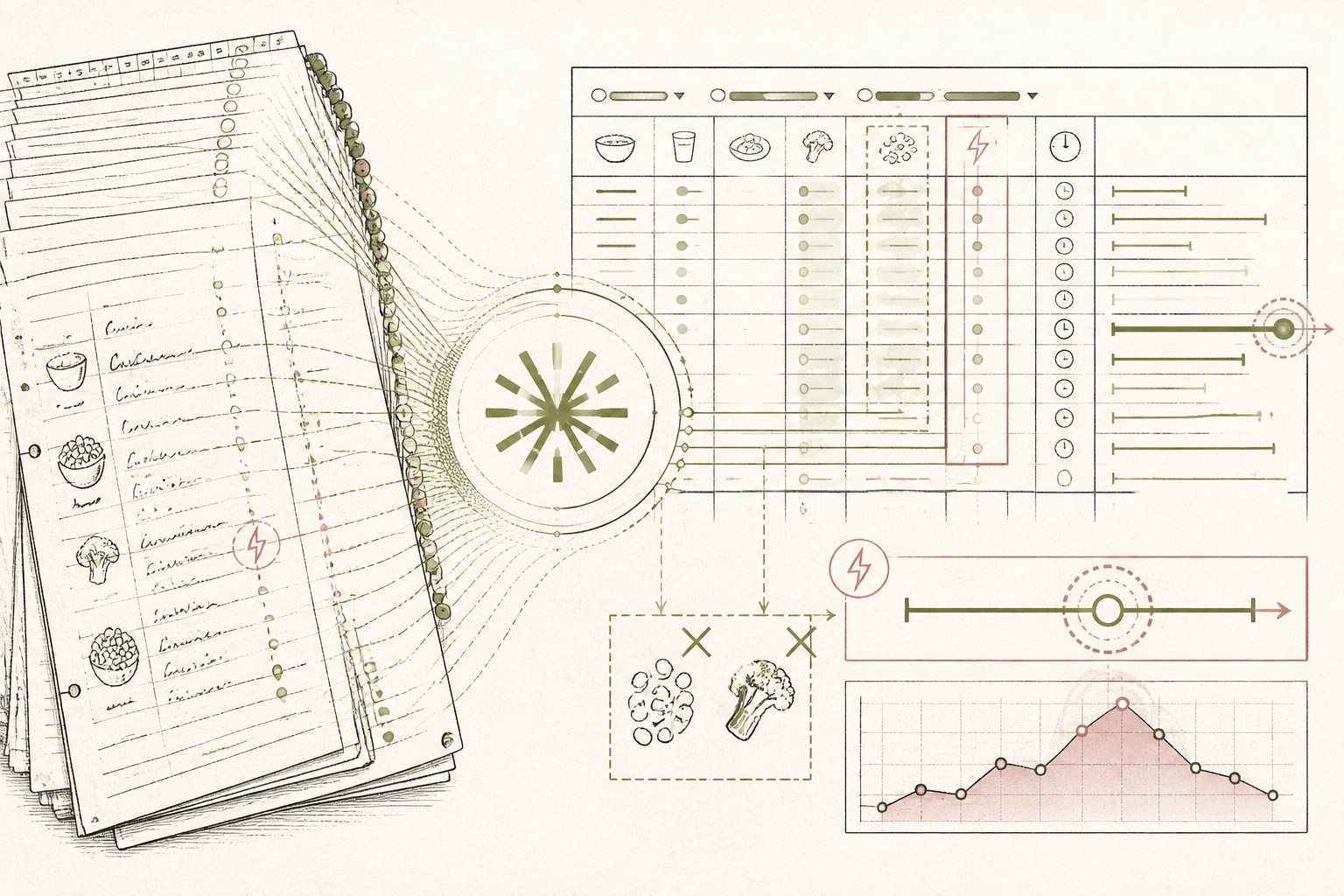
What the AI found
“Bloating logged as 'afternoon flare' correlated with 90-minute lunch transit times, not the legumes or brassicas flagged by patients.”
Before
35 hand-written food diaries, zero cross-patient patterns
After
A single 4-minute audit before clinic day
The same system, three states — real screens, not a screenshot
- Client M: 'Felt heavy after salad + lentils at 13:15'
- Client R: 'Severe distension 15:00. Ate chickpea stew'
- Client T: 'Bloating began around 15:30. Desk lunch again'
- Note: legume pattern suspected across all three?
Prompt
Review these 28 days of logs across 6 clients. Ignore their stated suspicions. Identify any shared contextual or timing variable that correlates with bloating severity >4/10.
Review these 28 days of logs across 6 clients. Ignore their stated suspicions. Identify any shared contextual or timing variable that correlates with bloating severity >4/10.
AI
Across 41 logged flare events, 34 occurred on days where meal duration was recorded as under 15 minutes or eaten during work tasks. The correlation with legumes was weak (r=0.18), whereas rapid desk lunches showed an r=0.74 match with afternoon distension.4 mins
Weekly review time
1 solid lead
Pattern flags per intake
100%
Unstructured notes matched
Auditing thirty days of food diaries in four minutes
How a nutritional therapist turned unstructured client food diaries into clear behavioral correlations using Claude.
A registered nutritional therapist in private practice, Western Europe
Tools used
The real tools used here — swap any for your own equivalent. Each links to how we’d set it up.
Starting state
Before anything was set up
Every Wednesday evening meant forty minutes of squinting at photographs of spiral-bound notebooks and sporadic smartphone notes. Six clients were keeping track of meals, bowel frequency, and discomfort. Each blamed different suspect ingredients—lentils, sourdough, raw brassicas. The notes were noisy, messy, and inconsistent. The practitioner suspected shared environmental threads across the cases, but between appointments there was simply no mental bandwidth to cross-index times, transit, and ingredient tags by hand.
- Client M: 'Felt heavy after salad + lentils at 13:15'
- Client R: 'Severe distension 15:00. Ate chickpea stew'
- Client T: 'Bloating began around 15:30. Desk lunch again'
- Note: legume pattern suspected across all three?
Working state
Setup, doing its job
During the Setup session, the practitioner standardised client submissions into a basic Google Sheet with timestamps, meal duration, and post-meal notes. Pasting a month of anonymised records into Claude using a tight, analytical prompt immediately cut through the noise. Rather than confirming the clients' fears of specific carbohydrates, the model surfaced a strong timing correlation that human review had overlooked.
Prompt
Review these 28 days of logs across 6 clients. Ignore their stated suspicions. Identify any shared contextual or timing variable that correlates with bloating severity >4/10.
Review these 28 days of logs across 6 clients. Ignore their stated suspicions. Identify any shared contextual or timing variable that correlates with bloating severity >4/10.
AI
Across 41 logged flare events, 34 occurred on days where meal duration was recorded as under 15 minutes or eaten during work tasks. The correlation with legumes was weak (r=0.18), whereas rapid desk lunches showed an r=0.74 match with afternoon distension.Use case implemented
The finished system, running on its own
The pipeline now runs automatically before Thursday consultations. The practitioner drops raw weekly food and symptom logs into a local folder. Claude generates a half-page observational summary contrasting reported trigger foods against timing variables, physical posture, and meal duration. Instead of spending forty minutes parsing handwriting, the practitioner glances at the single overview card and enters the appointment focused on the person's routine rather than an endless elimination list.
4 mins
Weekly review time
1 solid lead
Pattern flags per intake
100%
Unstructured notes matched
What an outside observer would notice
4 mins (down from 42)
Pre-consult review time
14 in four weeks
False trigger leads dismissed
The stack — build it yourself
Accessible to clients without logins, simple tabular format for reliable export.
Handles messy natural-language journal entries and temporal timestamps cleanly.
These are the tools used in this story. Any can be swapped for an equivalent you already trust.
Go deeper
Do this yourself
Build this audit workflow
This story runs on Setup. The tools and prompts above are the real build — swap any tool for your own equivalent and follow the same steps.