What the AI found
“"Your subjective exhaustion peaks not on days with high meeting hours, but on days with more than four calendar fragments under 25 minutes."”
Before
Sunday dread blamed on late Friday email replies
After
one 4-minute Friday audit protecting his weekends
The same system, three states — real screens, not a screenshot
- Oct 12: Completely drained. 4 Slack pings after 6pm.
- Oct 19: Sunday dread back again. Too many syncs this week?
- Oct 26: Wiped out. Felt like zero actual work got done.
Prompt
Audit these 3 weeks of calendar logs alongside daily exhaustion scores (1-10). Identify which structural variable—meeting volume, late pings, or schedule distribution—correlates most closely with days rated 7 or higher. Quantify the pattern.
I have pasted my last 3 weeks of calendar entries alongside my daily 1-10 exhaustion ratings from Apple Notes. Audit the correlation between total hours, message times, and my worst fatigue ratings.
AI
Total meeting hours show weak correlation (r=0.18) with your worst days. However, your subjective exhaustion peaks not on days with high meeting hours, but on days with more than four calendar fragments under 25 minutes. You averaged 14 of these gaps weekly, creating context-switching residue that lingered into your weekends.58 bpm (-7 bpm)
Avg Weekend Resting HR
0 per week
Meeting Frags <25m
4 min 12 sec
Friday Audit Time
Auditing schedule fragmentation to resolve persistent weekend cognitive fatigue
How a structured calendar audit isolated the true driver of weekend cognitive residue.
A 38-year-old product lead at a remote software consultancy, Northern Europe
Tools used
The real tools used here — swap any for your own equivalent. Each links to how we’d set it up.
Starting state
Before anything was set up
He carried a persistent Sunday evening dread into every weekend, convinced that working past 18:00 on Fridays was poisoning his recovery. His desk was littered with handwritten tallies of meeting counts and sporadic sleep scores, but none offered a clear lever. He cut evening Slack checks and moved his Friday wind-down to 17:00, yet the heavy cognitive static followed him to dinner every Saturday night.
- Oct 12: Completely drained. 4 Slack pings after 6pm.
- Oct 19: Sunday dread back again. Too many syncs this week?
- Oct 26: Wiped out. Felt like zero actual work got done.
Working state
Resources, doing its job
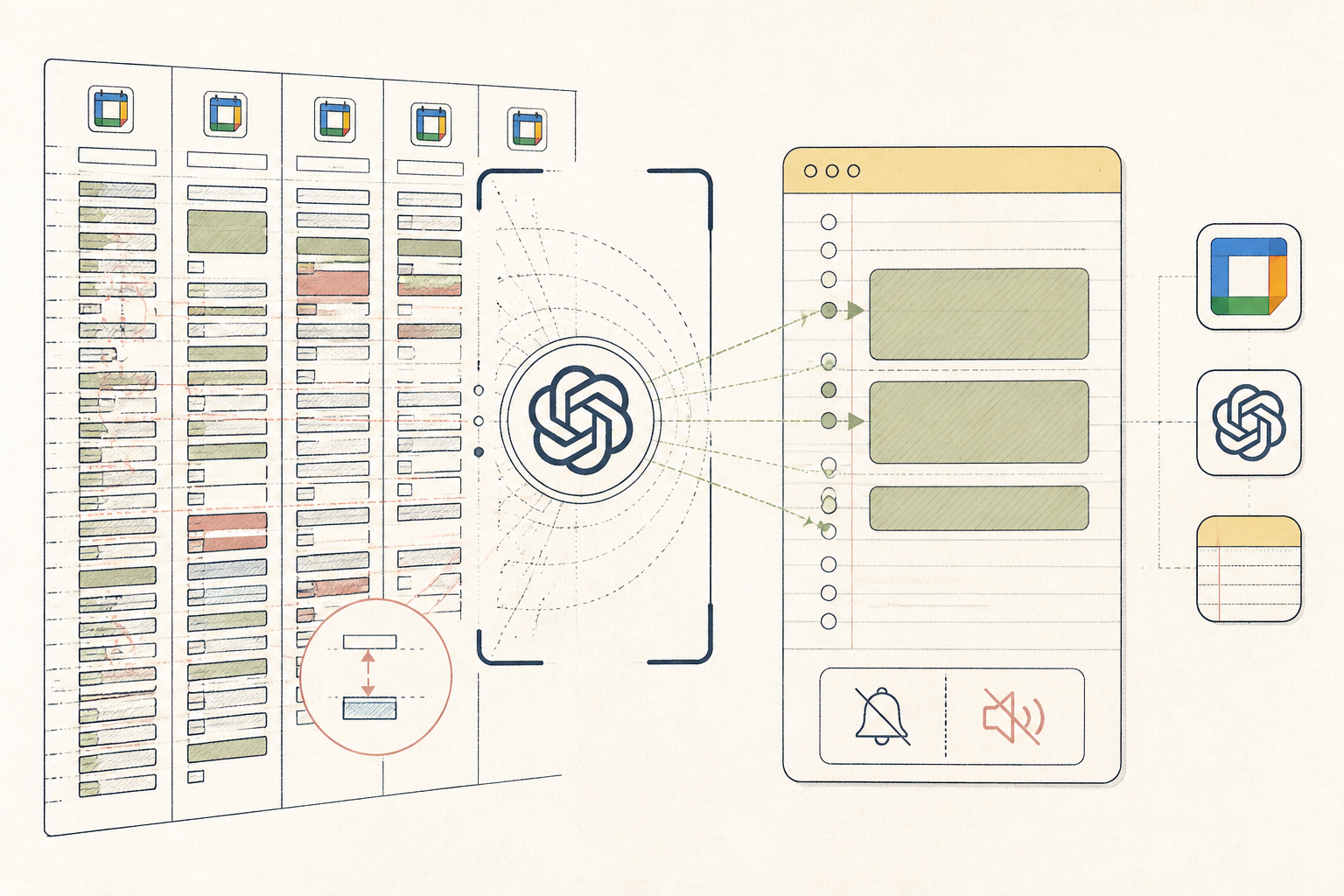
He used the Workload Audit Playbook to convert three weeks of calendar data and his two-line daily evening logs into a unified prompt. Rather than manually scanning twenty-one days of appointments, he fed the text export directly to ChatGPT using the playbook's structured correlation template. In under ninety seconds, the model isolated the actual driver: fourteen recurring micro-gaps between meetings that caused continual cognitive gear-shifting.
Prompt
Audit these 3 weeks of calendar logs alongside daily exhaustion scores (1-10). Identify which structural variable—meeting volume, late pings, or schedule distribution—correlates most closely with days rated 7 or higher. Quantify the pattern.
I have pasted my last 3 weeks of calendar entries alongside my daily 1-10 exhaustion ratings from Apple Notes. Audit the correlation between total hours, message times, and my worst fatigue ratings.
AI
Total meeting hours show weak correlation (r=0.18) with your worst days. However, your subjective exhaustion peaks not on days with high meeting hours, but on days with more than four calendar fragments under 25 minutes. You averaged 14 of these gaps weekly, creating context-switching residue that lingered into your weekends.Use case implemented
The finished system, running on its own
The system now runs every Friday at 16:30. A single shortcut exports his calendar distribution alongside his daily subjective score to ChatGPT, which verifies fragment counts and flags next week's schedule risks before he signs off. He no longer carries untangled week residue into Saturday morning. The calendar adjustments are mechanical rather than emotional: his team knows that half-hour windows under twenty-five minutes are automatically consolidated into single morning working blocks.
58 bpm (-7 bpm)
Avg Weekend Resting HR
0 per week
Meeting Frags <25m
4 min 12 sec
Friday Audit Time
What an outside observer would notice
Reduced from 14 to 0
Weekly calendar fragments
4 minutes
Friday wrap-up duration
Dropped from 8/10 to 3/10
Weekend subjective fatigue
The stack — build it yourself
Native .ics export provides timestamped blocks without third-party tracking overhead.
Quickly cross-references fragmented calendar time against brief qualitative notes.
Frictionless two-line daily logging on mobile without dashboard fatigue.
These are the tools used in this story. Any can be swapped for an equivalent you already trust.
Go deeper
Do this yourself
Explore the Workload Audit Playbook
This story runs on Resources. The tools and prompts above are the real build — swap any tool for your own equivalent and follow the same steps.