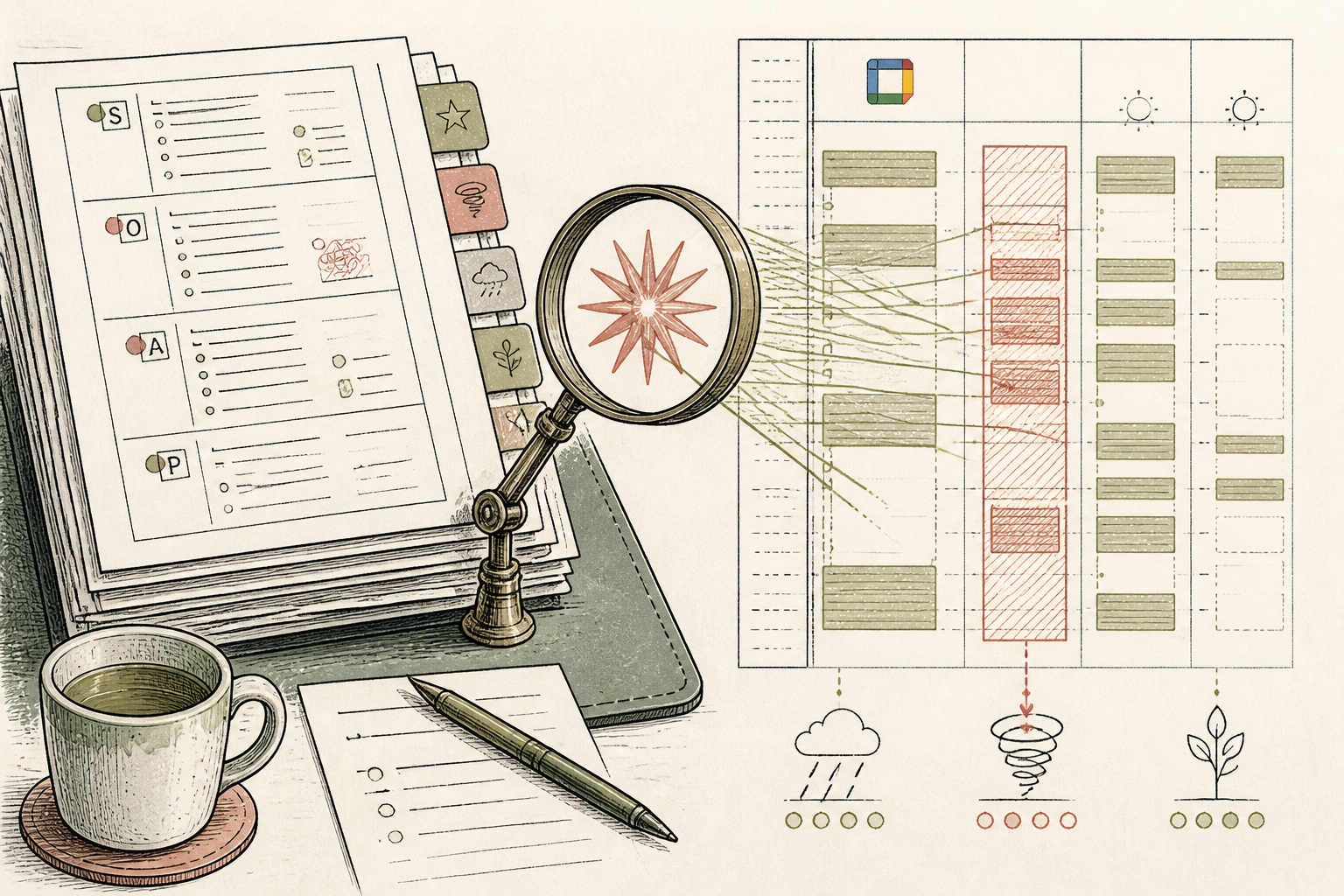
What the AI found
“Across 42 client notes, midday drop-offs occurred on days with consecutive back-to-back sessions, not on days with complex trauma intakes.”
Before
scattered subjective notes across 14 clients
After
a 12-minute Friday trend brief
The same system, three states — real screens, not a screenshot
- Oct 12: M. feeling stagnant. Heavy session. Felt exhausted by 4pm.
- Oct 14: S. breakthrough on grief. Low energy afternoon.
- Oct 19: Full day (5 clients). Rushed between appointments. Overwhelmed.
- Oct 21: J. missed session. Felt guilty catching up on admin.
Prompt
Here are 42 anonymised practitioner debrief notes from the last 3 weeks. Categorise recurring self-reported fatigue triggers against session types and pacing. Return a concrete correlation between my energy ratings and calendar structure.
Here are 42 anonymised practitioner debrief notes from the last 3 weeks. Categorise recurring self-reported fatigue triggers against session types and pacing.
AI
Across 42 entries, midday fatigue does not correlate with session intensity or trauma topics (r=0.12). It correlates directly with schedule structure: 82% of reported exhaustion occurred on days with 3+ consecutive sessions lacking a 20-minute buffer.14 active profiles
Caseload sync
0 this week
Buffer warnings
12 mins / Friday
Review cadence
Auditing Practitioner Mood and Caseload Strain With AI
How a private therapist built a reflective practice system in fifteen minutes a day.
A licensed psychotherapist in private practice, Western EU
Tools used
The real tools used here — swap any for your own equivalent. Each links to how we’d set it up.
Starting state
Before anything was set up
Her desktop was cluttered with fragmented Apple Notes, scratched paper intake margins, and vague end-of-day impressions across fourteen weekly clients. She spent Sunday evenings trying to remember if a client's mood had dipped two weeks prior or three, second-guessing her own clinical recall. Administrative fatigue clouded her objectivity, leaving her drained before Monday even began.
- Oct 12: M. feeling stagnant. Heavy session. Felt exhausted by 4pm.
- Oct 14: S. breakthrough on grief. Low energy afternoon.
- Oct 19: Full day (5 clients). Rushed between appointments. Overwhelmed.
- Oct 21: J. missed session. Felt guilty catching up on admin.
Working state
10-Day Challenge, doing its job
On Day 6 of the challenge, she pasted forty-two stripped, de-identified session logs into Claude. She asked the model to cross-reference her logged fatigue against session topics and calendar gaps. In seconds, the model isolated the actual stressor: complex trauma sessions had zero correlation with her afternoon fatigue. Back-to-back scheduling did.
Prompt
Here are 42 anonymised practitioner debrief notes from the last 3 weeks. Categorise recurring self-reported fatigue triggers against session types and pacing. Return a concrete correlation between my energy ratings and calendar structure.
Here are 42 anonymised practitioner debrief notes from the last 3 weeks. Categorise recurring self-reported fatigue triggers against session types and pacing.
AI
Across 42 entries, midday fatigue does not correlate with session intensity or trauma topics (r=0.12). It correlates directly with schedule structure: 82% of reported exhaustion occurred on days with 3+ consecutive sessions lacking a 20-minute buffer.Use case implemented
The finished system, running on its own
By day ten, the system ran on a quiet weekly routine. Every Friday afternoon, she drops her anonymised batch notes into a locked Claude project equipped with her tailored schema. Within twelve minutes, it generates a structured caseload summary, flags potential practitioner fatigue signals, and outlines client-reported mood patterns ready for Monday supervision. She spends zero weekend hours catching up on documentation, maintaining full oversight while protecting her own emotional stamina.
14 active profiles
Caseload sync
0 this week
Buffer warnings
12 mins / Friday
Review cadence
What an outside observer would notice
12 minutes
Friday admin time
Capped at 2 max
Back-to-back sessions
100% weekly
Caseload pattern review
The stack — build it yourself
Strict privacy controls, strong reasoning over lengthy text, and zero data training on enterprise tiers.
Automates required 20-minute clinician buffer blocks based on synthesis recommendations.
These are the tools used in this story. Any can be swapped for an equivalent you already trust.
Go deeper
Do this yourself
Explore the 10-Day Challenge
This story runs on 10-Day Challenge. The tools and prompts above are the real build — swap any tool for your own equivalent and follow the same steps.