What the AI found
“Your afternoon cognitive slump didn't follow heavy meals; it followed days with more than three context switches before 11:00, regardless of sleep score.”
Before
afternoon fog blamed on lunch or caffeine
After
a protected 90-minute morning deep work block
The same system, three states — real screens, not a screenshot
- 14 Oct: 15:00 crash. Cut carbs at lunch, no change.
- 18 Oct: Heavy fog by 14:30. Slept 8h12m (Oura 84). Why?
- 22 Oct: Tried second espresso at 13:00. Jittery, unfocused.
- 29 Oct: Brain feels underwater by 15:00 again.
Prompt
Here is my calendar schedule for the last 20 workdays alongside my 1-10 focus ratings recorded at 15:00. Cross-reference the days with ratings below 4 against meeting density, meal logs, and morning task switches. What pattern explains the low scores?
Here is my calendar schedule for the last 20 workdays alongside my 1-10 focus ratings recorded at 15:00. Cross-reference the days with ratings below 4 against meeting density, meal logs, and morning task switches. What pattern explains the low scores?
AI
Your focus ratings show zero meaningful correlation with lunch type or sleep duration (r=0.08). However, all 7 days with a rating under 4 featured at least four task switches across different projects before 11:00. On days with a single protected morning block, your average 15:00 focus was 8.1.1.2 avg
Pre-11am context switches
8.4 / 10
Self-rated 3pm clarity
90 min
Uninterrupted focus block
Auditing cognitive fragmentation to resolve the afternoon slump
How an independent researcher exposed the hidden trigger behind a daily 3pm mental fog.
A 38-year-old independent policy researcher, Northern Europe
Tools used
The real tools used here — swap any for your own equivalent. Each links to how we’d set it up.
Starting state
Before anything was set up
Afternoons arrived like wet wool. By 15:00, reading dense regulatory drafts felt impossible, forcing repeated paragraphs and misplaced references. The assumption was physiological: too many carbohydrates at midday, insufficient hydration, or poor sleep architecture. A scratchpad in Apple Notes documented erratic dietary adjustments, varied caffeine cut-offs, and steady complaints about sluggish thinking, yet the cognitive drop returned four days out of five, completely untethered to the previous night's sleep score.
- 14 Oct: 15:00 crash. Cut carbs at lunch, no change.
- 18 Oct: Heavy fog by 14:30. Slept 8h12m (Oura 84). Why?
- 22 Oct: Tried second espresso at 13:00. Jittery, unfocused.
- 29 Oct: Brain feels underwater by 15:00 again.
Working state
Hacks Pass, doing its job
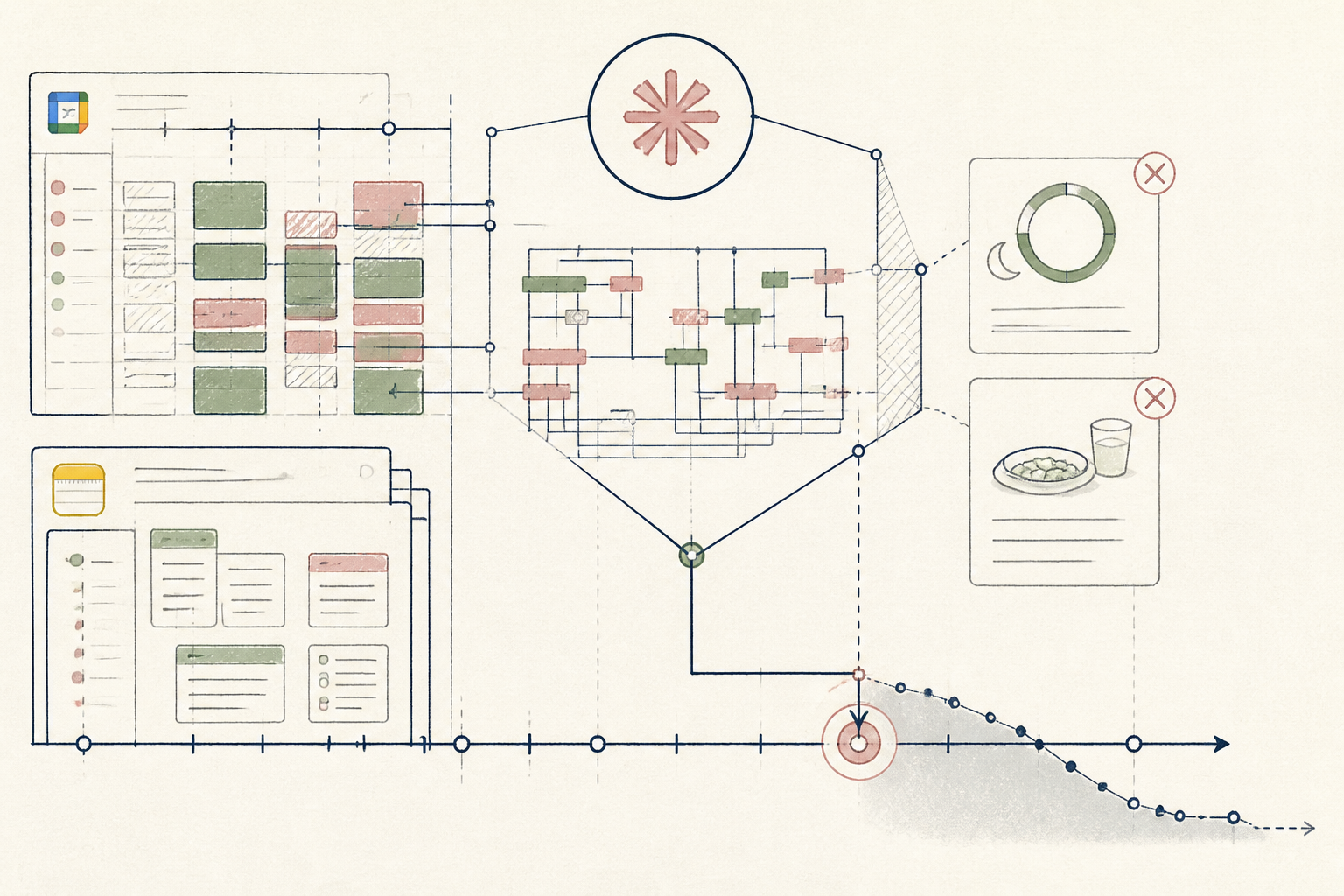
Exporting four weeks of Google Calendar records alongside daily 15:00 subjective clarity ratings yielded forty paired rows. Using a focused analytical prompt in Claude, the logs were evaluated for hidden dependencies across meeting volume, dietary notes, and early morning activities. Within seconds, the analysis separated schedule architecture from nutrition, identifying morning project fragmentation as the sole statistical determinant of late-day mental depletion.
Prompt
Here is my calendar schedule for the last 20 workdays alongside my 1-10 focus ratings recorded at 15:00. Cross-reference the days with ratings below 4 against meeting density, meal logs, and morning task switches. What pattern explains the low scores?
Here is my calendar schedule for the last 20 workdays alongside my 1-10 focus ratings recorded at 15:00. Cross-reference the days with ratings below 4 against meeting density, meal logs, and morning task switches. What pattern explains the low scores?
AI
Your focus ratings show zero meaningful correlation with lunch type or sleep duration (r=0.08). However, all 7 days with a rating under 4 featured at least four task switches across different projects before 11:00. On days with a single protected morning block, your average 15:00 focus was 8.1.Use case implemented
The finished system, running on its own
The system now protects itself without active intervention. A shared template links calendar categories directly to a daily review note in Apple Notes. Every morning before 09:00, the individual holds a single non-negotiable ninety-minute block for deep writing, moving administrative check-ins and Slack sorting past 11:30. The post-lunch lethargy has resolved into steady, predictable stamina across the late afternoon, driven entirely by deliberate morning boundaries rather than supplement adjustments or afternoon espresso routines.
1.2 avg
Pre-11am context switches
8.4 / 10
Self-rated 3pm clarity
90 min
Uninterrupted focus block
What an outside observer would notice
-65%
Pre-11:00 meeting switches
+420 words/day
Afternoon writing output
3.1 -> 8.2 / 10
Post-lunch subjective focus
The stack — build it yourself
Handles long tabular context logs without truncation or losing row alignment.
Provides clean timestamp exports of daily task blocks and interruptions.
Fast, local daily logging of self-rated mental clarity scores at 15:00.
These are the tools used in this story. Any can be swapped for an equivalent you already trust.
Go deeper
Do this yourself
Read the build
This story runs on Hacks Pass. The tools and prompts above are the real build — swap any tool for your own equivalent and follow the same steps.