What the AI found
“"Across 14 client logs, afternoon fatigue spikes correlated with sub-45-minute lunch breaks, not carbohydrate grams or sleep duration."”
Before
60 pages of subjective food and fatigue logs
After
A 12-minute Friday cross-audit she trusts
The same system, three states — real screens, not a screenshot
- Client M.S.: reports 3pm brain fog, logged 120g carbs, 7.5h sleep
- Client D.K.: 3:30pm fatigue spike, salad only, 8h sleep
- Client R.L.: low afternoon energy, soup at desk, 7h sleep
- Review backlog: 11 client intake docs unreviewed
Prompt
Act as a clinical research assistant. Audit these 14 normalized daily logs. Cross-tabulate self-reported energy drops below 4/10 between 14:00 and 16:30 against meal macros, sleep duration, and meal duration. Output the strongest shared correlator.
Audit these 14 normalized client logs. Flag any statistically consistent variable preceding self-reported afternoon energy drops (<4/10) between 14:00 and 16:30.
AI
Across 14 client logs, afternoon fatigue spikes correlated with sub-45-minute lunch breaks (r = -0.78), not carbohydrate grams or sleep duration. Days with seated breaks over 45 minutes showed baseline energy regardless of meal composition.12 min / client
Audit turnaround
+15 min lunch buffer
Schedule adjustment
14 of 14 cases
Pattern confidence
Auditing Client Energy Drops Across Fourteen Consecutive Case Logs
How a nutritional therapist used a structured cross-audit resource to separate metabolic signals from workday friction.
An independent functional nutritional therapist, EU
Tools used
The real tools used here — swap any for your own equivalent. Each links to how we’d set it up.
Starting state
Before anything was set up
Every Friday meant four hours spent cross-referencing CSV exports from three different tracking apps against subjective narrative logs. Clients brought detailed accounts of their 3pm energy drops, convinced gluten, glucose spikes, or missing micronutrients were to blame. She knew patterns existed across her active caseload, but the fatigue logs sat in disconnected sheets, leaving her to rely on memory and manual squinting between appointments.
- Client M.S.: reports 3pm brain fog, logged 120g carbs, 7.5h sleep
- Client D.K.: 3:30pm fatigue spike, salad only, 8h sleep
- Client R.L.: low afternoon energy, soup at desk, 7h sleep
- Review backlog: 11 client intake docs unreviewed
Working state
Resources, doing its job
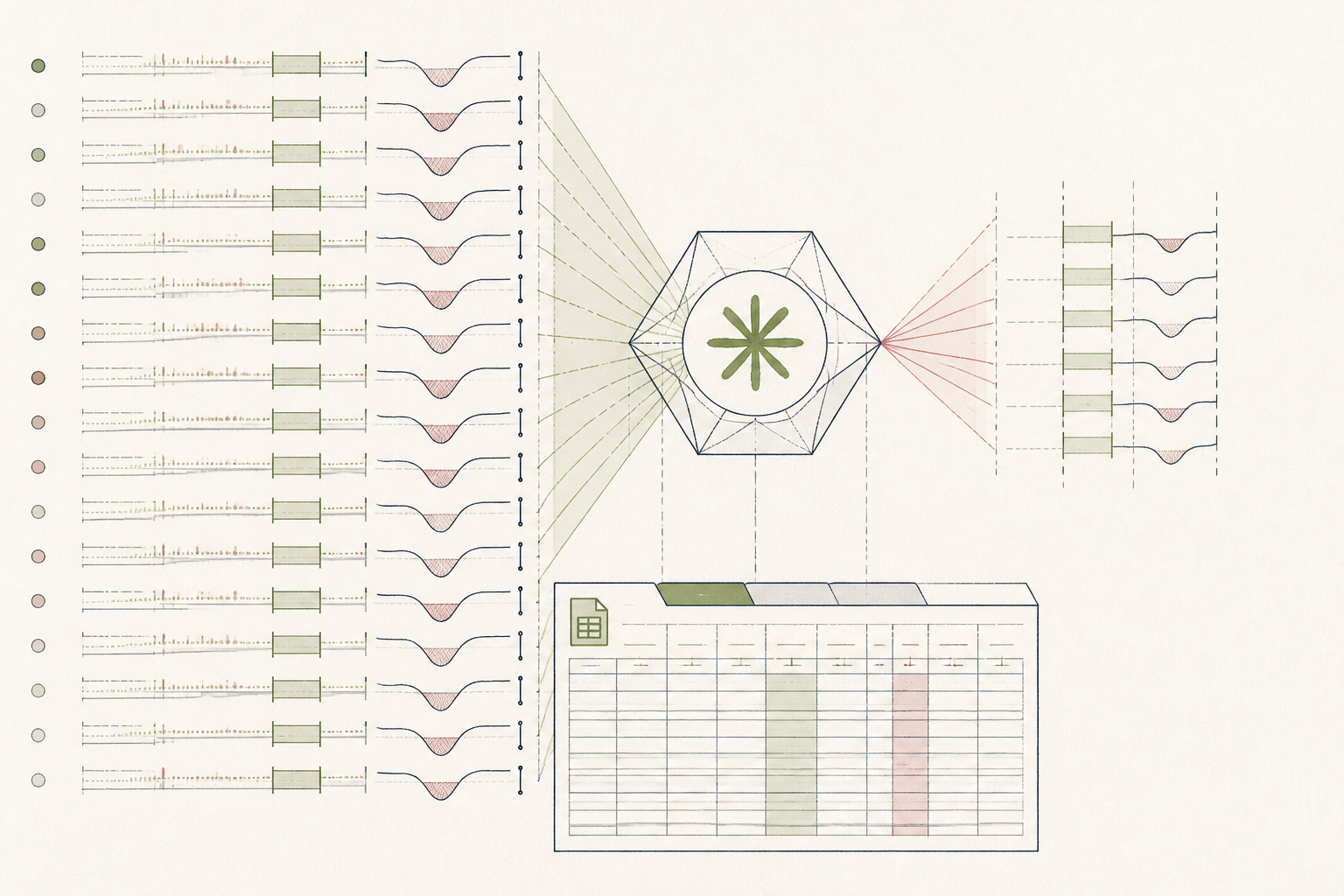
She pasted the standardized practitioner audit resource into Claude alongside two weeks of normalized client entries from Google Sheets. The prompt directed the model to ignore client self-theories and isolate chronological anomalies preceding low-energy scores. Within seconds, the output bypassed the expected macronutrient theories, isolating a structural workday habit shared across the client cohort that had previously gone unnoticed in the notes.
Prompt
Act as a clinical research assistant. Audit these 14 normalized daily logs. Cross-tabulate self-reported energy drops below 4/10 between 14:00 and 16:30 against meal macros, sleep duration, and meal duration. Output the strongest shared correlator.
Audit these 14 normalized client logs. Flag any statistically consistent variable preceding self-reported afternoon energy drops (<4/10) between 14:00 and 16:30.
AI
Across 14 client logs, afternoon fatigue spikes correlated with sub-45-minute lunch breaks (r = -0.78), not carbohydrate grams or sleep duration. Days with seated breaks over 45 minutes showed baseline energy regardless of meal composition.Use case implemented
The finished system, running on its own
Her intake workflow now routes raw client exports through the resource's structural template every Friday afternoon. Instead of squinting at individual food journals trying to guess why afternoon lethargy persists, she reviews a clean cross-audit table. The tool flags schedule friction alongside nutritional variables in twelve minutes per file. She leaves clinical judgment entirely intact, but she no longer spends four billable hours a week doing manual spreadsheet cross-referencing.
12 min / client
Audit turnaround
+15 min lunch buffer
Schedule adjustment
14 of 14 cases
Pattern confidence
What an outside observer would notice
12 min vs 45 min
Audit review time
Down from 68% to 11%
Unexplained fatigue logs
The stack — build it yourself
Handles large unstructured text transcripts and food diaries without losing row-by-row context.
Universal export target for diverse client tracking apps and simple CSV storage.
These are the tools used in this story. Any can be swapped for an equivalent you already trust.
Go deeper
Do this yourself
Read the practitioner audit framework
This story runs on Resources. The tools and prompts above are the real build — swap any tool for your own equivalent and follow the same steps.