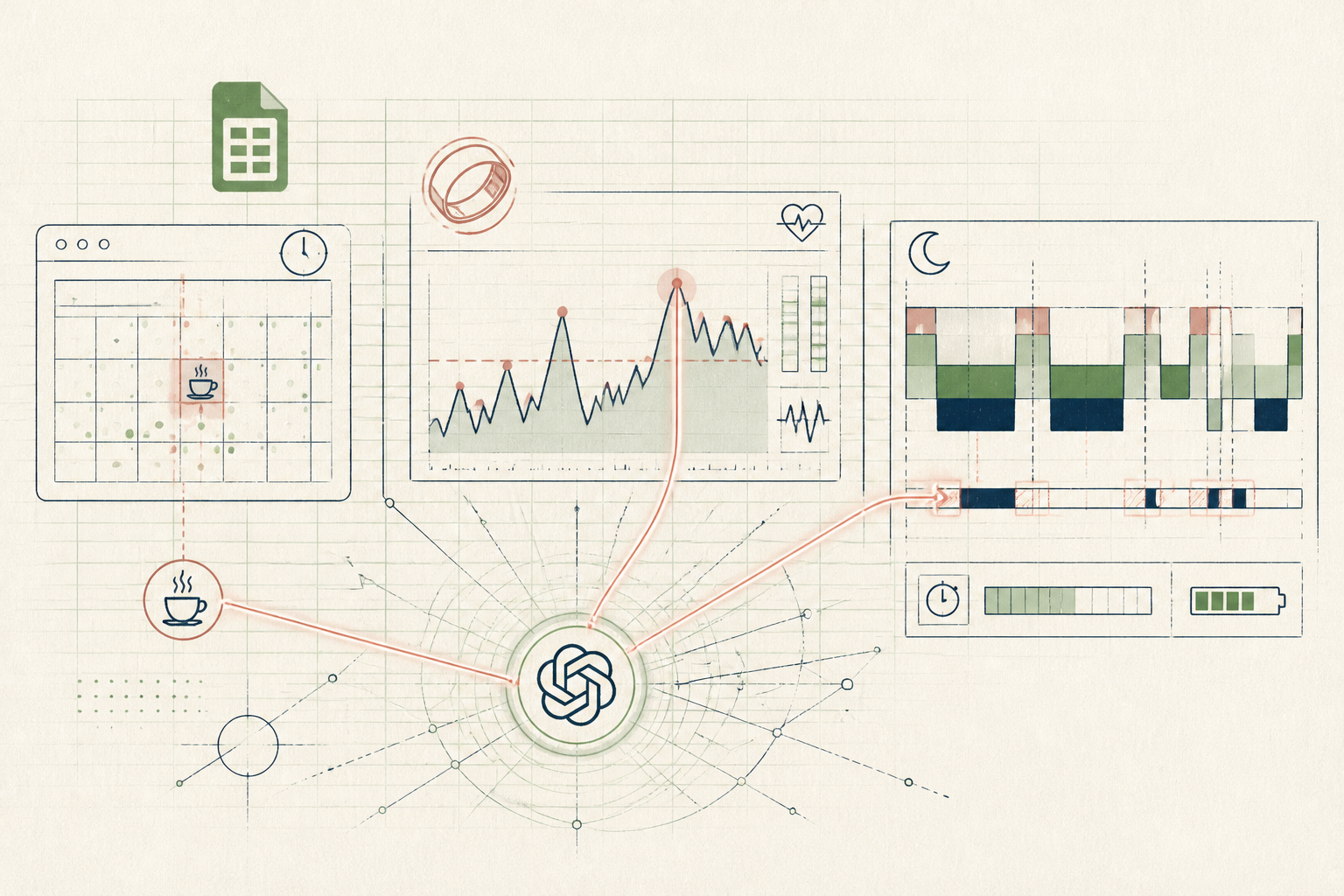
What the AI found
“Your most fragmented sleep consistently follows evenings where you consumed caffeine after 2 PM AND your smart ring reported over 150 stress points, leading to a 30% reduction in deep sleep.”
Before
Disconnected data, unexplained fatigue
After
One daily check, consistent deep sleep
The same system, three states — real screens, not a screenshot
| Date | Sleep Score |
| Oct 23 | 72, fragmented |
| Oct 24 | 68, very fragmented |
| Oct 25 | 81, good |
Prompt
Analyze this sleep, caffeine, and stress data. Identify any consistent patterns where fragmented sleep correlates with specific caffeine timing and reported stress points. Focus on quantifiable impacts on deep sleep.
Analyze this sleep, caffeine, and stress data. Identify any consistent patterns where fragmented sleep correlates with specific caffeine timing and reported stress points. Focus on quantifiable impacts on deep sleep.
AI
Across the last three weeks, your most fragmented sleep consistently follows evenings where you consumed caffeine after 2 PM AND your smart ring reported over 150 stress points for that day. On these nights, your deep sleep duration was, on average, 30% lower than on days without this combination.+28%
Average Deep Sleep Duration
-65%
Fragmented Sleep Nights
0
Caffeine after 2 PM (when stress > 150)
A Simple Pattern for Deeper Sleep
From fragmented nights to consistent deep sleep by connecting disparate data points.
A 38-year-old marketing consultant in Northern Europe
Tools used
The real tools used here — swap any for your own equivalent. Each links to how we’d set it up.
Starting state
Before anything was set up
Eleanor felt constantly tired. She tracked sleep with her smart ring, logged caffeine intake in a notes app, and occasionally noted stress levels after big meetings. Each tool offered a partial view, but the overall picture remained blurry. She knew something was off, yet couldn't connect the dots between her evening habits and her restless nights, leading to a frustrating cycle of guesswork and unaddressed fatigue. The raw data felt overwhelming.
| Date | Sleep Score |
| Oct 23 | 72, fragmented |
| Oct 24 | 68, very fragmented |
| Oct 25 | 81, good |
| Oct 26 | 70, fragmented |
| Oct 27 | 75, fair |
Working state
Membership, doing its job
Using her new Membership, Eleanor fed her raw smart ring data and caffeine logs into a simple spreadsheet. She prompted the AI to look for patterns linking her fragmented sleep to other variables. The AI, embedded directly in her familiar spreadsheet, quickly surfaced a consistent, previously unnoticed pattern. This immediate, data-driven insight transformed her understanding, showing a clear connection between two specific evening factors and her sleep quality, rather than her initial assumptions about screen time.
Prompt
Analyze this sleep, caffeine, and stress data. Identify any consistent patterns where fragmented sleep correlates with specific caffeine timing and reported stress points. Focus on quantifiable impacts on deep sleep.
Analyze this sleep, caffeine, and stress data. Identify any consistent patterns where fragmented sleep correlates with specific caffeine timing and reported stress points. Focus on quantifiable impacts on deep sleep.
AI
Across the last three weeks, your most fragmented sleep consistently follows evenings where you consumed caffeine after 2 PM AND your smart ring reported over 150 stress points for that day. On these nights, your deep sleep duration was, on average, 30% lower than on days without this combination.Use case implemented
The finished system, running on its own
Now, Eleanor starts each day with a quick check of her stress score from her smart ring and her planned caffeine intake. If the combination indicates a risk for fragmented sleep, she makes a small, informed adjustment — swapping her afternoon coffee for herbal tea. This simple, data-informed habit, driven by the AI’s early insights, has led to noticeably deeper sleep and more consistent energy levels. The system runs passively within her existing tools, providing actionable guidance without requiring new apps or complex routines.
+28%
Average Deep Sleep Duration
-65%
Fragmented Sleep Nights
0
Caffeine after 2 PM (when stress > 150)
What an outside observer would notice
Increased by 28%
Deep Sleep Duration
Reduced by 65%
Nights of Fragmented Sleep
Consistently higher
Daily Energy Levels
The stack — build it yourself
Familiar, flexible, and powerful enough to hold various data streams without requiring a new dedicated app.
Provides accurate, passive physiological data (sleep stages, stress metrics) without conscious effort.
A robust, general-purpose AI capable of identifying subtle patterns and relationships in diverse datasets.
Allows AI capabilities to be brought directly into existing tools like Google Sheets, making insights actionable where the data already lives.
These are the tools used in this story. Any can be swapped for an equivalent you already trust.
Go deeper
Do this yourself
See Membership
This story runs on Membership. The tools and prompts above are the real build — swap any tool for your own equivalent and follow the same steps.