What the AI found
“"Your deep sleep dropped by 38 minutes only on nights when dinner ended after 20:45, regardless of whether you had wine or screen time."”
Before
14 months of Oura exports left untouched in Downloads
After
One 4-minute Friday summary and no wearable friction
The same system, three states — real screens, not a screenshot
- Oura export 2023_v2.csv sitting in Downloads
- Try magnesium bisglycinate again?
- Cut screens at 21:30 — did not feel any different
- Woke up unrefreshed at 06:15 again
Prompt
Here is the merged 90-day table containing sleep stages, resting heart rate, dinner end time, and alcohol units. Find the strongest statistical correlations with deep sleep under 45 minutes.
Here is the merged 90-day table containing sleep stages, resting heart rate, dinner end time, and alcohol units. Find the strongest statistical correlations with deep sleep under 45 minutes.
AI
Analyzing 90 days. Screen time past 22:00 showed no statistically relevant shift in deep sleep (p=0.41). Alcohol (1-2 units) correlated with a minor resting heart rate rise (+4 bpm) but preserved deep sleep percentages. However, your deep sleep dropped by 38 minutes only on nights when dinner ended after 20:45, regardless of whether you had wine or screen time. On nights dinner completed before 20:00, deep sleep averaged 1 hour 24 minutes.1h 22m (+31m)
Avg deep sleep
6 of 7 nights
Cutoff adherence
3.5 mins
Weekly review time
A Done-For-You Data Bridge Unlocks Forty Minutes of Deep Sleep
How an automated data bridge isolated the single habit costing forty minutes of deep sleep.
A 44-year-old architectural consultant, Western Europe
Tools used
The real tools used here — swap any for your own equivalent. Each links to how we’d set it up.
Starting state
Before anything was set up
Fourteen months of high-resolution biometric records sat inside compressed folders on his desktop. Every morning brought a familiar low-grade frustration: checking a recovery score, noticing an hour of fragmented rest, and wondering whether to blame the late email, the single glass of wine, or room temperature. He had neither the appetite nor the twenty spare hours required to clean spreadsheet columns, normalize timestamps, and write statistical scripts.
- Oura export 2023_v2.csv sitting in Downloads
- Try magnesium bisglycinate again?
- Cut screens at 21:30 — did not feel any different
- Woke up unrefreshed at 06:15 again
Working state
Done-for-you, doing its job
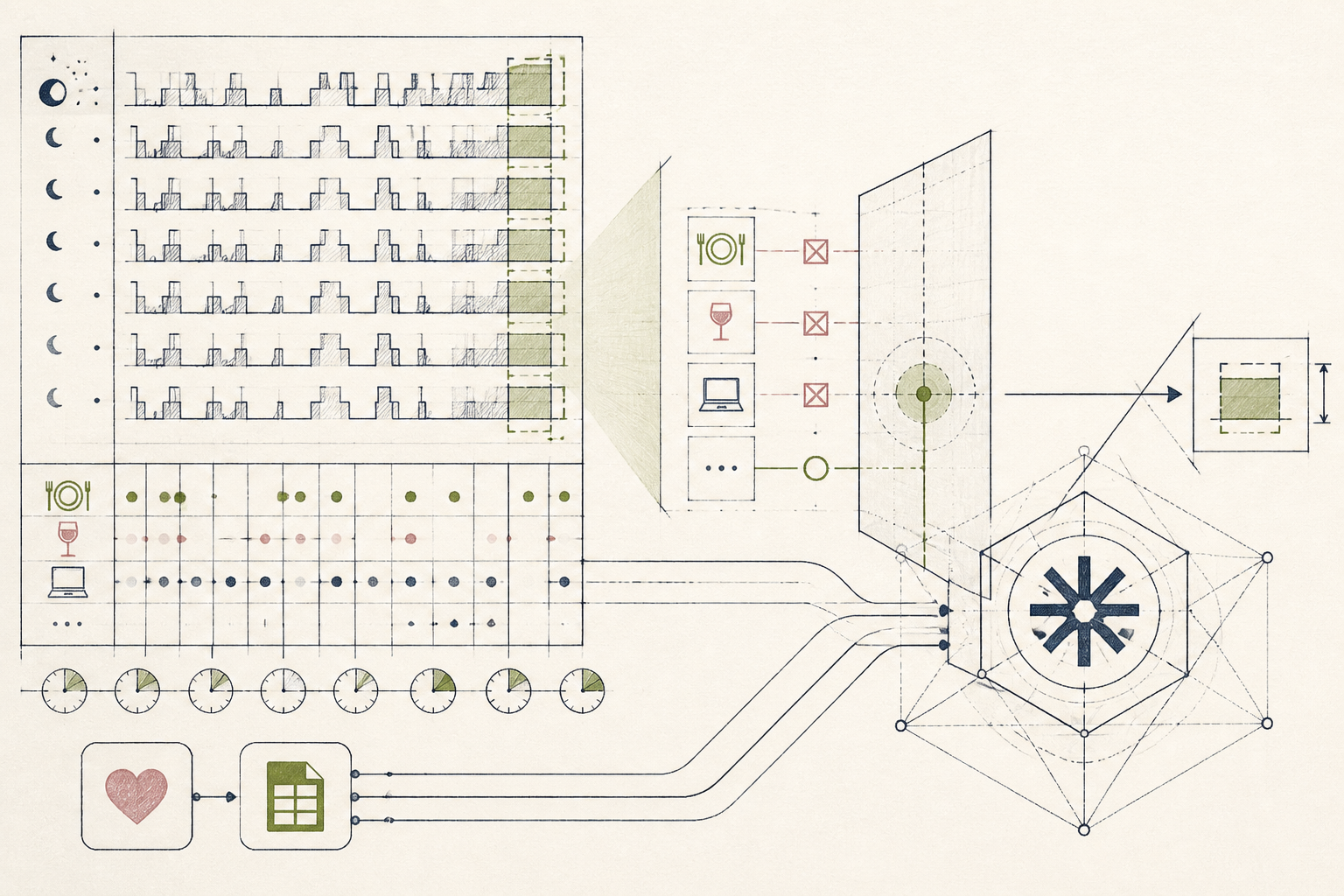
The done-for-you handoff removed the setup barrier entirely. Our team built a zero-touch pipeline that merged his evening meal logs from his calendar with his wearable's sleep stages into a standardized Google Sheet. On the first structured run, Claude processed ninety days of cross-referenced records, rejecting his assumptions about evening screen exposure and isolating the exact dinner cutoff threshold that dictated his recovery.
Prompt
Here is the merged 90-day table containing sleep stages, resting heart rate, dinner end time, and alcohol units. Find the strongest statistical correlations with deep sleep under 45 minutes.
Here is the merged 90-day table containing sleep stages, resting heart rate, dinner end time, and alcohol units. Find the strongest statistical correlations with deep sleep under 45 minutes.
AI
Analyzing 90 days. Screen time past 22:00 showed no statistically relevant shift in deep sleep (p=0.41). Alcohol (1-2 units) correlated with a minor resting heart rate rise (+4 bpm) but preserved deep sleep percentages. However, your deep sleep dropped by 38 minutes only on nights when dinner ended after 20:45, regardless of whether you had wine or screen time. On nights dinner completed before 20:00, deep sleep averaged 1 hour 24 minutes.Use case implemented
The finished system, running on its own
The finished system runs quietly without manual data entry. A lightweight shortcut pulls dinner timestamps from Apple Reminders alongside Apple Health sleep architecture into a clean weekly prompt in Claude. Every Friday at 17:00, the composite subject receives a three-bullet synthesis: dinner end-time adherence, deep sleep duration, and next week's recommended kitchen cutoff. He spends four minutes reviewing it, makes his schedule adjustments for the weekend, and closes the browser.
1h 22m (+31m)
Avg deep sleep
6 of 7 nights
Cutoff adherence
3.5 mins
Weekly review time
What an outside observer would notice
+31 mins/night
Deep sleep avg
86% of nights
Dinner cutoff kept
4 mins review
Weekly friction
The stack — build it yourself
Consolidates sleep stage intervals and resting heart rate locally without third-party subscriptions.
Simple tabular target for automated weekly exports, easy to inspect and audit.
Handles small, dense numerical tables reliably with zero conversational filler.
These are the tools used in this story. Any can be swapped for an equivalent you already trust.
Go deeper
Do this yourself
Explore done-for-you systems
This story runs on Done-for-you. The tools and prompts above are the real build — swap any tool for your own equivalent and follow the same steps.