Wearables · Setup in 10 min· Setup Pass
Set up Oura for Sleep Analysis in 10 minutes
Configure the Oura ring and app to move beyond a simple score and read your raw sleep and recovery data.
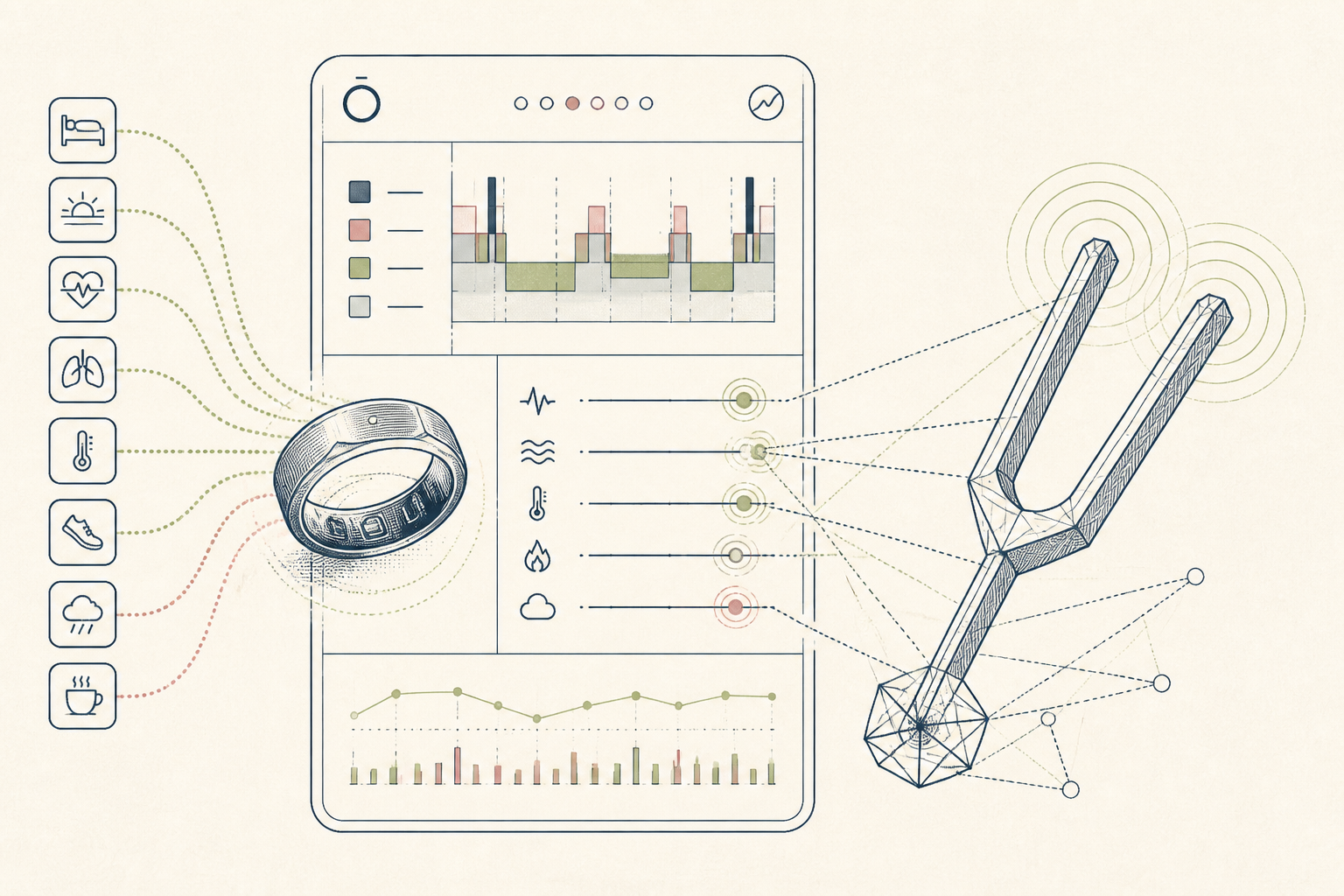
An Oura ring produces daily Sleep and Readiness scores, but these numbers alone offer little actionable information. A better workflow is to use the ring as a personal ledger, mapping specific lifestyle inputs to objective outputs in your sleep data. This setup shows you how to read the underlying data directly.
Before you start
- An Oura Ring and charger
- An active Oura account and paired phone
- 1-2 weeks of consistent wear for calibration
The steps
- 01
Calibrate Your Baseline
Wear the ring consistently for at least 14 nights. This initial period allows the app to learn your personal sleep and activity patterns, establishing a stable baseline against which all future data will be compared.
- 02
Tag Your Daily Inputs
Use the "Add a Tag" feature on the home screen each day. Tag everything from caffeine intake and late meals to specific stressors or supplements to build a personal ledger of how behaviors affect your sleep metrics.
- 03
Read Contributors, Not Scores
Ignore the top-level Sleep and Readiness scores. Instead, tap into the Sleep view and analyze the "Sleep Contributors"—looking for patterns in your deep sleep, REM sleep, and resting heart rate curves relative to the tags you added.
- 04
Isolate One Variable in Trends
Use the Trends view (top-left menu) to track a single metric against one tagged behavior. Correlate "Deep Sleep" with the "Meditation" tag, for example, to see if your practice has a measurable effect over a 30-day period.
- 05
Set Your Alert Thresholds
In Settings > Notifications, disable score notifications. Instead, enable alerts for significant changes in body temperature or heart rate variability, turning the ring into a specific detection tool rather than a general scorekeeper.
Honest note
The Readiness Score is a proprietary algorithm, not a clinical measure. It can create unhelpful anxiety when it conflicts with your subjective feeling, leading you to trust a black-box score over your own body. Treat it as a single data point—not as a definitive judgment on your capacity.
Want the whole stack, not just one tool?
The free 10-Day Challenge wires these together. Or join the free 45-min live workshop and watch me build it end-to-end.