Research · Setup in 8 min· Setup Pass
Set up Consensus for supplement research in 8 minutes
Configure Consensus to vet supplement claims by summarizing findings from published research.
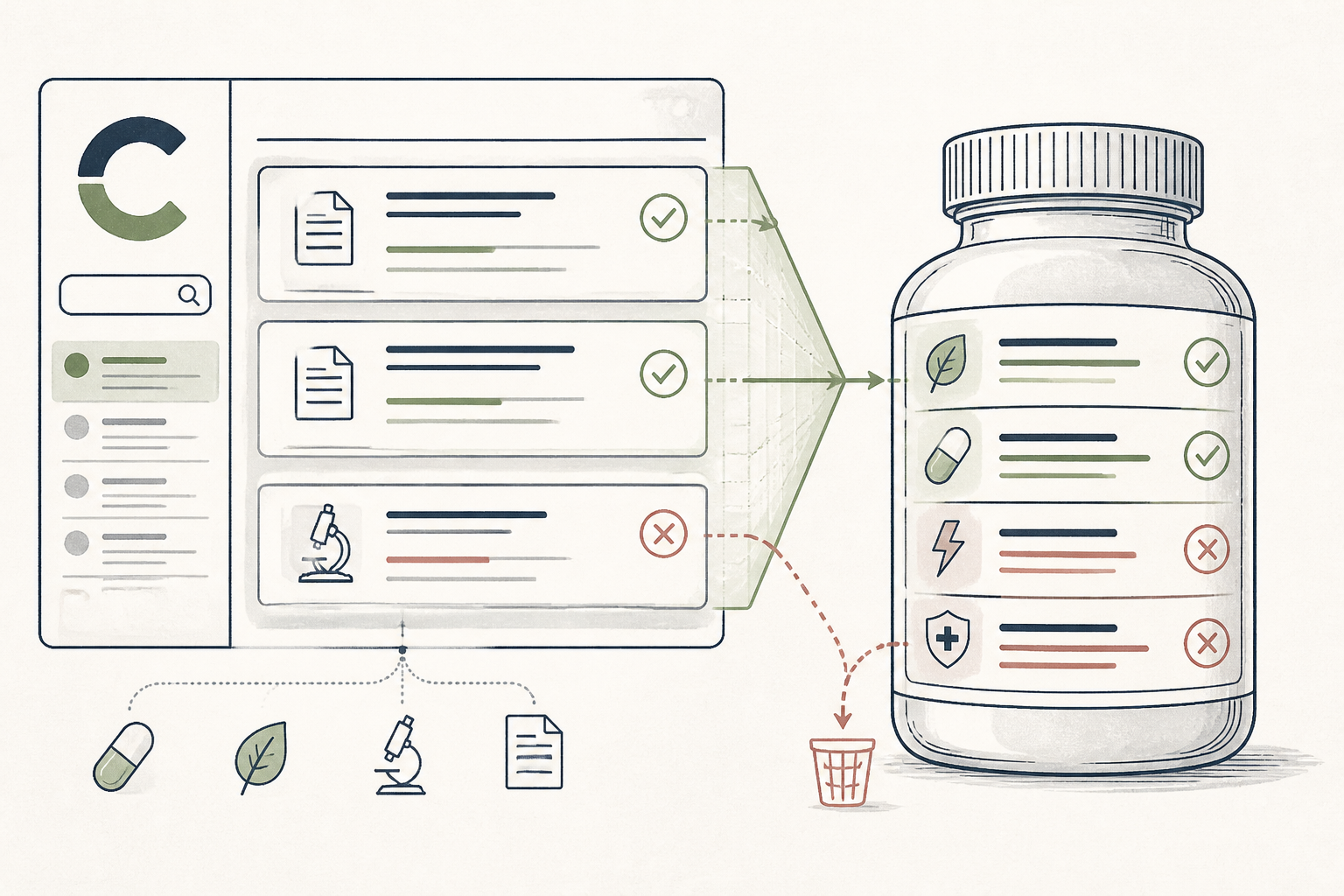
Health supplements are notorious for making bold claims on the bottle. Instead of relying on marketing copy or random blogs, use a dedicated scientific search engine to check the claims against the published literature. This setup creates a first-pass filter for any new supplement you are considering.
Before you start
- A Consensus account
- The name of a supplement or health intervention to research
- 8 quiet minutes
The steps
- 01
Start with a direct question.
Frame your search as a clear, answerable question. Instead of just typing "ashwagandha", ask "Does ashwagandha reduce cortisol?". This focuses the engine on finding studies that measure a specific outcome.
- 02
Apply the "Highly cited" filter.
After getting initial results, immediately select the "Highly cited" filter. This prioritizes studies that other researchers have referenced, which acts as a rough proxy for quality and impact, reducing the noise from less significant papers.
- 03
Use the Synthesize feature for a quick summary.
Click the "Synthesize" button to get an AI-generated summary of the findings from the top results. This gives you a rapid overview of the general agreement, or lack thereof, in the research. Read this as your "Ledger" layer in the 3-Layer Method—a summary of what is known.
- 04
Scan study snapshots for details.
Review the snapshot cards for the top 5-10 studies. Pay attention to the "Participants", "Intervention", and "Outcomes" sections. A study in 20 healthy male cyclists is not directly applicable to a middle-aged woman with a thyroid condition, for example.
- 05
Save key papers to a list.
For any studies that seem particularly relevant, use the "Save" icon to add them to a new list named after the supplement (e.g., "Creatine Research"). This creates a pre-vetted collection for deeper reading or for sharing with a client or clinician.
Honest note
Consensus is a search engine, not an oracle. The AI summary can miss nuance and is biased toward the papers it surfaces, and "highly cited" does not always mean "correct." It is a powerful starting point for research, not a replacement for reading the full papers or consulting a clinician.
Want the whole stack, not just one tool?
The free 10-Day Challenge wires these together. Or join the free 45-min live workshop and watch me build it end-to-end.